Our Clubhouse Panel
 Every Friday at 2 PM Diana Birdsall and I co-host a Clubhouse in our room “Ask the VO Coaches.” I am always excited about our awesome panels, and every week I might say it’s “the best one ever,” but holy smokes was this an awesome panel! This week, just in time for your summer get-away, we talked about travel rigs and what gear you need and what you don’t need to bring with you on that much needed trip. Whether you’re going to the beach, to the mountains, or just to see family you missed during covid, we talked about it all, and we talked about it with some of the best in the field! We had George- the-tech Whittam, Dan Leonard, Dave Scott, and Rick Wasserman. So, here’s a review of some of what we chatted about in case you missed our beyond awesome chat!
What’s the Point
The point of a travel rig is to be able to provide continual service to your clients. If you are booking work daily and earn your income from VO, you likely have or need a travel rig. If you are earning your income from voice over, odds are you provide your clients with good quality audio. The goal is to continue to do that on the road. Can you match your home studio? The consensus was probably not, but you can do your best. Dave Scott, video producer with All Systems Go AV, explained that when they cast a voice talent, they need good quality audio. If they are doing an explainer, and there is likely minimal music behind it, there is not a lof of wiggle room to mask reflections. If they are doing a commercial, at least there is a music bed behind it that gives some additional flexibility. It is always important to be transparent with the client and let them know you’ll be out of the studio, and work from there.
The Gear
So you’re probably wondering what mic and what pre-amp you need? You’ll hate me for saying this, but it depends. It depends on how much you travel and what your budget is. Rick Wasserman also brought up the important distinction between what sounds the best and the “in a pinch or in a pickle” scenario. Ideally, you have time to test your gear and determine what compliments your voice, and you are not recording in a pinch, but rather in a planned and controlled scenario.
There are some great travel mics for your travel rig, including but not limited to:
- Apogee 96K
- Apogee Mic Plus
- Apogee Hype
- Sure MV51 USB
- Rode NTUSB
For travel Preamps, Dan and George were clear to point out that all tested well in their shoot outs, but that they like the:
- Steinberg UR12
- Scarlett Focusrite Solo
- Mixerface
- Rode Ai1
Portable Booth Vs. Pillow Fort
Most traveling voice actors start with the pillow fort. At conferences, we typically all post photos of our pillow forts on social media. So, how do you know if it’s time to make the investment in a portable booth like George and Rick’s Tri Booth or the Vocal Booth to Go? Again, the answer is it depends on how much you plan to work while you travel, how much you travel, and how much you book. If you are just doing it to audition, you would not want to spend the money. If you are, however, booking substantial work daily, one of these booths will come in very handy.
https://youtu.be/lvdIGgVXb9Y tri booth video
During our panel professional voice actor Dave Braxton also joined to talk about recording in a car. He explained that it not only provided the ideal sound proofing, but also offered an escape from his family. While chatting about this, George shared this video from Rode which talks about how to do just that.
https://youtu.be/C6gE2_VdImU
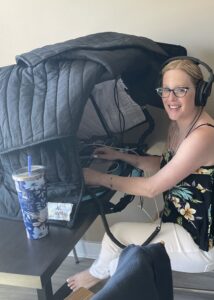 My Rig
My own rig has evolved a lot over the years. I know use:
- a Vocal Booth to Go
- a Sennheiser MKE 660 Microphone
- a UAD Apollo MK II Thunderbolt Preamp
- a Ninja clamp (essential to good positioning of the mic)
My thoughts as a Coach
We talked a lot about on the panel how having good mic technique matters. You have to set yourself up for success and going out and buying expensive gear doesn’t not mean that you will start booking. Once you are booking, then upgrade. Once you have steady clients, give them the curtesy of letting them know when you’ll be our of the studio. Don’t start new projects on home gear before a trip. Always let them know, and plan ahead,
 It happens, even in the time of covid, we leave our studios. As a professional voice talent, we have work we can predict, and the joy of work we cannot predict, that comes in at a moment’s notice and can have a pretty tight turn around time. As a working mom, whether I’m home or traveling I’m always juggling my responsibilities as a small business owner and my role of a mom, this year more than ever. This year, my high school juniors are looking at colleges. And as if looking at colleges for twins is not challenging enough, their interests do not overlap at all. Emma is targeting schools with Speech programs and STEM programs. Jack is looking for International Relations and Russian. So, we are doing two completely different college searches at once. What does this mean for me as a voice actor? It means I’m leaving the booth for the first time in a year and I need to be prepared. Voice over work should never prevent travel, it just means you need the right set up for your voice over travel rig and to take the necessary steps when planning.
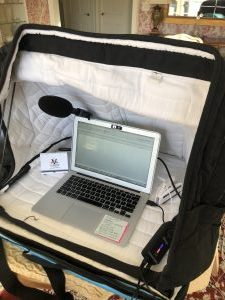 The point of the travel rig is to sound like you sound in your home studio when you are on the road so that you can provide clients with a continuity of service. I have tweaked my rig quite a few times over the years, and finally invested in a quality set up that I am pleased with. I now bring:

