So You’re Leaving the Booth
 It happens, even in the time of covid, we leave our studios. As a professional voice talent, we have work we can predict, and the joy of work we cannot predict, that comes in at a moment’s notice and can have a pretty tight turn around time. As a working mom, whether I’m home or traveling I’m always juggling my responsibilities as a small business owner and my role of a mom, this year more than ever. This year, my high school juniors are looking at colleges. And as if looking at colleges for twins is not challenging enough, their interests do not overlap at all. Emma is targeting schools with Speech programs and STEM programs. Jack is looking for International Relations and Russian. So, we are doing two completely different college searches at once. What does this mean for me as a voice actor? It means I’m leaving the booth for the first time in a year and I need to be prepared. Voice over work should never prevent travel, it just means you need the right set up for your voice over travel rig and to take the necessary steps when planning.
What’s in The Travel Rig
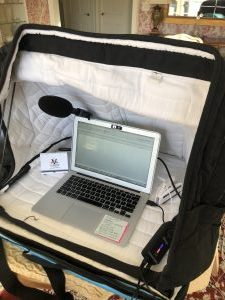 The point of the travel rig is to sound like you sound in your home studio when you are on the road so that you can provide clients with a continuity of service. I have tweaked my rig quite a few times over the years, and finally invested in a quality set up that I am pleased with. I now bring:
- A VoMo booth to go
- A Sennheiser MKE 660 microphone
- Sennheiser headphones
- An AUD Appollo MK II Preamp
- A MacBook Air with Twisted Wave
The reason this set up works, is that an effects stack works was created that gives the same sound to the finished audio of that recorded in my booth. It is quite remarkable.
If you are still in the pillow fort phase, here is a video that might be helpful from when I was using pillow forts as well:
To Bring Or Not To Bring
Now that I have this amazing set up, does this mean that I never take off or that I bring the travel rig everywhere? No. For instance, this weekend I am away Friday night through Sunday. I left the rig at home. I did have one booking come in from an international client. I asked if they could please wait until Monday and that worked out, but if not I was willing to let the gig go. Sometimes you just need a break. Typically, I evaluate what I’ll be doing, how much free time I’ll have, and how much I typically earn that time of year. For example, the last four years in a row July has been my highest earning month of the year. If I go anywhere in July, the travel rig is coming with me. June, in contrast is a slower month. It might be safer to travel without it or to plan travel for that month. Tracking your trends in a CRM can be helpful for you to make such calls. Ultimately, we are all entitled to a break, but you have to weigh how disruptive it will be to your long term success. If your client hires another talents, and then that talents gets then ongoing work instead of you, can you live with that?
Professional Procedures to Take
Ultimately the point of the travel rig is to serve your clients well. If you know travel is coming up, and you are starting a project that might have pickups or script changes you should let the client know. You might also discuss with them the option of recording on your travel rig from home so that the audio matches. If you will have limits to your availability while on the road, it is great to give your regular clients a heads up. If they are used to a speedy turn around and you will have a delay, they’ll appreciate the notice. If you send out a newsletter, the newsletter is a great place to let clients know when you’ll be out of the studio. If you are on regular rosters that send you work, they appreciate the advance notice as well. Typically two weeks notice before travel is standard, and that way clients have the chance to decide of they want to work around your dates and you can decide whether or not you need your rig!
Last Thoughts
Ultimately, there are a lot of ways to get great sound on the road, from pillow forts made out of comforters to tiny mics that plug into your phone. It makes sense to decide what your goals are: ranging from auditions to booked work to pickups, and then determine what gear best meets your needs.
 What I explained to Liz, and what is interesting, is that during the Pandemic I continue to book what I have always booked, there is just less of it. So what am I still booking? Commercials, eLearning, and telephony/IVR. For me, the amount of jobs I typically have in a day or even half a day on some weeks I am having total in a week. I am thankful for every single booking, but the volume of booked work for me during the pandemic has gone down. Typically, I do a lot of radio commercials. The commercials I have booked this month have been radio commercials. They have been from steady clients who continue to send work. Some are for clients here and some have been for clients abroad, as far as New Zealand.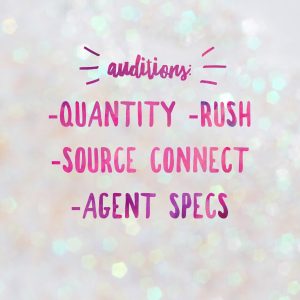
 As a professional voice over actor, I get requests for RUSH jobs all the time. This is why it is so important to be a full-time voice talent, so that I am always available when clients need me. I get requests from standing clients that I have worked with repeatedly and from new clients who happen to need something right away. Folks need audio in a hurry for all sorts of reasons. Sometimes they are just too close to their deadline. Sometimes those in productions were also hired late and the commercial, video, or social media is set to air and the VO is often the last piece of the puzzle. Sometimes it is an
  As a full time professional voice over actor, I am well-aware that my clients have options, so I want to make it really easy for my VO clients to work with me! I consider my business model to be client centered, I put their needs first, and try to put myself in their shoes always. Whether they are video production companies, eLearning content providers, or agents, I want them to trust when they book me that the experience will be seamless because I want to make this as easy for them as possible. Why? I want them to come back over and over again, so I want to be their go to voice in my vocal range. Outstanding service is what sets the bar higher. Pristine audio is a given. It is assumed that the sound matches either our demos or the audition we have sent in, so the way to stand out and have clients keep coming back is to give them what they need and make the experience a delight! Here’s what I offer every time:
 I assume when you hire me that you need your audio back as quickly as possible. Typically when you cast me in a project, you will immediately (my average response time is 9 to 11 minutes) get my “Seal the Deal” email that confirms all the details. This will confirm the rate, the turn around time, and any questions that I may have about the booking. Unless you tell me when you send me the booking that you don’t need it for several days, I assume you want it as soon as I can get it to you. I often have people contact me about RUSH jobs and tell me that they need it “right away.” To me, that implies they need me to stop what I am working on and record their project. For that I add a $50 RUSH fee. Otherwise, I typically will have your job back to you in four to six hours. If it will be longer, the exceptions are if I am on location somewhere and I let you know. Always. Right away.
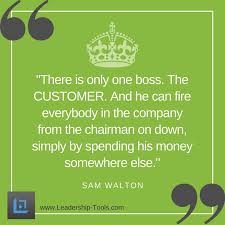 In an industry where clients have choices, customer service matters! I want my clients to know how much I appreciate every opportunity, and I want to make it as easy as possible for them to work with me. I think back to times I have had to buy a gift for someone and hesitated because of the wait at the store or how long it took the clerk to wrap the gift. At the end of the day, I want my service to match the quality of my audio: outstanding is the only option.
 So, what I gather is that folks can’t imagine is how the work of a creative can fill an entire day, or perhaps weeks and years on end. Given the opportunity, I will happily, and enthusiastically elaborate and tell you what days are like for a working voiceover talent.
 I do try to do 20-40 auditions a day, and they come in from clients, Pay to Plays, and agents around the country. If a booking comes in mid-day, I stop what I am doing and record. For bigger jobs I typically have advance notice. For example, I did 20 videos on Thursday, but I new about them about 2 weeks in advance so that I could book out the day on my calendar. I do I lot of commercials and have a lot of RUSH work as well. I am always happy to do rush jobs. I understand when folks have deadlines, and I never mind getting audio right back to clients. Often when more booked work comes in, time on LinkedIn or for marketing takes a back seat. I tend to keep up with my client correspondence as that is very important to me!
 I can’t ever completely detach because there is no one else to man the fort. Since I am the business, if I disconnect, it ends. I find it challenging to find the right balance between savoring this precious time with my children, which goes entirely too fast, and catching the momentum of my business which I have worked so hard to build.
 Those Shindigs Where You Really Need Them
 And aside from our amazing in-person impression, all we leave them with, in the end, is our tiny little card. I found my self extremely curious about the cards that other voiceover talents were giving out and it made me re-evaluate the ways in which I was using the precious space on my own card. I was standing there in gorgeous Burbank at this conference looking at the card in my hand and questioning, is my card sufficient for the major purpose it serves in life?