Construction and The Foundations We Establish
Recently my husband’s parents bought a ranch around the block from us. They needed to gut renovate it and my brother-in-law is the project manager. It has been quite the undertaking, and my brother-in-law has done everything, from day-to-day interactions with all of the various crews working on the job site, to making choices about every material to use each step of the way. He has had to sort out bids and come up with various plans all while weather and kids pose on-going challenges.
This parallels running a voice over business in many ways. In voice over, like with a construction project, the mindset matters profoundly. The foundation of our business is ours to build, and to create by our own design. The intent of this blog is to think about a few key components of mindset related to voice over.
What are your Goals?
 When you build a house, sometimes you are doing an update to make a space your own and sometimes you are doing a gut renovation. Either way, from the outset, you need to consider your goals for the project. In voiceover, knowing your goals enables you to have direction in your daily pursuits. If you know where you want to be, and if you have a clear vision for yourself, it is easier to work towards reaching those goals. And the goals you have might well be completely different from other voice talents you know. For instance, I do not do medical narration or audio books. Two of the women in my accountability group work in both of these genres, so their goals and their day to day marketing endeavors look quite different. As a professional voice over actor, I am very clear about my passions and where I want to spend my time. This is a key component of my mindset.
Business Mindset
 Even though I am a working creative, from the start I have run my business like a business. Our mindset and the choices we make determine whether voice over is a business or a mere hobby. Do you want this to be your career or something you simply dabble in? For me, from day one, this was going to be a career. There was no other option. When I decided to pursue voiceover, I did so in lieue of returning to teaching, so I had the luxury of plunging into VO full time from the get go. Besides working full-time, other choices helped establish this is a business. Using a CRM is essential. This helps you track all of your outreach, your costs, your bookings, your contacts… all of your efforts in one place. I have blogged before about my experience using Voiceoverview, but I truly believe this specific CRM is essential to the success of my business.
Having an invoicing system and being consistent about it is essential to a business mindset in voice over. After all, it’s a business and you want to get paid! I know many talents who invoice weekly. For me, I invoice with the delivery of the finished audio for every single booking. When I send the audio, I send a link to the invoice. If you happen to use Voiceoverview, it integrates with Waves App, Freshbooks, and Quickbooks! Ultimately you need to decide how often invoicing will work for you, but for me I love doing it at the time of delivery because it means no job ever slips through the cracks.
Another aspect of a business mindset is having a business checking account. No one told me about this when I launched my voice over business, so I mention this often to try to make it easier for those starting out. I actually learned the hard way about 18 months in to my voice over journey. I tried to deposit a check at the bank at my local branch and suddenly they would not accept it. It was an eye opener, as by this point I perceived myself to be running a small business. So, if you are a solopreneur, you must actually also open a business checking account. This, too, is crucial.
Make Your Studio A Pro Studio
 If you really want to succeed in voice over, and establish yourself as a professional voice talent, you need to have a professional studio. First, it is essential to maintain business hours. As a business owner, if you want to be available and accessible to your clients, you should have set business hours each day. For me, I typically work from 8 am- 6 pm, and schedule breaks for myself at my lunch hour for things like exercise classes or seeing friends. I also use my lunch hour to make myself available for consultations with new students or people looking for demo. But, the main point, is that I am available to clients all day, every day, during regular business hours.
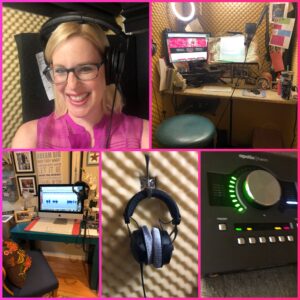
Next, it is also important to have a professional home studio set up. I often have folks new to voice over ask me if it is really necessary to go to the effort and expense of buying equipment and if they can just rent studio space. I can tell you unequivocally that if you intend to succeed in voice over you simply MUST have a home set up. Further, it is not enough to have a basic home set up, you have to have a quality set up so that you produce pristine audio. This requires a booth with acoustic treatment, gear, and training in audio engineering so that you are capable of mastering your recordings. Once this is in place, you are ready to have your business up and running.
Mindset matters. Every choice you make matters. Run your voice over business like a business from day one.
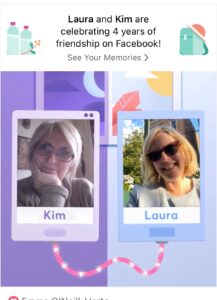 If you’re in voice over, and you’re on Facebook, then you know how many groups there are for voice actors. There are so many. Why do I think voice actors spend time posting, commenting, and chatting on Facebook? Well, when you work alone in a padded foam booth, it’s really nice to have people. There is a really amazing, close knit voiceover industry, and even during covid, we all stayed close by continuing to chat on places like Facebook. In the past two weeks, I had to Facebook anniversary reminders of
  friendiversaries with close friends. Seeing these video reels flash in my feed brought me profound joy. It reminded me of how much I have built. If you have the privilege of working in voiceover, and you are successful, you know that it takes a lot more that years of long days of hard work. Success in voice over also takes the support of awesome industry friends who are there to support you on good days and bad.
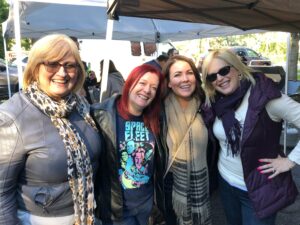 If I had to go back to the very beginning, and try to unravel this thread, I’m not really sure how my multitude of VO friendships and connections started. It may have begun with Anne Ganguzza and VO Peeps. I certainly “met” other voice talents that way. It may have begun with taking zoom classes through GVAA and keeping in touch with my classmates. It may also have begun with attending Uncle Roy’s famous BBQ. As a newbie, all of these made me feel part of a community and helped me see where I fit in. When you are just starting out, it is sometimes hard to push yourself to go. You might worry that no one will talk to you. It is so, so important to go and meet people face to face.
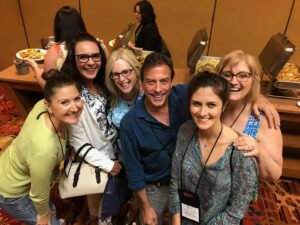 Conferences are an AMAZING place to bond. It literally does not matter which conference you pick, they are incredible. Yes, there is lots of learning and sharing of knowledge. But, in truth, as we all learned from doing everything remotely this year, the educational aspect alone is not what gets us to leave our families and hope on a plane. It is for sure the social aspect of the conferences that is worth more than gold. It feeds your soul and builds you up. The interactions are genuine and you will make friendships that endure. The women that I speak to daily I “knew” before I met them in person, but seeing them at WoVo Con and seeing them at VO Atlanta was our time to connect and really get to know each other. We lift each other up in every way possible.
 week I co-host a panel with one of my VO besties and fellow VO Coach Diana Birdsall. Our club is called “Ask the VO Coaches” and recent panelists have including Dave Scott from All Systems Go AV, Randy Thomas, George-the-Tech Whittam, Dan Leonard, Shelley Avellino, Bev Standing and more! Lot’s of voice actors come into the room and we chat about topics that matter to us. Clubhouse has given us a space to support each other and have an active and on going dialogue that raises the level of performance of the industry.
  I also recommend having practical hooks in your book. I have a hook for my cans and a hook for my wires. It helps keep things neat and organized.
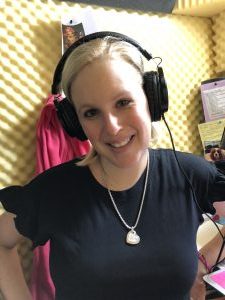 I also do love having Source Connect. So many clients and agents require it. I occasionally need to have support sessions, and they do offer great support from Source Connect. Again, like with Zancastr, there are no latency issues. There are, though, sometimes quirks connecting. Sometimes people are confused with how to use it. If you are not both connecting with the same sample rate, for example, you won’t connect smoothly and it will be an issue, so that all needs to be decided ahead of time.
 I wish I know how important a good travel rig is. It took me five years to get my travel rig to sound as good as my home set up. That is WAY too long. If you are just starting in voice over during the pandemic, I realize it is hard to imagine actually packing up and leaving home, but when we do, the rig matters.
 It happens, even in the time of covid, we leave our studios. As a professional voice talent, we have work we can predict, and the joy of work we cannot predict, that comes in at a moment’s notice and can have a pretty tight turn around time. As a working mom, whether I’m home or traveling I’m always juggling my responsibilities as a small business owner and my role of a mom, this year more than ever. This year, my high school juniors are looking at colleges. And as if looking at colleges for twins is not challenging enough, their interests do not overlap at all. Emma is targeting schools with Speech programs and STEM programs. Jack is looking for International Relations and Russian. So, we are doing two completely different college searches at once. What does this mean for me as a voice actor? It means I’m leaving the booth for the first time in a year and I need to be prepared. Voice over work should never prevent travel, it just means you need the right set up for your voice over travel rig and to take the necessary steps when planning.
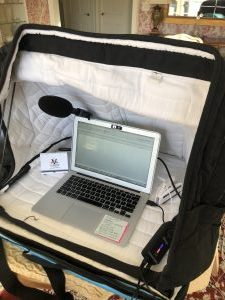 The point of the travel rig is to sound like you sound in your home studio when you are on the road so that you can provide clients with a continuity of service. I have tweaked my rig quite a few times over the years, and finally invested in a quality set up that I am pleased with. I now bring:
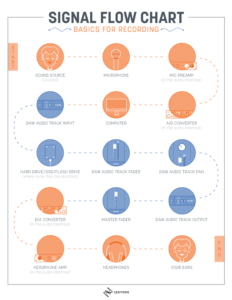 Depending on which voice actor you ask, you’ll get a different answer to the questions “What’s the best DAW for VO?” I have used Audacity, Adobe Audition, and Twisted Wave. I may be proficient in all of them, but I LOVE Twisted Wave. To be clear this does not mean that other DAWs, from Reeper to Pro Tools don’t have immense value, but for me, I am quick and good on Twisted Wave. It serves my purposes well. And when I have a client who needs total production with music, I hire a professional engineer to mix it down anyway, so I really can do all that I need to do on Twisted Wave. Some of my favorite features are the shortcuts, multiple effects stacks, and ease of file splitting.
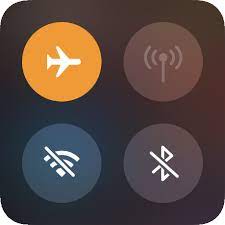 When I am in my booth, I turn my iPhone and Apple Watch to airplane mode. I do this because when I develop a good flow, I do not want the phone ringing to interrupt me. I do offer one word of caution: if you are doing a live session and you coincidentally cannot connect with your client, and have all your devices in airplane mode, it can be quite frustrating if they are unable to reach you. So, while you may not want your phone in the studio for a directed session, perhaps before you silence everything you should make certain that you connect.
 Like many in voiceover, I am constantly revising my business plan, shifting my focus from commercials to explainers to elearning to targeting specific industries. As I revise my plan, my goals change. While I have a planner or agenda that I love, I find that mapping out my strategy for the week helps me to keep my mind on the big picture. As auditions and work pours in, it’s easy to get caught up in the little things and push off the tasks that we think can wait, but in doing so, in pushing off those marketing emails and that LinkedIn outreach, we are pushing off the pursuit of our longterm goals. It is so important to always have an eye on your “why.” If you lose site of that, and you are just buys submitting audition after audition, you can easily get stuck in a rut.
  If your fan makes noise,
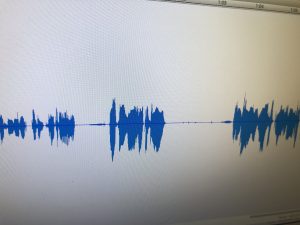 Late Friday afternoon I was in my booth recoding a bunch of agent auditions that had come in. Initially I felt fine. I had completed all of my booked work and I wanted to submit a few more reads before I called it a day. I typically don’t have a lot of mouth clicks when I record. I do run Izotope RX7 as part of my effects stack, which takes care of whatever clicks there are, but I tend to stay hydrated and am not so clicky, especially since I gave up caffeine. I noticed that even though my noise floor was the same as it always is, I had a crazy amount of spikes and clicks present that I do not typically see. This was 3 to 5 minutes before I became violently ill and had to run from the booth, I could see what I had no idea was about the be a horrible case of food poisoning, in my audio!
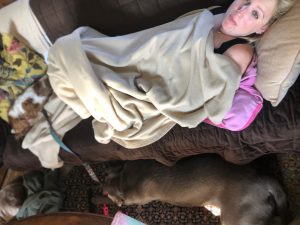 As a small business owner, I work all the time. Typically on the weekends I work less, but I still work at points every day. This food poisoning forced me to pause. I was not even sure on Saturday if I would be ok for my like sessions on Monday, but I know realize I will be. Talking is hard, sitting up is hard. Sometimes the forced rest is essential to get back to where we were. I guess it is an opportunity to reset- to restart. In truth I have no other option, when one is so dizzy that going up and down the stairs feels unsafe, the rest is the only option. In lieu of any work, I laid on the sofa in my den surrounded by my dogs and tried not o move at all.

