Getting Started in Voice Over
When people come to me for voice over coaching, they are at all different point in their VO journey. Sometimes they are quite experience but many are totally new to VoiceOver and are making the bold move to pursue their dreams. Building a strong foundation is extremely important, and my production partner Dave Scott and I work really hard to help our students learn things the right way from the start. Still, whatever regardless of when you plan to do your demos, it is really important to start practicing on an actual microphone with a preamp or interface in a studio setting for several reasons. Here are some thoughts to consider:
Learning Mic Technique
 Good microphones are powerful. Whether you are starting out with middle of the road mics like the Rode NT1 or the Cad Equitek E100S, or investing in a more expensive microphone right away like the Neumann TLM 103, these microphones are condenser mics and will pic up all the sound in a large radius around them. You need to learn proper technique to best enhance your sound. Also, technique varies by genre. The way I work with my mic for conversational commercial reads or intimate reads is different. When I do video games I move around a lot and often back away from the mic, especially when I am shouting and doing effects. These are all skills I was taught and worked hard to hone, I did not wake up one day and just know how to do it. It takes time. And you do not want to walk into a studio for a job or worse for a booking and not have the skills necessary to rock that session!
Form Good Habits
Put simply, lessons are expensive. When you pay for a voice over coach or take a voice over class online, you are investing in yourself and your career. Whether it is the time spent with the coach in sessions, the time spent doing your homework in between sessions, or for daily practice, you need to be establishing good habits. You simply cannot do this without the pro equipment. You need to set up your studio so that you can prepare to be a professional. There is only one way to do this and you need to master your technique early on so that it is seamless when you launch your business.
You Might Have Diction Issues
No one in VoiceOver wants to have speech issues. Speech issues that I have had to deal with as a voice over coach range from diction issues, regional accents, articulation issues, plosives, and sibilance. If you only record on your computer and submit, it can be really hard for your coach to pick up some of these, or pick up the severity of some of these. Imagine speeding months coaching, getting ready for demo day, going to a pro-studio, stepping in front of a U87, and your coach hears a major diction issue they never noticed until demo day. What a disaster! This can, however, be easily avoided simply by setting up your professional home studio and working with your coach on real recording equipment.
 The other side of this is that you need to become a critical listener of your audio too! You need professional headphones, or cans as we call them, that do not have a filter in them. You can not really hear how you sound without them, and you can not really hear what clients will hear or be listening to without them, so this is essential to your training!
You Need to Practice Recording and Editing
When you are working with a VoiceOver coach, you need to practice recording and editing they way you would when you would submit for an audition or a job. You can only do this if you have a functioning booth with a microphone, preamp or interface, computer with a DAW, and good cans. You need to practice editing your audio every day so that you get used to the ins and outs of your DAW and become efficient at producing pristine audio. Nothing else will suffice in this business. And it does not happen overnight, believe me!
Conclusions
I hope this has helped you better understand why you should not wait to set up your home studio! Timing matters a lot. While budget plays a factor for most people, even with cost in mind we can work with you to help guide your choices as your start to big gear for your home studio. It’s better to have it ready and get going and be well-practiced when your launch your business. For those of you thinking that you might get coaching, do your demos, then build your booth, that is not advisable. Read the blog again and re-think your plan! Now, best of luck in your VO journey!!
 When you build a house, sometimes you are doing an update to make a space your own and sometimes you are doing a gut renovation. Either way, from the outset, you need to consider your goals for the project. In voiceover, knowing your goals enables you to have direction in your daily pursuits. If you know where you want to be, and if you have a clear vision for yourself, it is easier to work towards reaching those goals. And the goals you have might well be completely different from other voice talents you know. For instance, I do not do medical narration or audio books. Two of the women in my accountability group work in both of these genres, so their goals and their day to day marketing endeavors look quite different. As a professional voice over actor, I am very clear about my passions and where I want to spend my time. This is a key component of my mindset.
 Even though I am a working creative, from the start I have run my business like a business. Our mindset and the choices we make determine whether voice over is a business or a mere hobby. Do you want this to be your career or something you simply dabble in? For me, from day one, this was going to be a career. There was no other option. When I decided to pursue voiceover, I did so in lieue of returning to teaching, so I had the luxury of plunging into VO full time from the get go. Besides working full-time, other choices helped establish this is a business. Using a CRM is essential. This helps you track all of your outreach, your costs, your bookings, your contacts… all of your efforts in one place. I have blogged before about my experience using Voiceoverview, but I truly believe this specific CRM is essential to the success of my business.
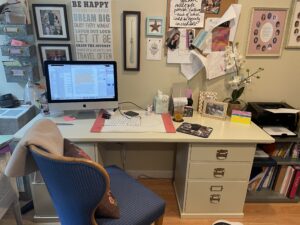
 If you really want to succeed in voice over, and establish yourself as a professional voice talent, you need to have a professional studio. First, it is essential to maintain business hours. As a business owner, if you want to be available and accessible to your clients, you should have set business hours each day. For me, I typically work from 8 am- 6 pm, and schedule breaks for myself at my lunch hour for things like exercise classes or seeing friends. I also use my lunch hour to make myself available for consultations with new students or people looking for demo. But, the main point, is that I am available to clients all day, every day, during regular business hours.

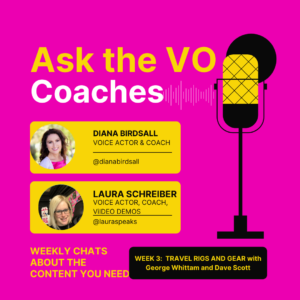
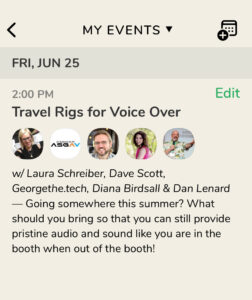 Every Friday at 2 PM Diana Birdsall and I co-host a Clubhouse in our room “Ask the VO Coaches.” I am always excited about our awesome panels, and every week I might say it’s “the best one ever,” but holy smokes was this an awesome panel! This week, just in time for your summer get-away, we talked about travel rigs and what gear you need and what you don’t need to bring with you on that much needed trip. Whether you’re going to the beach, to the mountains, or just to see family you missed during covid, we talked about it all, and we talked about it with some of the best in the field! We had George- the-tech Whittam, Dan Leonard, Dave Scott, and Rick Wasserman. So, here’s a review of some of what we chatted about in case you missed our beyond awesome chat!
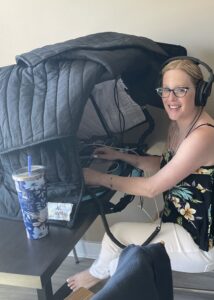 My Rig