My jam
You might be thinking, hey- I wonder what it’s like to be a voice over actor? As a full-time, professional voice actor, sometimes my days can feel a little bit like Groundhogs Day, meaning that there is a certain rhythm to my days that tends to play and repeat. To be honest, as a working mom, I’ve come to count on this routine and structure and don’t mine it at all. I find this order and structure is really helpful and as my business has grown over the years, and I have expanded into coaching and demo production, I have carefully worked all of that into my schedule. There are some basic elements that are to be expected in every voice actor’s day:
Auditions:
 I typically do these quite early, and I think my auditions serve as a great warm up for my actually paid work. Whether they are for pay to plays or for agents, I love running through the pace of auditions and feel that this helps me stay on my toes and understand the current industry trends for what is being sought after. Daily submissions are a must, and I typically submit early morning and late afternoon at a minimum. I like submitting, and relative to other talents I know, I regularly submit a lot. I think it depends on your specific goals, but auditioning is for sure a part of my daily routine.
Booked Work
Then I begin my booked work. Depending on what is do when, and how urgent some bookings are, I decide my order of events. Sometime the vocal age of the casting comes into play for me. For example, if I am required to sound young, I have a specific window when I sound really young during the day, so I make sure to record at that point. Conversely, if I need to sound like a mom, or a 40 something, I save those recordings for after lunch. Thus, I plan my day.
Website Updates
I am often doing website updates. From adding blogs like this one, to adding client logos, testimonials, new demos we have done for students, and samples of finished booked work, the like of website updates goes on and on. I try to do these regularly so they do not become insurmountable.
Marketing and Direct Outreach
Marketing is a constant it my daily routine. I think the only day of the month when I do not send any emails is the day my newsletter goes out. I have different groups of people I work on reaching out to, and I am always keeping in touch with current clients and reaching out to new ones. I also do all of my own social media work, so marketing is a daily constant.
Billing and Invoicing
I do this regularly. Every time I deliver finished audio to a client, I send their invoice along with it. I send regular reminders, and am very on top of my invoicing. After all, voice over is not a hobby!
Equipment
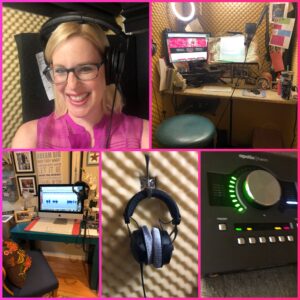
My gear is so important. It is the foundation of all of my work. Whether I am researching my next purchase or neatening my wires, I am doing something related to m studio gear every day. I also constantly watch YouTube videos about equipment and find tis very helpful.
Dog walking
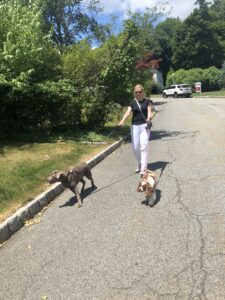 A highlight of my day, throughout my day, are the breaks I take with my studio dogs Violet and Daisy. I love walking with the girls and taking these sporadic breaks every few hours is really good for me. It is so good to leave the studio and get actual fresh air. I occasionally run into neighbors and that is really nice too.
Workouts:pilates
In addition to walking, I do Pilates regularly and this is very much a part of my routine. I find that scheduling this time for my self is essential to my mental and physical wellness. I tend to do these reinvigorating workouts either early morning, before work, or mid-day on my lunch break.
Household Chores
As a wife and mother, my daily household chores are endless. From cooking and cleaning to laundry and homework help, the list goes on and on. This time of year, there are holiday chores too like gift wrapping and all of those cards!!
The Glimpse….
So a lot needs to happen to run a successful voiceover business. There are a lot of moving parts, and when something falls off of my radar, ultimately it means less work will come in. So, it’ on me to make sure that my work gets done, and all of my ducks are in a row.
 When you build a house, sometimes you are doing an update to make a space your own and sometimes you are doing a gut renovation. Either way, from the outset, you need to consider your goals for the project. In voiceover, knowing your goals enables you to have direction in your daily pursuits. If you know where you want to be, and if you have a clear vision for yourself, it is easier to work towards reaching those goals. And the goals you have might well be completely different from other voice talents you know. For instance, I do not do medical narration or audio books. Two of the women in my accountability group work in both of these genres, so their goals and their day to day marketing endeavors look quite different. As a professional voice over actor, I am very clear about my passions and where I want to spend my time. This is a key component of my mindset.
 Even though I am a working creative, from the start I have run my business like a business. Our mindset and the choices we make determine whether voice over is a business or a mere hobby. Do you want this to be your career or something you simply dabble in? For me, from day one, this was going to be a career. There was no other option. When I decided to pursue voiceover, I did so in lieue of returning to teaching, so I had the luxury of plunging into VO full time from the get go. Besides working full-time, other choices helped establish this is a business. Using a CRM is essential. This helps you track all of your outreach, your costs, your bookings, your contacts… all of your efforts in one place. I have blogged before about my experience using Voiceoverview, but I truly believe this specific CRM is essential to the success of my business.
 If you really want to succeed in voice over, and establish yourself as a professional voice talent, you need to have a professional studio. First, it is essential to maintain business hours. As a business owner, if you want to be available and accessible to your clients, you should have set business hours each day. For me, I typically work from 8 am- 6 pm, and schedule breaks for myself at my lunch hour for things like exercise classes or seeing friends. I also use my lunch hour to make myself available for consultations with new students or people looking for demo. But, the main point, is that I am available to clients all day, every day, during regular business hours.
 I also recommend having practical hooks in your book. I have a hook for my cans and a hook for my wires. It helps keep things neat and organized.
 I also do love having Source Connect. So many clients and agents require it. I occasionally need to have support sessions, and they do offer great support from Source Connect. Again, like with Zancastr, there are no latency issues. There are, though, sometimes quirks connecting. Sometimes people are confused with how to use it. If you are not both connecting with the same sample rate, for example, you won’t connect smoothly and it will be an issue, so that all needs to be decided ahead of time.
 I wish I know how important a good travel rig is. It took me five years to get my travel rig to sound as good as my home set up. That is WAY too long. If you are just starting in voice over during the pandemic, I realize it is hard to imagine actually packing up and leaving home, but when we do, the rig matters.
 It happens, even in the time of covid, we leave our studios. As a professional voice talent, we have work we can predict, and the joy of work we cannot predict, that comes in at a moment’s notice and can have a pretty tight turn around time. As a working mom, whether I’m home or traveling I’m always juggling my responsibilities as a small business owner and my role of a mom, this year more than ever. This year, my high school juniors are looking at colleges. And as if looking at colleges for twins is not challenging enough, their interests do not overlap at all. Emma is targeting schools with Speech programs and STEM programs. Jack is looking for International Relations and Russian. So, we are doing two completely different college searches at once. What does this mean for me as a voice actor? It means I’m leaving the booth for the first time in a year and I need to be prepared. Voice over work should never prevent travel, it just means you need the right set up for your voice over travel rig and to take the necessary steps when planning.
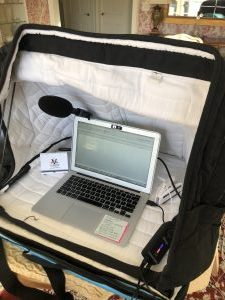 The point of the travel rig is to sound like you sound in your home studio when you are on the road so that you can provide clients with a continuity of service. I have tweaked my rig quite a few times over the years, and finally invested in a quality set up that I am pleased with. I now bring:
 Depending on which voice actor you ask, you’ll get a different answer to the questions “What’s the best DAW for VO?” I have used Audacity, Adobe Audition, and Twisted Wave. I may be proficient in all of them, but I LOVE Twisted Wave. To be clear this does not mean that other DAWs, from Reeper to Pro Tools don’t have immense value, but for me, I am quick and good on Twisted Wave. It serves my purposes well. And when I have a client who needs total production with music, I hire a professional engineer to mix it down anyway, so I really can do all that I need to do on Twisted Wave. Some of my favorite features are the shortcuts, multiple effects stacks, and ease of file splitting.
 When I am in my booth, I turn my iPhone and Apple Watch to airplane mode. I do this because when I develop a good flow, I do not want the phone ringing to interrupt me. I do offer one word of caution: if you are doing a live session and you coincidentally cannot connect with your client, and have all your devices in airplane mode, it can be quite frustrating if they are unable to reach you. So, while you may not want your phone in the studio for a directed session, perhaps before you silence everything you should make certain that you connect.
 Like many in voiceover, I am constantly revising my business plan, shifting my focus from commercials to explainers to elearning to targeting specific industries. As I revise my plan, my goals change. While I have a planner or agenda that I love, I find that mapping out my strategy for the week helps me to keep my mind on the big picture. As auditions and work pours in, it’s easy to get caught up in the little things and push off the tasks that we think can wait, but in doing so, in pushing off those marketing emails and that LinkedIn outreach, we are pushing off the pursuit of our longterm goals. It is so important to always have an eye on your “why.” If you lose site of that, and you are just buys submitting audition after audition, you can easily get stuck in a rut.
  If your fan makes noise,
 You need a solid demo that represents both a range of your abilities and your understanding of the industry. My vocal range is from teen to middle age, and that is demonstrated in my eLearning demo, which goes from tech industries to pharma to medical. My demo switches gears from upbeat and engaging to serious and professional. My demo is set to music, which is controversial is often eLearning is dry. I wanted my demo to standout and by pleasant to listen to, and I believe it meets that goal.
 It has been a while since I was cast as a generic third person narrator in eLearning. Instead, for the last sic months, ever booking to land on my desk is a character role, where the instructional designer wants an authentic, genuine role that is believable for their training. For example, this week I was cast as a college student who had gone down the wrong path and had a drug problem and was now in recovery. I had to be sensitive and relatable. It had to be believable. I was telling this girl’s story in this university’s training scenario. Last week I was a caller in a pay roll company’s HR training. I was the good caller this time, but in the past I’ve been the bad caller. In both instances the character had to be believable, authentic, and sincere. As a female eLearning narrator, this is a big responsibility: to continue booking work for clients you have to be able to switch gears and maintain whatever character you are playing for them that day. The character must be consistent throughout and must have nuance.
 Rates are really important. My bookings typically range between $0.25/word and $0.45/word with a $150 minimum and $1 per split. I charge for splits if there are more than 10. I prefer to quote the price per word and not per finished minute as I speak quickly. Last week I had a potential client reach out and ask me if I was on Upwork. I told them I was not. They wanted to know if I would honor Upwork’s rates, and I explained that at this point in my career I could not work for those rates. I then referred the client to GVAA and Gravy for The Brain, in hopes of keeping the conversation going. They did come back to me that if they had flexibility they would let me know, but in the mean time it is important to be willing to walk away. The next day I had a job come in that was 617 words and paid of $400. It is important never to settle.
 Most typically, my eLearning clients want MP3s that are split and fully edited. I typically add EQ, compression, and a d-esser. If you are booking eLearning work for big companies, it is expected that you should have a professional grade studio at this point. Especially because they often do not have music or effects behind their training, the quality of the audio that you provide matters more than ever.

