Getting Started in Voice Over
When people come to me for voice over coaching, they are at all different point in their VO journey. Sometimes they are quite experience but many are totally new to VoiceOver and are making the bold move to pursue their dreams. Building a strong foundation is extremely important, and my production partner Dave Scott and I work really hard to help our students learn things the right way from the start. Still, whatever regardless of when you plan to do your demos, it is really important to start practicing on an actual microphone with a preamp or interface in a studio setting for several reasons. Here are some thoughts to consider:
Learning Mic Technique
 Good microphones are powerful. Whether you are starting out with middle of the road mics like the Rode NT1 or the Cad Equitek E100S, or investing in a more expensive microphone right away like the Neumann TLM 103, these microphones are condenser mics and will pic up all the sound in a large radius around them. You need to learn proper technique to best enhance your sound. Also, technique varies by genre. The way I work with my mic for conversational commercial reads or intimate reads is different. When I do video games I move around a lot and often back away from the mic, especially when I am shouting and doing effects. These are all skills I was taught and worked hard to hone, I did not wake up one day and just know how to do it. It takes time. And you do not want to walk into a studio for a job or worse for a booking and not have the skills necessary to rock that session!
Form Good Habits
Put simply, lessons are expensive. When you pay for a voice over coach or take a voice over class online, you are investing in yourself and your career. Whether it is the time spent with the coach in sessions, the time spent doing your homework in between sessions, or for daily practice, you need to be establishing good habits. You simply cannot do this without the pro equipment. You need to set up your studio so that you can prepare to be a professional. There is only one way to do this and you need to master your technique early on so that it is seamless when you launch your business.
You Might Have Diction Issues
No one in VoiceOver wants to have speech issues. Speech issues that I have had to deal with as a voice over coach range from diction issues, regional accents, articulation issues, plosives, and sibilance. If you only record on your computer and submit, it can be really hard for your coach to pick up some of these, or pick up the severity of some of these. Imagine speeding months coaching, getting ready for demo day, going to a pro-studio, stepping in front of a U87, and your coach hears a major diction issue they never noticed until demo day. What a disaster! This can, however, be easily avoided simply by setting up your professional home studio and working with your coach on real recording equipment.
 The other side of this is that you need to become a critical listener of your audio too! You need professional headphones, or cans as we call them, that do not have a filter in them. You can not really hear how you sound without them, and you can not really hear what clients will hear or be listening to without them, so this is essential to your training!
You Need to Practice Recording and Editing
When you are working with a VoiceOver coach, you need to practice recording and editing they way you would when you would submit for an audition or a job. You can only do this if you have a functioning booth with a microphone, preamp or interface, computer with a DAW, and good cans. You need to practice editing your audio every day so that you get used to the ins and outs of your DAW and become efficient at producing pristine audio. Nothing else will suffice in this business. And it does not happen overnight, believe me!
Conclusions
I hope this has helped you better understand why you should not wait to set up your home studio! Timing matters a lot. While budget plays a factor for most people, even with cost in mind we can work with you to help guide your choices as your start to big gear for your home studio. It’s better to have it ready and get going and be well-practiced when your launch your business. For those of you thinking that you might get coaching, do your demos, then build your booth, that is not advisable. Read the blog again and re-think your plan! Now, best of luck in your VO journey!!
 I have been blessed to have three precious dogs in my life, and each of them has brought me immeasurable joy. I had no idea, however, that when we got our Labrador Retriever Daisy, in addition to being super sweet and super smart, she would also be super challenging to walk without the right training. A neighbor with two Great Dane pups introduced me to the dog training books by the Monks of New Skete, who have been training dogs since the 1970s. We made the choice to send Daisy for a board and stay training program, and I learned from the brothers that there were a few keys essential to Daisy’s success. We needed to be consistent with her obedience every day and maintain her routine. She would need structured daily exercise. We needed to plan everything- even her walks, to set her up for success. As a small business owner, I realized that in voice over all the lessons that would lead to success for Daisy also hold true to maintaining a successful professional voiceover career.
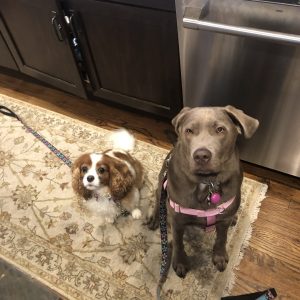 Now back from New Skete, every day Daisy has to run through her exercises, from leave it and heal to place. Similarly, working on my craft is essential every day. From warm up exercises to practicing cold reading, this is part of my daily routine. I recently reflected on this in my blog about the class that I am taking with Kim Handysides, but in order to stay strong in the reads that I submit both as auditions and as booked work, this daily work is essential to my success.
 Just as Daisy needs her purposeful walk, I need a certain amount of daily exercise to stay in shape for voice over, I walk four to five miles a day. I do pilates three times a week. All of that is in addition to my vocal warm ups. When your body is your instrument, you have to maintain your instrument every single day.
 In the same way that communicating well with Daisy strengthens our family bonds, doing all of the above plus communicating well with clients strengthens our connections with them. As they can rely on our work being consistently good and being there when they need it, they will be able to trust us for their clients, and in the end that trust is what matters most. As a professional talent, a new booking is great, but when that new booking comes back, it’s almost as good as when Daisy comes galloping towards me.
 Each session got my wheels turning for different reasons, but during Armin’s session that was around 11 AM EST, when he spoke of defining quality in the industry. My head was bursting with ideas. If you don’t know Armin Hierstetter, he is the founder and CEO of the online casting platform Bodalgo. Unlike some platforms where you can simply sign up, Bodalgo stands apart because Armin has a screening process to begin with, setting a bar for “quality” from the start. In his talk, Armin spent a bit of time talking about what is going on industry wide in terms of quality, what quality looks like, and how quality could be achieved.
 It is imperative that in order to be competitive in the voice over industry today a talent must have coaches and continue to work on their craft. When I started I did a combination of one on one coaching in specific genres, online classes, acting and improv. Whether or not you are working towards a demo, a good coach will help you develop your strengths and identify your weaknesses. They will also help you identify next steps and encourage you with other genres of voice over that would likely be a good fit. As MaryLynn mentioned in her blog post,
  If you want to succeed in voiceover, there are not short cuts to creating quality work. There is an industry standard and the bar is high. That is what books. If you are aware of those of us who continue to book at this time, the answer to what sets them apart is one word: quality.

