The Philosophical Question of VO
 Without doubt people love John DiMaggio’s character Bender on “Futurama.” So when DiMaggio’s contract was up, he faced a dilemma. Many voice actors have actually faced this very dilemma. Does he hold out for the rate he deserves? Should does he walk? Or perhaps in this instance, DiMaggio responded like his character Bender would have.
This is a complex situation. If you have not watched the show or have not read about it, there are a few key details. DiMaggio has played Bender since the 90s. He has described Bender as being part of his soul. Hulu decided to revive the series. There are a lot of unanswered questions:
-
We do not know the entire budget.
-
What was John DiMaggio’s offer was relative to others in the cast like Billy West?
-
Was actually only about the rate?
As voice actors, we face a daily struggle. We are working artists. Creatives. How do we align artistic principles with business principles? If something is “part of your soul” how do you attach a rate? When a character becomes part of the fiber of who we are, how do we walk away? At the same time, we spend years training. We invest in pricey gear. We have a huge cost to maintain our business. How can we afford not to maintain our rates? If we do not stand up for our value, who will?
Recently I was on a college tour at Georgetown with my son. They tour guide spoke about religious and philosophical life on campus. He said they want the students to grapple with the questions to which there are no answers. When I read DiMaggio’s story, I thought back to this. As voice actors, we need to find the intersection between our acting goals and our business goals.
Voice Over Bookings Like Library Books
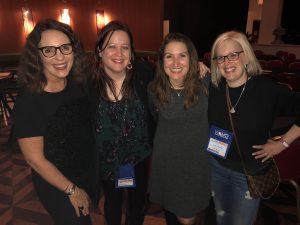
 In March of 2019, I was at the World Wide Radio Summit in Burbank. I remember Kelly Doherty saying something brilliant. She likened VO gigs to library books. Kelly said they are ours for a time then they go to someone else. I loved that. As someone who has always believed we get the jobs we are meant to get, that worked for me. My friend used to do the Burlington ads on Spotify, then I did them. Now someone else is. I used to do the IVR for Big Bear Gear. Then they wanted a male voice and I happily passed it on. That’s how it goes.
What makes it different in the scenario is with Bender, is that fans equate actor with the actor. The actor has developed the character. The actor has not only made the character who he is, but the character then becomes a part of the fiber of the actor.
Now, let’s flesh this out. There are times when actors assume roles that have already existed. For example, Bob Bergen took over as Porky Pig. Dora from Dora the Explorer has been voiced by three actors: Isabella Merced, Caitlyn Sanchez, and Fatima Ptacek. “Tom and Jerry” had no fewer than seven voice actors over the many years. There was not feuding when these actors stepped into a role, the role, like a library book, simply changed hands.
What Makes the Bender’s Voice Over Role Different
Some philosophical questions must be asked at this point in analysis:
-
Does fan attachment come into play?
-
Do some actors define a role?
-
Can actors seamlessly take over for each other?
-
Where is the line between budget and performance?
-
Is it more important for a talent to earn a living wage? Or, is it more important for the character to go on to exist and be part of a series?
 When DiMaggio could not reach an agreement, many industry insiders came to his defense assuring everyone that they would not assume his role either. This leaves us with an open-ended question: imagine of someone had tried to replace Beaver Cleaver or Arther Fonzerelli? If someone tried to replace Peter Cullen as Optimus Prime, we would notice that too, so perhaps some characters are just different. Perhaps Bender is one of those characters. That, of course, leads to another great question: does the voice actor develop the role is does the role create the space for great talent?
As a professional voice actor, I can tell you that great scripts are a gift and they do not come your way so often. When they do, they give voice actors a chance to shine. It is hard to give a brilliant performance when the specs in no way match what you are sent script wise. So my thoughts are that when characters become iconic, it’s because an extremely gifted actor is placed in a wonderful cast and has a great script to work with.
Voice Actors Earning a Living Wage
All of that said, I am a voice actor because I have a passion for my craft. I have an advanced degree and while there are many things that I could do, there is only one thing that I want to do: voice over. Of my daily routine, I take joy in the minutiae with one exception: negotiating rates. Despite the prevalence of well-publicized rate cards, I constantly have to negotiate with clients. It is so frustrating. DiMaggio’s recent problems bring all of this to light. If the most famous and talented among us cannot get paid what they feel they need to continue an on-going role that they are known for, how are the rest of us supposed to hold out hope that we will get the rate we need on the next commercial or eLearning gig?
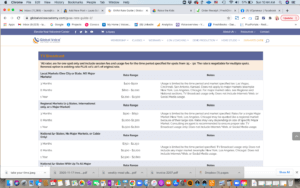
 Let me share two experiences that happened in the past week. Last week, I heard from an Indie Video Game producer that I worked with in 2016. They were offering me the same role I played then. I had detailed notes in my CRM that they needed a discount as they were trying to launch the game with a kickstarter campaign. When I quoted them this time a normal, mid-range rate, they came back to me saying they were shocked that my rated had gone up. They went on to say that the five other talents had agreed to the rate they offered and they wanted to pay everyone the same. I referred them to the GVAA rate guide, which I will discuss later, and reminded them of the terms of 2016. They came up to my rate for me and for the other talents.
 Imagine a scenario where we all just stopped negotiating. Let’s say a client offers $200 for two TV commercials with no mention of the length of usage, and instead of trying to negotiate, sort out the details, and explain why buy outs don’t work for us, we all just said “sure.” The implications would be staggering. The clients, then, would assume there is nothing wrong with this sweat shop pay, and would assume that our years of coaching and on-going professional development, that our expensive studio equipment, that the service we provide, that none of it has value, and that the can continue to lower and lower the rates. Where will it end? How low will they go? I shudder at the thought, and fear that if we are not willing to walk away, these bargain basement rates will become more and more common. You must know your worth and be willing to stand up for it.
 They sent me the script and asked for my rate. They needed a RUSH turn around, but I was not charging them an extra fee for that. Since they were a repeat client and I was available I didn’t want to nickel and dime them. Anyway, I made a mistake almost right away. The voice over job I did for them was for an explainer video with usage limited only to their website. I assumed, again, I assumed that this was the same. I assumed this because the top of the script was labeled in bold font “VIDEO SCRIPT.” I initially quoted the job based on the last, recent voiceover work I did for them and the assumption that it was a video.
 On the call, it was great to catch up with the client. As a full-time, professional female voice over actor, building client relationships means a lot to me, and phone calls like this always provide an opportunity not only to better understand my client’s unique and specific needs, but also to get to know them. How better to build a relationship than to actually speak?
 Now, these questions should have been asked in my initial reply email when they were casting me. I should have asked them before I threw any numbers into the air. And as a long established professional voice talent, I should have know better.
 I will never be in such a hurry, even when I tell myself it’s for the client, that I skip major parts of the information gathering process. The point of having years of experience in the industry is not only to serve the clients well and to provide an outstanding level of service, but is also for precisely these scenarios, when years in the industry should teach us to take a breath, pause, and look at what we are dealing with. I realize that if I could make this basic mistake, anyone can. So do yourself a favor, ask questions. Enjoy the dialogue and back and forth. Don’t be afraid to hop on the phone and clarify a few details. I realize the clients in this scenario could just as easily have been inflexible about the budget, and that would have led to a very different blog today.


 In 2020 live sessions have been more important than ever. Sure some clients still want us to self direct, but as no one or barely anyone) is recording in person, the live session is more important than ever. What surprises me is that I would have guessed that every client would want the quality offered by Source Connect. This is not the case. Surprisingly, I am asked for zoom and given phone patch dial-ins more often than I am asked to use Source Connect. As a professional voice actor, most live sessions are for commercials, but I have done a few for eLearning clients recently. Interestingly, it has been so long that I have been asked for ISDN that I gave up my direct bridge through ipDTL as no one seemed to want that anymore. So, despite the quality that some connections offer, clients seem to like what is easy for them and what they are comfortable with.
 Rates have been all over the place in 2020. I have had to turn down more jobs in 2020 than in the past 5 years combined. This may be because I am being found more, or it is because more people who never cast a voice talent are now casting and are not familiar with industry standard rates, or budgets are changing. As a working voice over professional, it is one thing to be flexible and have a range of acceptable rates, and it is another issue entirely to compromise one’s worth to pick up a new client. I have found that the biggest area that clients lack understanding in is usage for social media. They do not understand the difference between organic usage and paid placement, and they do not understand that usage across multiple platforms matters. My hope is that if voice talents continue to work together to educate clients this will shift in coming years.
 The specs are changing and the buzz words that we are asked for have changed. When I started the millennial conversational read was the go to read. Now it seems that, for commercial voice overs, the authentic, natural read is what is wanted. A real person who sounds believable is the go to read. Interestingly, I think there has been a backlash from millennials who do not like or enjoy a lot of the characteristics that have been assigned to their generation, and the shift that we see is a direct response to that.
 For those of us professional talents who are putting in the hours of work every single day, I am pleased and grateful for the abundance of work in 2020. Initially when the pandemic hit my business slowed in March and I panicked that everything would change. By April it seemed to bounce back and castings had picked up again. According to industry friends who are as established as I am or have been in the industry longer, this is the best year they have had yet. I realize it is Thanksgiving weekend, but I typically have an attitude of gratitude all year, whenever the bookings gods shine down on me. I realize that my clients have a choice and I am thankful when the choice goes my way, and this year it has happened more than last year. When so many businesses are struggling, in our industry and around the country, this is truly something to celebrate.
 My direct bookings, bookings where clients come straight to me, are triple my pay to play bookings in 2020 and up 14% from 2019. I am really pleased with this. These direct bookings are a combination of clients that find my website, rosters that I am on because I found them, or repeat clients who were initially from a pay to play but not they continue to come back to me. I also have direct bookings from social media, including instagram and LinkedIn. The number of direct bookings being so high means that I am not dependent on pay to plays to survive. Instead, I use the pat to plays to add to my client pool. I am extremely thankful for all of the direct bookings.
 You need a solid demo that represents both a range of your abilities and your understanding of the industry. My vocal range is from teen to middle age, and that is demonstrated in my eLearning demo, which goes from tech industries to pharma to medical. My demo switches gears from upbeat and engaging to serious and professional. My demo is set to music, which is controversial is often eLearning is dry. I wanted my demo to standout and by pleasant to listen to, and I believe it meets that goal.
 It has been a while since I was cast as a generic third person narrator in eLearning. Instead, for the last sic months, ever booking to land on my desk is a character role, where the instructional designer wants an authentic, genuine role that is believable for their training. For example, this week I was cast as a college student who had gone down the wrong path and had a drug problem and was now in recovery. I had to be sensitive and relatable. It had to be believable. I was telling this girl’s story in this university’s training scenario. Last week I was a caller in a pay roll company’s HR training. I was the good caller this time, but in the past I’ve been the bad caller. In both instances the character had to be believable, authentic, and sincere. As a female eLearning narrator, this is a big responsibility: to continue booking work for clients you have to be able to switch gears and maintain whatever character you are playing for them that day. The character must be consistent throughout and must have nuance.
 Rates are really important. My bookings typically range between $0.25/word and $0.45/word with a $150 minimum and $1 per split. I charge for splits if there are more than 10. I prefer to quote the price per word and not per finished minute as I speak quickly. Last week I had a potential client reach out and ask me if I was on Upwork. I told them I was not. They wanted to know if I would honor Upwork’s rates, and I explained that at this point in my career I could not work for those rates. I then referred the client to GVAA and Gravy for The Brain, in hopes of keeping the conversation going. They did come back to me that if they had flexibility they would let me know, but in the mean time it is important to be willing to walk away. The next day I had a job come in that was 617 words and paid of $400. It is important never to settle.
 Most typically, my eLearning clients want MP3s that are split and fully edited. I typically add EQ, compression, and a d-esser. If you are booking eLearning work for big companies, it is expected that you should have a professional grade studio at this point. Especially because they often do not have music or effects behind their training, the quality of the audio that you provide matters more than ever.

