By Laura Schreiber & Voice123’s The Booth
This article is sponsored by Voice123.
You nailed the audition! Your voice is exactly what the client wanted and it’s that project you had a special feeling about. Now comes the difficult part; maintaining successful client communications throughout each stage of the project.
It might seem easy since you already landed the job, but keep in mind that clients need to see value to continue the relationship or work with you again in the future. So when working with clients, whether it’s an audition, a direct booking, a booking from an audition, or a repeat client, you only have one chance to get that first communication right! When they reach out to you, it is up to you as the voice talent, to set the tone for how the communications will go. A warm, friendly, helpful response goes a long way in every scenario and helps to build the foundation for a great talent-client relationship.
Do your best to make them happy every single time!
Common miscommunications when working with clients
Miscommunication issues can take many shapes and forms. Messages can be taken out of context by cultural differences and delays can creep in if both parties are in a different time zone.
I have worked with international clients and had some miscommunication issues, so often the more information that you can spell out at the start of work, the easier it is for everyone.
Worse-case scenarios: A client gets offended, gets the wrong impression, or pulls out of the project. Or a voice actor could jump the gun, miss a deadline, or drop the ball altogether by missing an important project requirement.
How can these negative situations be avoided?
From the first communication with a client, it is best to understand the intentions behind the project. If you can, ask questions about the tone of the project and specifically what they are looking for. Knowing the answers to these and other vital questions in advance of doing the work leads to successful client communications and also confirms that a booking is a booking.
To help you with this, here’s a checklist of vital points that you need to go through beforehand.
- Ask the client if they have a scratch track.
- Ask if they know what music they are going to use. (This helps me understand the tone and the pace of the voice over.)
- Confirm the file format. WAV, MP3, or both?
- Confirm if the client needs raw or edited audio.
- Confirm whom, where and when to invoice.
- Confirm your service agreement, payment, and revisions policy.
A key takeaway for clients, in this case, is to contribute to a faster process by responding in a timely manner, being transparent about project details, and keeping a voice actor in the loop regarding any changes or delays.
How to manage client expectations
In general, all back and forth client communications should be prompt. If you are replying to an audition request, it is to your advantage to submit on the early side. Personally, as soon as I get an audition that looks appealing, I try to submit it. If you can be in the first ten submissions, that is ideal. Sometimes it is hard because of differences in time zones, or the demands of another project, but early submission is the key to getting booked. Once the client hears what they need, they will cast the job. They also would rather work with a talent who is responsive.
When replying to emails, whether for an audition or for a booking, being available makes you easy to work with. If you reply quickly and are transparent in your business practices, you are far more likely to gain a client. Timing matters. If a client has a deadline, you do not want to be the reason why they have to push their deadline. Instead, make it easy for them to get what they need by both responding promptly and submitting promptly.
Make all replies personal so that the client feels heard. Be sure to respond to all of their asks in your email and cover all bases. This also includes your turnaround time, pickup/revision policy, and payment terms.
Do’s and Don’ts for setting the right expectations
- Don’t feel shy or afraid to outline your terms. Clear and transparent client communications benefit everyone.
- Do find out the client’s intentions behind the project. Are they trying to increase sales, or drive more traffic to their website? And what is their target audience?
- Do ask about the tone of the project. Often, the client has a specific sound; a voice in their head that they’re trying to match. Asking for an example such as a celebrity, similar sound, or even one of your samples could point you in the right direction.
But how does this translate into a written message when working with clients? Here are some specific templates that can be copied and tweaked to suit your needs.
Template 1: If you missed a client’s message
Hi, Name,
I am so sorry for the delay!
I had to ________, but I am definitely available now. I always aim for professional and fast communication so I really apologize for this.
If you’d still like to move forward with this, I’m more than happy to make it up to you by adding ____ free revisions instead of _____. And also willing to _________, as a gesture of good faith.
Let me know and once again, sincere apologies.
Check out the full list of free Client Communications Templates here.
To sum things up, successful client communications are all about knowing what to say, how to say it, and when to say it. Don’t leave anything to chance. Prepare your communications ahead of time, follow the right format and tone, and always follow the 3 Ps when working with clients:
Professional, Punctual, and Polite.
But there’s so much more to communicating and working with clients. Read the complete Client Communications Checklist For Voice Actors in Voice123’s Voice Over Guide.
 When I started in voice over years ago, I remember thinking that when I had an agent I will have “made it.” I remember Screwing Up is Part of Success”one of my coaches telling me that she worked for five years before she had her first agent, so that I could align my expectations. At that point, I did not even know about managers. I was lucky, I was able to get on quite a few agents rosters pretty early in my voiceover career. As a working professional, I would hear a lot of chatter on social media about various agents and managers and how to get signed, as if somehow getting on the roster would lead to the ultimate success.
 I signed with this manager specifically for the Radio Imaging part of my business in January 2019. Within the first week, I sent him 5 leads of stations who wanted to sign me and wanted to negotiate retainers. The email above was a call I got a week later. Of these leads, my manager destroyed every single one of them. I was not on the calls. I had empowered him to speak on my behalf. The email above “I was told that our station was not big enough for your services.” is a glimpse of how these prospects were treated in my name. Was this the road to the big agencies? No. Worse, when he tried to renegotiate the stations I had, I lost them. There were other odd quirks about the manager. He wanted any auditions to be professionally mastered, which was an added expense. He also sent Sound and Fury auditions, but I get those from other agents, so now I was paying him to get auditions I was already getting. It was terrible. I realized early on and I was stuck. I basically had to stop soliciting all Radio Imaging business or it would be tied to him. Years of hard work and planning came to a screeching halt. Be careful who you pick to represent you.
 As voice over actors, daily we play both the role of the talent and the role of the small business owner. Immediately in 2015 I decided that not only would I coach with Anne but I would hire her to help build my brand, as I needed to learn all that I could from her. She hit the nail on the head, working hard to get to know me so that the brand that we built for Laura Schreiber Voice is truly a reflection of the work that I do and what I bring to my clients. As a working creative, we are in a unique role because we ultimately get hired by other brands to represent them, but it is in solidly establishing our own unique brand that we can distinguish ourselves from others in our industry. According to Forbes article from March 2018, “your brand often acts as a function of your reputation and visibility.” As a professional voice over actor, it is essential to establish your brand so that your clients will get to know you as an individual and will trust you as a professional.
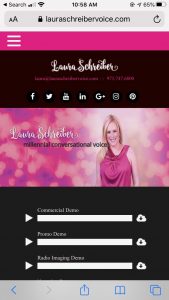 As a solopreneur, your brand begins with your website. It is your store front. Clients can listen to your demos, see samples of your booked work, and find out how to contact you. Those are the basics, but the fun begins when you use your website to do two things: show clients how you are different than other voice over actors and how you will best meet their needs. Kristin Wendys of The SelfEmployed.com advises “Think first with the eyes of a client and analyze what he is looking for, what are his biggest concerns, and what problems he needs to solve.” Some voice actors have brief summaries so that clients can quickly learn about their services, but much in the way that I am very chatty, my website is overflowing with long narrative explanations that I hope will help my clients connect with me.
 Visual images help create your brand and your logo is very much a part of this. I have both an avatar that I love and a Laura Schreiber Voice Logologo. I use them both differently. My logo is on official correspondences like
  I’m a pretty happy and upbeat gal, and I am genuinely appreciative of each and every one of my voice over bookings and clients, but that doesn’t mean that I don’t have to work hard to create a routine that fosters this attitude of grattitude so that the folks I work with know without a doubt how appreciated they are! This time of year is one of my favorite times of year! Not only do I get to spend more time with the people that I love, but it is also a great time to give a little something extra in the way of thanks to those who help a small business thrive! As a solopreneur, I love these special moments and find that they make all the difference!
 If you have not made it clear that you are not in your booth, do not leave them guessing. Make it as easy as possible for your clients to get what they need when they need it!
 Since I am almost always sending gifts to an office, My husband typically gives his opinion as well, since Harlan actually works in an office. Harlan is of the strong opinion that clients want food, particularly sinful food, and that they would not indulge in on their own. So the past few years specialty food like fudge from the Jersey shore and high-end candies from Sugarfina have made the cut. I have something very special planned for this year.
 I have blogged before about being a migraine sufferer. I happened to have had a pretty bad headache on the Saturday of this conference. It would not go away. I had to miss some sessions I really wanted to see in the morning. I eventually went down to participate, even though I did not feel 100%. To be honest I did not even feel 30%, and if I were home I would have stayed in all day. But I flew across the country for so many reasons, and none of them included a day of napping. It was not easy for me, but the biggest challenge, bot physically and mentally, was getting through Everrett Oliver’s session. If you have never coached with Everett, he is truly outstanding. He pushes in all the right ways. He makes you go places you would rather not but as an outstanding booth director he gets it out of you. I LOVE working with Everett. And in truth, as a working professional, when booked work comes in, I have to record, so this was a good exercise. I am not shy but I am much more comfortable in front of my own mic than in a room full of people, even if those people are my tribe. I loved every minute. LOVED. I am glad I participated. I hope to work with this amazing coach again soon.
 Lastly, I want to broaden your thinking of what an audition is. Anytime you put yourself and your voice or samples in front of a client that is an audition opportunity! A phone call, and of course a cold call, gives a client a chance to hear you. A direct email to someone you have met with your demo likewise gives a client a chance to hear you. Meeting someone at a conference or a networking event and talking about why your service is different from that of other voice actors is an in-person audition: you have their undivided attention, they hear your voice, and you are speaking! An audition is not just a read with a script or a demo submitted. Always be prepared with you 30 second elevator shpiel and be proud of who you are and what you do. Sparkle!

