
My Dreams Come True
 Having studio dogs is a luxury. As a working mom, I have blogged about this before, but I never knew if I would be able to have children. When I was 22 and I got my first Cavalier King Charles Spaniel of blessed memory, I was not sure if this fur baby would be my only child. While I have been blessed with human children too, they never changed the status of my dogs, who have meant the world to me. My dogs have been there for me and by my side on my best and worst days. For my greatest celebrations and for my worst sorrow. I believe that Barclay, Violet, and Daisy understand and connect with me in a unique and special way, and having them in my life is as much a dream come true as my professional voice over career is. I very much view having these precious fur babies by my side in my home studio as a luxury. Everything about my career, from my studio set up to being able to be present for my children is icing on the cake to being able to live the dream of life as a full-time voiceover actor. If you are thinking of getting a studio dog, I urge you to move forward without hesitation. If you are thinking about it, let me share the traits that have made my dogs ideal to be in the studio daily and give you some ideas of what traits work, what does not, and what to look for when having a voice over studio dog.
Violet
 Violet has always been a wonderful studio dog. Violet is a Blenheim cavalier King Charles Spaniel. Her temperament is calm, quiet, and she is eager to please. She rarely barks and sleeps a lot. Despite her angelic personality, there are several challenges to having this love muffing in the booth. When Violet sleeps, she often snores. Despite her tiny size of only 15 lbs, her snore sounds like a local train coming through town. The next challenge is that Violet, who was bred to be a lap dog, very much wants to sit on my lap. While she will sometimes settle down and snuggle with her sister, she will more often beg to be on my lap. Imagine that I am doing a long form narration or eLearning project and she is on my lab. If she exhales or shakes and her collar rattles, the mic will pic this up. While Violet is pretty close to being perfect, there are some hiccups sometimes and as human as she seems she still has no idea that I am doing actual work or that she can interrupt it.
Daisy
Daisy the Silver LabDaisy is a Labrador Retriever puppy. As a silver Lab, she is just precious. She is goofy and sweet and has a lot of energy. Let’s just say when she first came to the voice over booth, she had no idea it was a place of work. She literally tried to eat the aurelex acoustic foam off of the walls! Well, that could not go on. Outside the studio, Daisy had a number of behavior issues ranging from jumping to counter surfing to pulling while walking that also needed to be addressed. So, we sent her to the Monks of New Skete for some dog training. They taught Daisy to go to her place. It was amazing. After 17 days at the monastery, when she returned, she understood to lay by my feet quietly when given the command “place.” This was life changing and Daisy is now a wonderful and enjoyable companion in the studio.
When They are Not There
Regardless of how amazing Violet and Daisy are, I do not have the girls in the booth for live sessions. Whether I am doing a Source Connect of Zoom session, my feeling is that when clients are paying a premium for m services, the dos should not be there. Ever. I do a lot of commercial work and also have live sessions for video game work and sometimes even eLearning, and there is not a circumstance in which the dog’s behavior interfering with the audio would every be acceptable. In a business where there are a lot of people who do what we do, and we as talents are very replaceable, we need to be mindful of what is ideal for our clients and put their needs above all elese. Are there times I would prefer to have my pups in the booth? Of course there are, but it is more important to have clients return again and again.
So, if you are a voice actor and you are getting a pup, here are some things to keep in mind:
- You want a dog that is not a barker. They either are or they aren’t, and if they are that will never change.
- You want a dog who is not anxious. They need to be ok by themselves when you have live sessions. If you put them somewhere else in your house, whether it is a crate, a den, a gated kitchen, you need to be able to count on them to be quiet for the duration of your session.
- You want a dog who can stay calm and rest for upwards of an hour, even at a young age. As voice actors, it’s an endurance game. We are often in our studio for hours on end. You want a dog who can tolerate being indoors and does not demand walks or outdoor play on their schedule.
I am so thankful for my girls. I hope you find a studio dog to make your voiceover life complete!
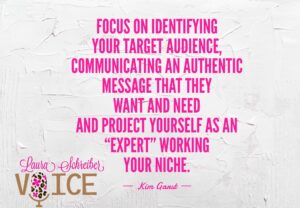 from the US and Canada. Our focus was on marketing, and even as a panel member, it really got my wheels turning. I could not help but think of the specificity of my recent outreach, especially in eLearning. I have worked so hard to build my business as an eLearning narrator, and I think in order to really reach prospects, you need to think about who you are working with. From the very beginning of the process through the completion of the booked work, understanding your audience is essential to success as a working female narrator in eLearning.
 Social media content, across platforms, needs to have the target audience in mind as well. This can be a bit trickier, as it is harder to control who sees your posts. You can, however, try to catch the eye of a specific group of clients or prospects by being clever about your target audience. If, for example, you are posing on Instagram and you want to reach out to instructional designers, both the content you use and the tags that you include in your post matters. Another way to grab your audience is to tag influencers and professionals in that field. Quote them. Have a conversation about them. If you want to work in eLearning, you need to be part of the dialogue.
 When you book an eLearning job, understanding the audience or the enduser is so important. For example, I was recently cast in a training for a local hospital: RWJ St. Barnabas, right here in NJ. It was a caller training. When I first read through the script, in my practice read, I sounded warm, gracious, and welcoming. I then re-read my roll: “Bad Caller.” I was the example of what not to do. Everything I just rehearsed had to be thrown out the window and the opposite read was needed. I was talking to the same people, but I was the example of what not to do, and I had to be the best “Bad Caller” they ever heard. Your job as an eLearning narrator is to make it obvious. They should not have had to figure out what was wrong with my phone skills, so I had to make every effort to clearly connect with the listener. Keeping the audience in mind should inform and transform every eLearning performance.
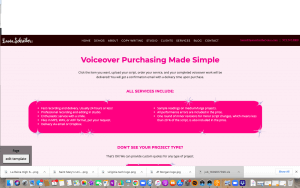
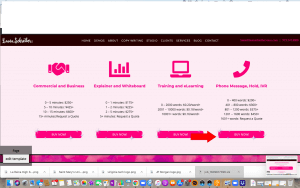

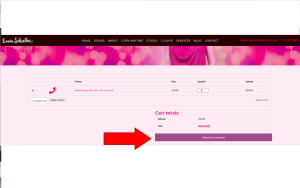
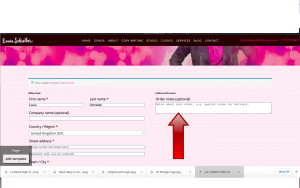
 It’s 2021. We’re still in a pandemic. We need what we need quickly. Laura gets it and she wants you to have perfect audio without a fuss at the click of your mouse. Let Laura know how she can help you!
 You need a solid demo that represents both a range of your abilities and your understanding of the industry. My vocal range is from teen to middle age, and that is demonstrated in my eLearning demo, which goes from tech industries to pharma to medical. My demo switches gears from upbeat and engaging to serious and professional. My demo is set to music, which is controversial is often eLearning is dry. I wanted my demo to standout and by pleasant to listen to, and I believe it meets that goal.
 It has been a while since I was cast as a generic third person narrator in eLearning. Instead, for the last sic months, ever booking to land on my desk is a character role, where the instructional designer wants an authentic, genuine role that is believable for their training. For example, this week I was cast as a college student who had gone down the wrong path and had a drug problem and was now in recovery. I had to be sensitive and relatable. It had to be believable. I was telling this girl’s story in this university’s training scenario. Last week I was a caller in a pay roll company’s HR training. I was the good caller this time, but in the past I’ve been the bad caller. In both instances the character had to be believable, authentic, and sincere. As a female eLearning narrator, this is a big responsibility: to continue booking work for clients you have to be able to switch gears and maintain whatever character you are playing for them that day. The character must be consistent throughout and must have nuance.
 Rates are really important. My bookings typically range between $0.25/word and $0.45/word with a $150 minimum and $1 per split. I charge for splits if there are more than 10. I prefer to quote the price per word and not per finished minute as I speak quickly. Last week I had a potential client reach out and ask me if I was on Upwork. I told them I was not. They wanted to know if I would honor Upwork’s rates, and I explained that at this point in my career I could not work for those rates. I then referred the client to GVAA and Gravy for The Brain, in hopes of keeping the conversation going. They did come back to me that if they had flexibility they would let me know, but in the mean time it is important to be willing to walk away. The next day I had a job come in that was 617 words and paid of $400. It is important never to settle.
 Most typically, my eLearning clients want MP3s that are split and fully edited. I typically add EQ, compression, and a d-esser. If you are booking eLearning work for big companies, it is expected that you should have a professional grade studio at this point. Especially because they often do not have music or effects behind their training, the quality of the audio that you provide matters more than ever.
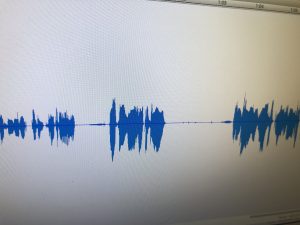 Late Friday afternoon I was in my booth recoding a bunch of agent auditions that had come in. Initially I felt fine. I had completed all of my booked work and I wanted to submit a few more reads before I called it a day. I typically don’t have a lot of mouth clicks when I record. I do run Izotope RX7 as part of my effects stack, which takes care of whatever clicks there are, but I tend to stay hydrated and am not so clicky, especially since I gave up caffeine. I noticed that even though my noise floor was the same as it always is, I had a crazy amount of spikes and clicks present that I do not typically see. This was 3 to 5 minutes before I became violently ill and had to run from the booth, I could see what I had no idea was about the be a horrible case of food poisoning, in my audio!
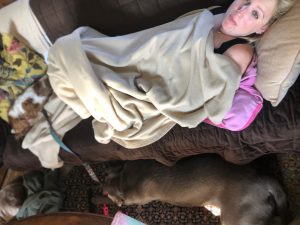 As a small business owner, I work all the time. Typically on the weekends I work less, but I still work at points every day. This food poisoning forced me to pause. I was not even sure on Saturday if I would be ok for my like sessions on Monday, but I know realize I will be. Talking is hard, sitting up is hard. Sometimes the forced rest is essential to get back to where we were. I guess it is an opportunity to reset- to restart. In truth I have no other option, when one is so dizzy that going up and down the stairs feels unsafe, the rest is the only option. In lieu of any work, I laid on the sofa in my den surrounded by my dogs and tried not o move at all.
 For the first time in my five years as a full time voice over actor I mis-quoted a client. In truth, I was extremely tense about the election results so if I did not make a mistake here I could have made one some where else. A new client found me on LinkedIn for a toy project. I have a tight NDA, but I can say that it’s a toy and right away my voice seemed like the perfect fit for this project.
 When the client had their final script, they emailed me an NDA and a contract. Then they emailed me the finalized script which was again an excel spreadsheet. In the email they confirmed the initial rate. To my horror, I realized immediately that I had under-quoted the client significantly. The script was not 4 lines, It was 154 lines. Further, they needed the files split which was also not included in the initial bid. My heart sank. I never want to disappoint a client or to make their job harder. I genuinely thought the job was the first four lines. I am not clear whether or not the client was also questioning if the bid covered the full scope of the project by the way their email was written, but I still had to re-quote. With all the work I had, I would be spending a good deal of time on this and could not do the job for the rate I had initially quoted. I felt, though, like a buffoon.
 Immediately I messaged my accountability group with whom I speak to all the time, every day. I trust these women more than anyone to lead me in the right direction. When they did not respond within minutes, I called them. Two of them were actually together at that moment, and they helped me draft a thoughtful and sincere email to address my error and revise the quote. It began with “I do apologize but…” I felt awful about doing it but I also could not live with myself if I did not. Interestingly, it was the opinion of two of the others in the group that the error was mine and I should do the job at the lower rate. They pointed out that I risked both losing the client and that if this client knows other clients I risked tarnishing my reputation. I weighed my options and sent the email with the revised quote.
 The client was not pleased when she got the email with the revised quote she had to go back to both her team and to the clients for approval. The next day I heard that they were ready to move forward. I ended up having to call the client. When I downloaded the excel spreadsheet, I had some formatting issues as a Mac user. I called the client and they were extremely helpful. It was actually great to speak with them and have yet another opportunity to apologize and let them know that I genuinely did not intend to make things difficult for them. Our chat went very well and I am extremely thankful to have laid what I hope is the foundation of a good working relationship.

