A Lot of eLearning Trends In 2020
Whether it’s because of the Covid 19 Pandemic or the industry just continues to boom, there is more eLearning work than ever! The demand for female voice over roles is continual, and as a full-time professional voice actor, every time an eLearning job arrives in my inbox I am delighted. I have always loved working with the instructional designers and project managers to bring their content to life. Before I became a voice actor, I was a teacher, so perhaps that it was I feel so at home with this genre. At the moment, there is a huge amount of eLearning content and based on the work coming in I have noticed a lot of trends in the type of work being sought, rates, tech needs, and what books the work. If you are looking to expand your eLearning bookings or to work more in this genre, these are questions you should be asking:
What gets your foot in the door with eLearning content creators?
 You need a solid demo that represents both a range of your abilities and your understanding of the industry. My vocal range is from teen to middle age, and that is demonstrated in my eLearning demo, which goes from tech industries to pharma to medical. My demo switches gears from upbeat and engaging to serious and professional. My demo is set to music, which is controversial is often eLearning is dry. I wanted my demo to standout and by pleasant to listen to, and I believe it meets that goal.
What are you typically asked for when cast in an eLearning role?
 It has been a while since I was cast as a generic third person narrator in eLearning. Instead, for the last sic months, ever booking to land on my desk is a character role, where the instructional designer wants an authentic, genuine role that is believable for their training. For example, this week I was cast as a college student who had gone down the wrong path and had a drug problem and was now in recovery. I had to be sensitive and relatable. It had to be believable. I was telling this girl’s story in this university’s training scenario. Last week I was a caller in a pay roll company’s HR training. I was the good caller this time, but in the past I’ve been the bad caller. In both instances the character had to be believable, authentic, and sincere. As a female eLearning narrator, this is a big responsibility: to continue booking work for clients you have to be able to switch gears and maintain whatever character you are playing for them that day. The character must be consistent throughout and must have nuance.
What Rates are you booking at?
 Rates are really important. My bookings typically range between $0.25/word and $0.45/word with a $150 minimum and $1 per split. I charge for splits if there are more than 10. I prefer to quote the price per word and not per finished minute as I speak quickly. Last week I had a potential client reach out and ask me if I was on Upwork. I told them I was not. They wanted to know if I would honor Upwork’s rates, and I explained that at this point in my career I could not work for those rates. I then referred the client to GVAA and Gravy for The Brain, in hopes of keeping the conversation going. They did come back to me that if they had flexibility they would let me know, but in the mean time it is important to be willing to walk away. The next day I had a job come in that was 617 words and paid of $400. It is important never to settle.
What technological requests do you get from clients?
 Most typically, my eLearning clients want MP3s that are split and fully edited. I typically add EQ, compression, and a d-esser. If you are booking eLearning work for big companies, it is expected that you should have a professional grade studio at this point. Especially because they often do not have music or effects behind their training, the quality of the audio that you provide matters more than ever.
Final Thoughts:
There is a lot of eLearning work for voice actors at the moment. If you intend to be booking it, you need to have great sound and be able to maintain a character consistently for the duration of the script. Your demo gets you in the door, but if you can’t sound as good as that on every single job, then you are not ready to work.
 I’ll start out by saying that neither of my twins dream of becoming full time voice over actors like me. And though they do not share my dream, they support me in every way possible and are actually part of my small business team in integral ways this summer. In the past few weeks, one of my VO besties reached out and said that one of her regular clients needed 14-16 year old voices to do some eLearning narration, and my twins happen to be 16. So, they submitted demo reads. Again, it is not their life’s ambition, but in the summer of Covid-19 they realize that this is a great opportunity to learn and to do something that most kids never get a chance to do.
 Following multi-step directions is hard for many adults, and there are very specific directions unique to every voice over job. This booking was for sure an exercise in following multi-step directions for Jack. For Jack’s first booking:
 Maintaining a professional demeanor in the professional world is important. I remember meeting Michelle Sundholm’s sons Ashton and Everett at VO Atlanta in 2018.They were so polite and they were so composed. It is this exact behavior that I am talking about. For Jack, since his interaction was online, it meant several details. First, it meant performing his work in a timely manor. It meant taking pride in his performance and doing his best. It meant sending follow-ups and hand written thank you notes, both to the client and to the friend who referred the opportunity to him. Jack had to carry himself the way the rest of us do, and he took pride in doing so.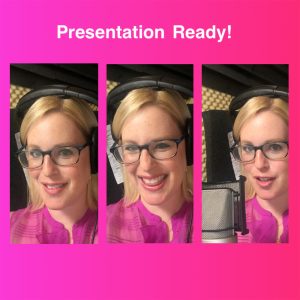
 Last fall, which seems like a lifetime ago given how much the world has changed during the current pandemic, I began researching upcoming eLearning conferences. I was actually hoping to find more conferences in my region. As a working mom with high school aged twins, flying across the country can sometimes be a challenge. I was overjoyed when I discovered the ICELW conference was to be held at Columbia University in the city of New York, my beloved alma mater. I submitted a proposal to speak about “Best Practices to Bring Your eLearning Module To Life” from the perspective that academics and HR people who never thought they would have to work with professional voice actors like me suddenly find themselves in the position to cast and work with voice talents as professional narrators for their eLearning modules and projects. I addressed questions that they should ask every time they have a project, VO tech and why it matters, and pricing for voiceover, including where it should be and what the price indicates. My presentation went nicely and it meant a lot to be a part of the dialogue. I am very excited, however, to share some of the larger takeaways from the more scholarly presentations during the conference as I reflect on how they will shape both my work, my voice over bookings, and client interactions as the
 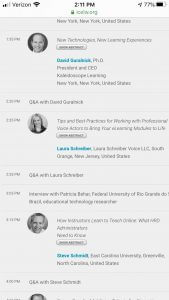 With an international audience and an enthusiastic crowd, there was a lot of discussion at the conference about how the advancing technology would enable content creators to re-imagine learning. David Guralnick from Kaleidoscope Learning and Columbia University talked about opportunities to use “technology to humanize learning” and went on to present a thrilling example combining AI and interactive technology. In this example, the student asked questions about Ancient Greece and the Acropolis and was able to create a scene where he was present in Ancient Greece having his questions answered. Particularly at a moment when students around the world are relying so heavily on on-line learning, this was thrilling and wonderful to see. The advantages of this were how realistic the scenario is and how clear the examples are. Clearly the new technology enables better communication of content. As a narrator, I have been working with more companies that create K-12 content in the last year, and I am sure such technology would be a huge asset to them.
 There were multiple sessions during the ICELW conference that addressed new technologies like AI, VR, and enhanced/mixed reality. I was riveted by these sessions as well. Someone brought up that when Steve Jobs designed the first iPod, he did not do a focus group, he just knew it would be a better device and he was creating the technology to drive a potential future experience. That is what a lot of the new experiential learning technology does. There is vast potential, the sky is the limit so to speak. Michelle Cortese, a VR Product Designer at Facebook and Professor at NYU gave a thrilling demonstration of work her students are doing. I was fascinated as a former educator, as a parent, and as a working creative. I could not help but see the intersection between technology and improv, something that so many of us in voice over spend so much of our time training in. The social behaviors that occur were fascinating, and unpredictable, and again as a working creative this made me think of improv which is not something that I typically connect to my eLearning work. Although, under further analysis, the point of studying improv, is that we are supposed to bring it with us into the booth so that our reads and takes on characters are fresh and exciting. What I found so fascinating about the sample that Michelle shared is that all of the content in the VR chat was user generated and is in the moment art. It is a vision and content that comes from the user. When so much of the learning content that we work with is contrived, this opens up a world of creative possibilities for end users. Fernando Salvetti also demonstrated work with enhanced/mixed reality and I was riveted. The possibilities that are simple and user friendly are true game changers. Having worked in eLearning for years, being exposed to such projects is eye opening.
 As in so many projects I am a part of, the bottom line matters. Dr. Tim Brock of the ROI Institute talked about creating a framework that balances needs and feasibility. The needs need to be defined at the beginning. This resonated with me a lot. Often voiceover is left off of the budget entirely, it’s an after thought. This was another area that I was addressing in my talk, the price of the voice over. When a company is looking at the ROI, the return on investment in the overall project, the voice over, and typically in eLearning we are talking about a narrator, needs to be a part of that calculation, from the start. As the technology continues to progress and is better and better, the voice over needs to be a part of the initial plan, not a lost minute add on. In Dr. Brock’s talk, he spoke of feasibility, and as the technology becomes more and more advanced, having an overall understanding for the get go of the feasibility certainly makes sense!
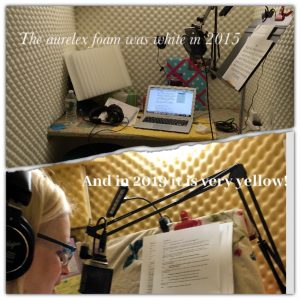 In the blink of an eye, it is the end of 2019 and time to set goals for 2020. But this year also marks my fifth year pursuing voice over full time. The foam in my booth has literally turned from bright white to a funky yellow! Five years ago so many things were unknown: how would I juggle being a working mom, how would I find VO clients, how would I run a business as a solopreneur? Now all of those things are still part of my daily life, but I am confidently figuring it out. There is a good rhythm to my voiceover practice. So looking ahead to 2020, I am optimistic that I am on the verge of more good things. and I have always believed that if I don’t say it aloud, or in writing, then the universe doesn’t hear it… so, here are my goals for 2020:
 I lot of my business, about 60%, comes direct from clients. Most of that is from clients that come back over and over again. This year I hope to add five or six more solid clients to my repeat client roster, folks I can work with over and over again and count on for steady work. Again, like my campaign work, this will enable me to really get to know them. This will also help my continue to build on my sustainable, consistent family income.
 I have noticed on social media that there is a tremendous generosity of spirit in the voiceover community now more than ever. From folks like Bev Standing, Mark Scott, J. Michael Collins, and Kim Handysides to name a few. I am thinking of my fellow voice talents this week and always. I share this joy in our community and am so proud to be a part of these great VO tribe. I wish everyone much success in 2020. I think back to what I learned from Anthony Gettig in the beginning of my career: The rising tide lifts all the ships in the harbor.
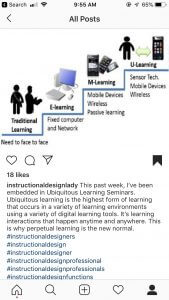 Today, I see my children sprawled across their bed surrounded by multiple devices. They read a lot but they only read books when a teacher gives them an actual book. Instead they read on many devices, seemingly at once. They will have their phone out, their computer out, and an iPad out, and they will be working on multiple screens getting input from all of them. To say that I am both baffled and simultaneously concerned about them getting cancer from all of the electronics is one thing, but the point is, as someone who deals with eLearning content all of the time, that this generation absorbs content differently than Gen-Xers.
 A few years ago I started to notice a big shift to mobile learning. I attended an eLearning Guild conference in San Diego in June of 2017 and the entire focus of the conference was on everything mobile! Now companies could train the employees anywhere, anytime, and why not have fun in the process. Gamification became a big buzzword. At that point, we went from just being narrators as voiceover actors, to really giving the content creators and instructional designers the characters for the roles that they needed.
 I have blogged before about being a migraine sufferer. I happened to have had a pretty bad headache on the Saturday of this conference. It would not go away. I had to miss some sessions I really wanted to see in the morning. I eventually went down to participate, even though I did not feel 100%. To be honest I did not even feel 30%, and if I were home I would have stayed in all day. But I flew across the country for so many reasons, and none of them included a day of napping. It was not easy for me, but the biggest challenge, bot physically and mentally, was getting through Everrett Oliver’s session. If you have never coached with Everett, he is truly outstanding. He pushes in all the right ways. He makes you go places you would rather not but as an outstanding booth director he gets it out of you. I LOVE working with Everett. And in truth, as a working professional, when booked work comes in, I have to record, so this was a good exercise. I am not shy but I am much more comfortable in front of my own mic than in a room full of people, even if those people are my tribe. I loved every minute. LOVED. I am glad I participated. I hope to work with this amazing coach again soon.

