Why Public Domain Books
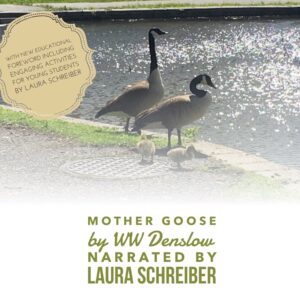 This week my third Public Domain audio book went live with Spoken Realms. As a professional audiobook narrator, I was delighted to have yet another opportunity to work with Steven Jay Cohen and his team to bring a book I was passionate about to life. I have previously blogged about why voice actors choose to do Public Domain projects, and if you are curious you can find that blog HERE. The short version is that narrating Public Domain works allows voice actors a chance to show publishers how they might be cast, in ways others might not have thought of using their voice. It allows us, the voice actors, to have a lot of fun narrating in between projects or during projects by working on manuscripts we are passionate about and putting our own, creative, unique spin on them. I have chosen works from poetry to women’s history to Christmas stories, all of which have brought me great joy.
In this blog, I want to focus on a shocking twist of events that happened after posting a public domain book on ACX. The book, WW Denslow’s Mother Goose, was actually live on audible and I received an email that it was being taken down as there were too many versions of it in existence. Let’s delve into my experience having a Public Domain book removed and what you can do so that this does NOT happen to you!
Mother Goose Story
In order to publish a Public Domain book, you must first assert yourself as the Rights Holder of at least one version, and your version must be different than any other version. As a former teacher, I wrote lesson plans for pre-school through second grade students to accompany these beautiful nursery rhymes and put them in the foreword. I also researched WW Denslow and wrote a brief, footnoted biography and added that at the end. Thus, my version was unique and within 72 hours it was live on Amazon.
Then, I posted my audio on ACX. Initially everything went fine. The book went live and I shared it on social media and I was delighted to add it to my roster. Then I got the following email:
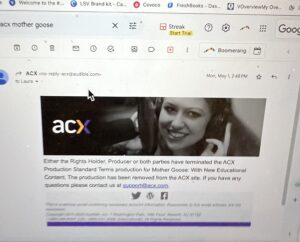
I was actually shocked and frankly dismayed that they would remove a title after publishing it. I wrote an email to the help and support team but got no reply.
After two weeks of not hearing back from ACX, I reached out to Steven Jay Cohen at Spoken Realms. At this point, I had successfully completed two other titles with him. I had actually submitted Mother Goose to ACX prior to my other work with Spoken Realms and that is the only reason I did not hold it for him to begin with. I explained my conundrum. Steven explained that they had a unique agreement with Audible and if they produced my work it could not be removed. Happily, we moved forward with the project. I do know, however, that other narrators continue to have issues posting Public Domain works on ACX. Please see a recent and relevant YouTube interview that I did on the same topic!
Lessons Learned
I have learned a lot from this experience. First, I will not ever endeavor to produce a Public Domain work through ACX again. It is simply not worth the risk of losing the production after the fact. I will produce all future projects through Spoken Realms. Next, there are differences in the editing standards required for Spoken Realms and those required for ACX. Even though I have a specific effects stack to apply to my audio that is perfect for ACX, it was not sufficient alone for Spoken Realms. More editing was required. So, for the first time in my many years as a full time voice actor, I sought the help of a professional editor. The Spoken Realms website actually has a wonderful list of all sorts of professionals in their portal, so I actually randomly picked one from the list and it has been fantastic! I have also been struggling to use 2nd Opinion, the approval software that is part of the Spoken Realms process, so the editor has done that for me on all three of my projects. Hannibal Hills, my brilliant editor, has been a true blessing and has made the process a joy. Others more tech savvy than I likely would not need this, but for me life is short and there are only so many hours in the day and Hannibal is a genius. So, in sum, my experience with Spoken Realms has been great, despite my own personal shortcomings in editing, and my Public Domain projects are live. Should you have a project you are dreaming of, perhaps apply and see if you can join their roster.
Resource List:
https://www.narratorsroadmap.com/
https://www.karencommins.com/2022/05/public-domain-narration-headquarters.html
 If you’re a professional voice over actor like me, and like me you’ve been in the business a while, then you know it is not so often that we get to speak directly with the folks who run casting platforms. Or with agents. Typically candid conversations like this only happen at conferences. It just so happens that one of my VO besties, the amazing Liz Atherton, who for many years was the founder and owner of Texas based TAG Talent, is now the brains behind Cast Voices, the newest casting platform that is sure to bring great things to our industry (know wood). Liz has an amazing team, including Nick Krause, an on-camera talent who also does some VO, and Bobby and Elizabeth Alcott. They have all worked really hard to bring us something that us new and different. They are extremely transparent in all of their practices, and they want to create something that raises the bar. In this scenario, we have unique, inside access.
  f you didn’t know, Diana Birdsall and I run a weekly Clubhouse in our Club “Ask the VO Coaches.” Last week, Liz Atherton and Nick Krause came into our club to chat with us all about the awesome features of Cast Voices. What made the hour special was that many guests got to ask their questions directly to Liz and Nick, and there was a great back and forth exchange. I noticed several things. First, Liz comes from a place of grattitude. She is so profoundly appreciative of the support they have had thus far from the voice over community. She views the process as extremely collaborative and despite her many years as an agent, speaks to every single talent with respect and patience. Next, Liz and Nick care very much about being clear and transparent about all practices. For example, if a project manager on the platform posts a job for $500, the talent sees the job as $500. They are not chipping away at it or altering anything. I also noticed that they are willing to engage in community dialogue. When a bling talent commented about accessibility issues on the site, Nick was extremely responsive and will to hear all suggestions about how to improve the tech. This is a team determined to work hard for the voice over community.
 My recent commercial booking for JP Morgan makes for a great case study in voice over bookings. As a professional voice actor, every booking makes us happy, but when the producer emailed me about these radio spots, his explanation was interesting. I was cast directly without auditioning. He did not mention my voice. Nor did he mention my demos. In this instance, it was a matter of scheduling and availability. As I work full-time, they needed someone who could accommodate a live session at a specific time, which turned out to be 11 a.m. on a Friday morning, and he needed to confirm that I was available. The timing, in this scenario, was the most important question I was asked. The producer got back to me and confirmed that I had indeed booked two spots and it was a go. I was delighted.
 I prepare for every single session, whether I am self-directing or in a live session. Part of my prep is administrative. I take some time to log the job in my CRM and create the invoice. I then print a large print version of the script using my preferred font. Then, prior to marking up the script, I spend a bit of time researching the brand and their other ads. Interestingly, JP Morgan and Chase are linked. As a client, when I log in for my JP morgan account I also log into my chase account. Well, at the moment, the below Chase spot is the most sought after read in a long time. Clients often request this as the benchmark for tone, style, and pacing, so I had this in mind going into my session for sure.
 I think the start of a live session is really important. There happened to be a lot of people on this call. In addition to the producer, there were several people from the Spotify team and several people from the JP Morgan Team, including the scrip writer. In my mind looking back here were at least eight people on the session. It is my job to make them happy and to make them comfortable. I try to use the time at the start of the session to let them know that my feelings are not a factor, and that the only thing that would upset me would be for them to know have exactly what they need at the end of the call. I try to have friendly banter, but I want them to know and to be comfortable that I will give them whatever they need, and that it is not about me, it is about them. I think there are a few precious moments to establish this rapport and set the tone.
 With so many on the call, there can be a lot of side chats during a directed session to make sure everybody has the takes that they want. This team was fantastic. They gave very clear direction and it was easy to take their feedback and run with it. They also all remembered to mute themselves while I was recording, which makes everything seamless. In this session, I read the first script all the way through three times. They gave me feedback. I again did three takes, and then we did some variations of the lines. Then, after the line reads, we did the whole script again. It really came together nicely. It was also super exciting to use Zoom’s audio share feature to play back the audio for the clients during the session so that they could mark the takes that they liked and we could also check the timing of the spots. Then we moved on to the next script, and worked through it the same way. The second one went a little faster as I understood what they were looking for from the first spot. All in all, the group was great to work with. For me, because JP Morgan is my bank and I use the app, it was easy to see the product and be enthusiastic about it because I actually enjoy the very features I was describing.
 I am often asked whether I prefer live sessions or self directing. The answer is really that it depends. I love self directing because it gives me a chance to be creative and a freedom to interpret the texts in front of me. I can explore my imagination and see where it goes. The downside, of course, is that there is always a chance of missing the mark and not giving the client what they need. With live sessions, I love the creative collaboration. I love working with other people. When I have the opportunity to work with the people who created the product or the people who wrote the script, I get a higher level of understanding and can often bring more nuance to the read. So, the answer is still: I depends.
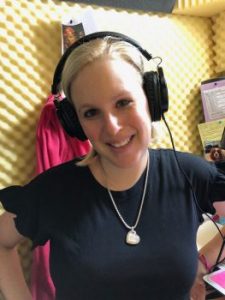 This week I had an unusual opportunity to have a zoom sessions with a few folks who do casting. I was on a zoom call with an extremely accomplished male voice actor based in Vancouver named Brent Miller. Brent and I get to spent about 45 minutes chatting with these folks about our background, experience, best clients, niche roles, and the kind of work we book. Here is a summary of what the Project Managers asked me and how I replied:
 I say this a lot: get a crockpot. It’s hard juggling a lot of balls, and if you still have household responsibilities and you have to work a full work day, it’s hard to do everything. Plan ahead as much as possible. I do weekly meal planning for all of our dinners. Another tip for working mom’s is to have patience. When I started I had all of these immediate goals for my
  Oprah. I have always loved Oprah. I actually came face to face with her once at the Jefferson Hotel in Washington, D.C. I was speechless. She looked amazing and said hello and I stood there mouth open and no words could come out. Nothing. Silence. But I have dreamt of speaking to her and collaborating with her and going to her school in Africa. I have dreamt of contributing in any way to one of her many amazing projects. I have fantasized about collaborating in numerous ways.
 Lastly, I want to broaden your thinking of what an audition is. Anytime you put yourself and your voice or samples in front of a client that is an audition opportunity! A phone call, and of course a cold call, gives a client a chance to hear you. A direct email to someone you have met with your demo likewise gives a client a chance to hear you. Meeting someone at a conference or a networking event and talking about why your service is different from that of other voice actors is an in-person audition: you have their undivided attention, they hear your voice, and you are speaking! An audition is not just a read with a script or a demo submitted. Always be prepared with you 30 second elevator shpiel and be proud of who you are and what you do. Sparkle!

