Nothing gets a group of Voice Actors More Excited…
It happens! Your brimming with joy! The very thing you’ve been waiting for has arrived: your sparkly new voice over  demo. In a lot of ways its up there in excitement with new jewelry and a new car. For professional voice talents, our voice over demos are our calling cards, and nothing gets us going like a new demo to fuss over. In my small inner circle, it happened just yesterday! One of my VO besties got a new commercial demo back from a well-known demo producer. She was so excited to share the demo with our group, and with good reason! The demo was clever. It did all that will be discussed below, and it was a joy to listen to. She sounded amazing, and we were really excited to ohhh and ahhh over it. So, what is it that makes a voice over demo stand out?
Voice Over Demos Are Aspirational
This is a voiceover actor’s chance to showcase your dream array of clients. Whether you are a newbie or an established professional, in a demo (vs. a reel of booked work), this is a voice talent’s chance to say “Hey, look what I can do for your brand.” It’s also your opportunity to show how versatile your voice is in terms of how many industries you can work in. Regardless of whether you choose current, hot, very new products, like the latest mobile app, or a trusted household stand-by that has been around for generations, this is your moment to show them what you’ve got. Particularly with commercial demos, but with other genres like narration too, your demo is the perfect place to lay the ground work for what you are working to build.
A Good Voice Over Demo Shows a Range
Those of us who have done multiple demos go from conversational to relatable to sympathetic to humorous all at the snap of a finger. These changes occur in a matter of seconds. We bring a read to life, flesh out the nuances, and just as the reader is connecting and feeling their heard strings or grinning a relatable grin, the spot is over and the next one is starting. Why is this important? Every second is precious. In a demo, we have very little time to convince the listener that we stand out from the crowd, and that they should work with us and not the last demo they listened to. Our ability to convey a range of emotion, tone, style, and pace in a short period of time is essential and a good demo does this.
Ideally Demos Are Short: 50-90 Seconds At Most
If you are lucky enough to have someone listen past your first 2 or 3 spots, just how long will they listen? You don’t know, but they do not want a two to three minute demo. Ideally your demo will be 50 to 60 seconds for a commercial demo. You want to create a demo that is so hot they want to listen over and over. You do NOT want to create something that is long and clunky so the listener never gets to the end. The vogue at the moment is that shorter is better. The only exception to this is in eLearning. Those videos are much longer because each excerpt is longer.
Video Demos Present Like Booked Work
Without doubt, video demos give voice over actors an advantage to others with audio only demos. Whether you are new or an established talent, this holds true. If you are new, a video demo gives you an instant body of work to market. If you are an established talent, a video demo both helps to draw your prospect in and enhances your existing body of work. Who among us, even those of us who have been working for years, does not still have dream clients? The video demo offers this aspirational piece to enhance your body of booked work.
Most Importantly, They Allow You to Market Yourself
At the end of the day, a solid demo is a marketing tool. It becomes another reason to connect. It is another great way to promote yourself. The voice over industry is more competitive than ever. The best way to make yourself stand out, is with a solid demo. Have you ever wondered why you can’t get onto certain rosters? Perhaps you have been trying to get an agent? Maybe you do lots of pay to play auditions, and never get anywhere? If any of this sounds familiar, the answer might be more basic than you think. Have all of these platforms/folks heard your demo? Going back to my VO group, one of my other VO besties says that a good commercial demo has the “bitch slap” factor. You listen and you are just blown away, it’s so awesome you want everyone to hear it. If you’re demo is not like that, you need a new demo!!
 The job of a
 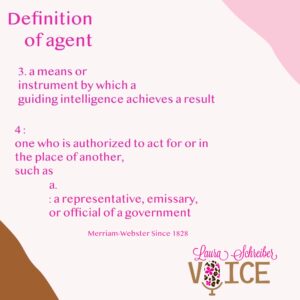 There are talent agents who cast voice actors all over the counts, and they, too, are outstanding for career and rates advice in voice over. A good agent not only secures industry leading rates, they also direct you reads and let you know when you are on the mark and when you need improvement. An agent has both business savvy and a good ear, so if you are lucky enough to be on their roster, work with them! Seek their guidance and build a rapport. You can learn so much for a good agent. Both you and the agent benefit from you learning as much as possible, so they would likely want to help as much as they can.
 I have blogged before about my accountability group, but I cannot stress enough how much this group has helped me daily to grow my business and make better choices. They have pushed me beyond boundaries I would have never thought to challenge, and they have made me look beyond. I am so much better because I am in the company of these women.
 You need a solid demo that represents both a range of your abilities and your understanding of the industry. My vocal range is from teen to middle age, and that is demonstrated in my eLearning demo, which goes from tech industries to pharma to medical. My demo switches gears from upbeat and engaging to serious and professional. My demo is set to music, which is controversial is often eLearning is dry. I wanted my demo to standout and by pleasant to listen to, and I believe it meets that goal.
 It has been a while since I was cast as a generic third person narrator in eLearning. Instead, for the last sic months, ever booking to land on my desk is a character role, where the instructional designer wants an authentic, genuine role that is believable for their training. For example, this week I was cast as a college student who had gone down the wrong path and had a drug problem and was now in recovery. I had to be sensitive and relatable. It had to be believable. I was telling this girl’s story in this university’s training scenario. Last week I was a caller in a pay roll company’s HR training. I was the good caller this time, but in the past I’ve been the bad caller. In both instances the character had to be believable, authentic, and sincere. As a female eLearning narrator, this is a big responsibility: to continue booking work for clients you have to be able to switch gears and maintain whatever character you are playing for them that day. The character must be consistent throughout and must have nuance.
 Rates are really important. My bookings typically range between $0.25/word and $0.45/word with a $150 minimum and $1 per split. I charge for splits if there are more than 10. I prefer to quote the price per word and not per finished minute as I speak quickly. Last week I had a potential client reach out and ask me if I was on Upwork. I told them I was not. They wanted to know if I would honor Upwork’s rates, and I explained that at this point in my career I could not work for those rates. I then referred the client to GVAA and Gravy for The Brain, in hopes of keeping the conversation going. They did come back to me that if they had flexibility they would let me know, but in the mean time it is important to be willing to walk away. The next day I had a job come in that was 617 words and paid of $400. It is important never to settle.
 Most typically, my eLearning clients want MP3s that are split and fully edited. I typically add EQ, compression, and a d-esser. If you are booking eLearning work for big companies, it is expected that you should have a professional grade studio at this point. Especially because they often do not have music or effects behind their training, the quality of the audio that you provide matters more than ever.


