
My Dreams Come True
 Having studio dogs is a luxury. As a working mom, I have blogged about this before, but I never knew if I would be able to have children. When I was 22 and I got my first Cavalier King Charles Spaniel of blessed memory, I was not sure if this fur baby would be my only child. While I have been blessed with human children too, they never changed the status of my dogs, who have meant the world to me. My dogs have been there for me and by my side on my best and worst days. For my greatest celebrations and for my worst sorrow. I believe that Barclay, Violet, and Daisy understand and connect with me in a unique and special way, and having them in my life is as much a dream come true as my professional voice over career is. I very much view having these precious fur babies by my side in my home studio as a luxury. Everything about my career, from my studio set up to being able to be present for my children is icing on the cake to being able to live the dream of life as a full-time voiceover actor. If you are thinking of getting a studio dog, I urge you to move forward without hesitation. If you are thinking about it, let me share the traits that have made my dogs ideal to be in the studio daily and give you some ideas of what traits work, what does not, and what to look for when having a voice over studio dog.
Violet
 Violet has always been a wonderful studio dog. Violet is a Blenheim cavalier King Charles Spaniel. Her temperament is calm, quiet, and she is eager to please. She rarely barks and sleeps a lot. Despite her angelic personality, there are several challenges to having this love muffing in the booth. When Violet sleeps, she often snores. Despite her tiny size of only 15 lbs, her snore sounds like a local train coming through town. The next challenge is that Violet, who was bred to be a lap dog, very much wants to sit on my lap. While she will sometimes settle down and snuggle with her sister, she will more often beg to be on my lap. Imagine that I am doing a long form narration or eLearning project and she is on my lab. If she exhales or shakes and her collar rattles, the mic will pic this up. While Violet is pretty close to being perfect, there are some hiccups sometimes and as human as she seems she still has no idea that I am doing actual work or that she can interrupt it.
Daisy
Daisy the Silver LabDaisy is a Labrador Retriever puppy. As a silver Lab, she is just precious. She is goofy and sweet and has a lot of energy. Let’s just say when she first came to the voice over booth, she had no idea it was a place of work. She literally tried to eat the aurelex acoustic foam off of the walls! Well, that could not go on. Outside the studio, Daisy had a number of behavior issues ranging from jumping to counter surfing to pulling while walking that also needed to be addressed. So, we sent her to the Monks of New Skete for some dog training. They taught Daisy to go to her place. It was amazing. After 17 days at the monastery, when she returned, she understood to lay by my feet quietly when given the command “place.” This was life changing and Daisy is now a wonderful and enjoyable companion in the studio.
When They are Not There
Regardless of how amazing Violet and Daisy are, I do not have the girls in the booth for live sessions. Whether I am doing a Source Connect of Zoom session, my feeling is that when clients are paying a premium for m services, the dos should not be there. Ever. I do a lot of commercial work and also have live sessions for video game work and sometimes even eLearning, and there is not a circumstance in which the dog’s behavior interfering with the audio would every be acceptable. In a business where there are a lot of people who do what we do, and we as talents are very replaceable, we need to be mindful of what is ideal for our clients and put their needs above all elese. Are there times I would prefer to have my pups in the booth? Of course there are, but it is more important to have clients return again and again.
So, if you are a voice actor and you are getting a pup, here are some things to keep in mind:
- You want a dog that is not a barker. They either are or they aren’t, and if they are that will never change.
- You want a dog who is not anxious. They need to be ok by themselves when you have live sessions. If you put them somewhere else in your house, whether it is a crate, a den, a gated kitchen, you need to be able to count on them to be quiet for the duration of your session.
- You want a dog who can stay calm and rest for upwards of an hour, even at a young age. As voice actors, it’s an endurance game. We are often in our studio for hours on end. You want a dog who can tolerate being indoors and does not demand walks or outdoor play on their schedule.
I am so thankful for my girls. I hope you find a studio dog to make your voiceover life complete!
 from the US and Canada. Our focus was on marketing, and even as a panel member, it really got my wheels turning. I could not help but think of the specificity of my recent outreach, especially in eLearning. I have worked so hard to build my business as an eLearning narrator, and I think in order to really reach prospects, you need to think about who you are working with. From the very beginning of the process through the completion of the booked work, understanding your audience is essential to success as a working female narrator in eLearning.
 Social media content, across platforms, needs to have the target audience in mind as well. This can be a bit trickier, as it is harder to control who sees your posts. You can, however, try to catch the eye of a specific group of clients or prospects by being clever about your target audience. If, for example, you are posing on Instagram and you want to reach out to instructional designers, both the content you use and the tags that you include in your post matters. Another way to grab your audience is to tag influencers and professionals in that field. Quote them. Have a conversation about them. If you want to work in eLearning, you need to be part of the dialogue.
 When you book an eLearning job, understanding the audience or the enduser is so important. For example, I was recently cast in a training for a local hospital: RWJ St. Barnabas, right here in NJ. It was a caller training. When I first read through the script, in my practice read, I sounded warm, gracious, and welcoming. I then re-read my roll: “Bad Caller.” I was the example of what not to do. Everything I just rehearsed had to be thrown out the window and the opposite read was needed. I was talking to the same people, but I was the example of what not to do, and I had to be the best “Bad Caller” they ever heard. Your job as an eLearning narrator is to make it obvious. They should not have had to figure out what was wrong with my phone skills, so I had to make every effort to clearly connect with the listener. Keeping the audience in mind should inform and transform every eLearning performance.
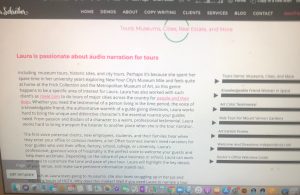 When I was in college, I used to joke that I would love to give tours but I couldn’t as I cannot walk backwards. Well, in the world of voice over, my ability to walk in any direction does not matter and I can guide and welcome people whether they are on site or doing a virtual visit. In the voice over industry, the path that we take typically follows a specific order, and that path often begins with a demo. For me, I have been booking work for tours for years, from city tours to museum tours, and somehow I’ve been doing it without a tour specific demo. I have now amassed quite a volume of this work, so now that I am clearly on this path, I have decided to do a tour specific demo. Perhaps its because I love the versatility of emotion and roles that one can play when giving tours, and the idea that you can be on-site, have a pre- visit, or a virtual visit, that makes professional voice over for tours so appealing.
 Now, in the click of our mouse, we can visit anywhere in the world! When planning a trip, these city tours are particularly valuable. Last year, I had an opportunity to work on one of the most valuable tour projects of my career! I booked a project with
  I’ll start out by saying that neither of my twins dream of becoming full time voice over actors like me. And though they do not share my dream, they support me in every way possible and are actually part of my small business team in integral ways this summer. In the past few weeks, one of my VO besties reached out and said that one of her regular clients needed 14-16 year old voices to do some eLearning narration, and my twins happen to be 16. So, they submitted demo reads. Again, it is not their life’s ambition, but in the summer of Covid-19 they realize that this is a great opportunity to learn and to do something that most kids never get a chance to do.
 Following multi-step directions is hard for many adults, and there are very specific directions unique to every voice over job. This booking was for sure an exercise in following multi-step directions for Jack. For Jack’s first booking:
 Maintaining a professional demeanor in the professional world is important. I remember meeting Michelle Sundholm’s sons Ashton and Everett at VO Atlanta in 2018.They were so polite and they were so composed. It is this exact behavior that I am talking about. For Jack, since his interaction was online, it meant several details. First, it meant performing his work in a timely manor. It meant taking pride in his performance and doing his best. It meant sending follow-ups and hand written thank you notes, both to the client and to the friend who referred the opportunity to him. Jack had to carry himself the way the rest of us do, and he took pride in doing so.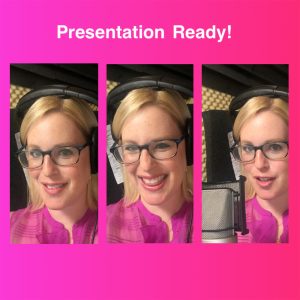
 Last fall, which seems like a lifetime ago given how much the world has changed during the current pandemic, I began researching upcoming eLearning conferences. I was actually hoping to find more conferences in my region. As a working mom with high school aged twins, flying across the country can sometimes be a challenge. I was overjoyed when I discovered the ICELW conference was to be held at Columbia University in the city of New York, my beloved alma mater. I submitted a proposal to speak about “Best Practices to Bring Your eLearning Module To Life” from the perspective that academics and HR people who never thought they would have to work with professional voice actors like me suddenly find themselves in the position to cast and work with voice talents as professional narrators for their eLearning modules and projects. I addressed questions that they should ask every time they have a project, VO tech and why it matters, and pricing for voiceover, including where it should be and what the price indicates. My presentation went nicely and it meant a lot to be a part of the dialogue. I am very excited, however, to share some of the larger takeaways from the more scholarly presentations during the conference as I reflect on how they will shape both my work, my voice over bookings, and client interactions as the
 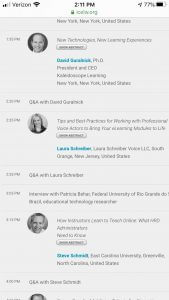 With an international audience and an enthusiastic crowd, there was a lot of discussion at the conference about how the advancing technology would enable content creators to re-imagine learning. David Guralnick from Kaleidoscope Learning and Columbia University talked about opportunities to use “technology to humanize learning” and went on to present a thrilling example combining AI and interactive technology. In this example, the student asked questions about Ancient Greece and the Acropolis and was able to create a scene where he was present in Ancient Greece having his questions answered. Particularly at a moment when students around the world are relying so heavily on on-line learning, this was thrilling and wonderful to see. The advantages of this were how realistic the scenario is and how clear the examples are. Clearly the new technology enables better communication of content. As a narrator, I have been working with more companies that create K-12 content in the last year, and I am sure such technology would be a huge asset to them.
 There were multiple sessions during the ICELW conference that addressed new technologies like AI, VR, and enhanced/mixed reality. I was riveted by these sessions as well. Someone brought up that when Steve Jobs designed the first iPod, he did not do a focus group, he just knew it would be a better device and he was creating the technology to drive a potential future experience. That is what a lot of the new experiential learning technology does. There is vast potential, the sky is the limit so to speak. Michelle Cortese, a VR Product Designer at Facebook and Professor at NYU gave a thrilling demonstration of work her students are doing. I was fascinated as a former educator, as a parent, and as a working creative. I could not help but see the intersection between technology and improv, something that so many of us in voice over spend so much of our time training in. The social behaviors that occur were fascinating, and unpredictable, and again as a working creative this made me think of improv which is not something that I typically connect to my eLearning work. Although, under further analysis, the point of studying improv, is that we are supposed to bring it with us into the booth so that our reads and takes on characters are fresh and exciting. What I found so fascinating about the sample that Michelle shared is that all of the content in the VR chat was user generated and is in the moment art. It is a vision and content that comes from the user. When so much of the learning content that we work with is contrived, this opens up a world of creative possibilities for end users. Fernando Salvetti also demonstrated work with enhanced/mixed reality and I was riveted. The possibilities that are simple and user friendly are true game changers. Having worked in eLearning for years, being exposed to such projects is eye opening.
 As in so many projects I am a part of, the bottom line matters. Dr. Tim Brock of the ROI Institute talked about creating a framework that balances needs and feasibility. The needs need to be defined at the beginning. This resonated with me a lot. Often voiceover is left off of the budget entirely, it’s an after thought. This was another area that I was addressing in my talk, the price of the voice over. When a company is looking at the ROI, the return on investment in the overall project, the voice over, and typically in eLearning we are talking about a narrator, needs to be a part of that calculation, from the start. As the technology continues to progress and is better and better, the voice over needs to be a part of the initial plan, not a lost minute add on. In Dr. Brock’s talk, he spoke of feasibility, and as the technology becomes more and more advanced, having an overall understanding for the get go of the feasibility certainly makes sense!
 I was so excited when this project came in. I was actually sitting at the Encore hotel and Casino in Las Vegas where I was staying right before WoVo Con 19 started when Brian, the producer called me. Both of my grandfathers served in the Pacific Campaign in World War II. I went to graduate school for History. My son is at present obsessed with World War II History. So, what could be more fun than voicing a project that would help draw high school students in and educate them about such an important period in time? The script was so well-written and Brian was so easy to work with, which always makes projects better! Being cast in this meant so much to me on so many levels.
 I always hate to overtly give away my age, but when I was a kid we did not have cable tv, we had the networks, PBS, and maybe two other channels. So, when they animation project came in for PBS, a channel I grew up glued to, as did my kids, my heart went all-aflutter! I think I was so enthusiastic both because it was PBS and because it addressed climate change, something I am so profoundly concerned about. It means a lot to me to
  have an opportunity to voice projects with an impact. I have also always loved taking my kids to museums too, so when I learned that this was tied in to the Chrysler Museum it was even better. In this animation, I used a kids voice. Like the WWII project, my goal was to draw kids in and keep them interested. As a working mom and a former educator, I feel like I bring all of this with my into the booth for these projects. When I have an opportunity like this, I am left feeling instilled with hope that change will come.
 As an American who grew up in a Philly suburb and resides in a New York suburb, I was cast by a London ad agency in a UK tampax spot for their UK tampax channel? How, you may ask? Well, my nephews have grown up in a posh sloan square neighborhood so I just had their little voices in my head when I auditioned and I guess that booked it! I cannot do a range of UK accents, I can specifically do central London as that is what I hear in my head. I can sometimes do slight cochney, but that’s it. Anyway, for this project we had a live session with a European creative team. It was not 10 minutes and done. I remember it going about 40 minutes, which is long for me. But the spot is cute and I am pleased with it. And since we all get out monthly visitor, we not have something that is relevant for girls and women, right? This was a fun one for sure!
 Well, who doesn’t love a good tv campaign? And when the hospital that you are voicing the campaign for is bought out by Cleveland Clinic, it gets even better! And when your Aunt and Uncle have a home in the viewing area? It feels like a home run! In truth, anytime I have an opportunity to work with clients on a repeat nature I am delighted, but I love doing campaigns because I enjoy the continuity. It is nice to have the project to look forward to, and I am always so sad when they end. I loved these spots and hope there are more down the line. I think these resonated with me so much because the real life stories they used were just so touching. Also, even though the hospital is based in Florida, the Alan, the producer, is a Jersey guy, and that just makes everything better.
 I may have been born in Philly, but I’ve been here 15 years and I’d say that’s long enough to call myself a Jersey girl- gel nails and supah blond hair and all! So, when an eLearning came my way that was all about training for hair products, let’s just say I didn’t have to act to sound upbeat and enthusiastic! I was so so excited to do this module for CosmoProf and Sally Beaty. From brushes to straighteners to curling irons, it’s like they had me in mind when they wrote the content!

