How Do you Know When You Are Ready?
So you’ve been working really hard to build your voice over career. You’ve been working with coaches, you’re on pay to plays, you’ve been doing some direct marketing, but now you feel that your moment has come! You want to make your bold move: it’s time for a voice over agent! But how do you get one? Well, before you begin your official outreach, it’s important to make sure you have positioned yourself for success. What does having an agent really mean? Having an agent really means access to increased opportunities, and you want to maximize this potential. Here are some key considerations when preparing to market ourself to an agent.
Demos Are Done…
You want to begin the agent outreach process once your commercial demo and any others that you are seeking representation for are complete. If you intend to work with an agent, and go after the more lucrative work, it is imperative to understand you cannot produce your demo on your own. Having top notch demos that compete and represent current industry trends is essential. Your demos should be ready to go before you begin marketing to agents.
Website is Up
Your website is your virtual storefront. It established your personal brand and why you are unique from other voice over actors. You should not start to market your self to voice over agents until your website is up. By “up” I mean fully operational. I do have a website planning guide under my “free resources,” but you need to make sure that you have downloadable demos and an easy to find contact page at the very least.
Source Connect is ALREADY SET UP
Most agents require you to have the PAID version of Source Connect in order to sign you. You might be thinking, oh, well, I’ll just tell them I have it and then when I book work I’ll add it. I strongly advise against this. When you get Source Connect, you have to have something done called getting your ports mapped. It is done through a service call on their end. You basically schedule the call, download software, give them remote access to your computer, and they map the ports to your router. It must be done from their end to your end, and it must be set up. Sometimes support appointments are harder to get than others, so it is really important to have Source Connect up and running. The other important detail is that once your ports are mapped, they are mapped to a specific location. So my ports are mapped to the iMac in my studio. If I were going out of town, and needed remote access, I would need to have my ports re-mapped to my MacBook Air. The other alternative is to rent studio space. Why does this matter? Reputable agents expect you to have Source Connect up and running so that if you book a gig with them they can schedule you anytime at the clients convenience.
What Should You Say?
It’s best to keep things short and sweet. Tell the agents who you are, why you are reaching out, and why you are qualified. Attach your VO Resume and appropriate demos. Give them your contact info. That’s it. You can follow up a week later to confirm they got it and then based on what they say decide how often to reply.
International Agents
While it is great to have regional representation, it is also extremely beneficial to have representation abroad as well. As they often need voices of all demographics and accents, it is in your best interest to reach out throughout Europe, Central America, South America, and Asia. The more opportunity you have, the more exposure you will benefit from.
Keeping In Touch
Sometimes agents are kind enough to reply and tell you that the do not have space on their roster at present but they may in the future. This is a great opportunity. This means there is something about you that they like enough to respond, but it is now your responsibility to check in without stalking them! So, you have to decide how often you will pursue this lead and when it is the right time. Such instances include when you have a stellar booking or a very strong month, if you are nominated or win an award, if your earnings start to rise drastically, and if you have been to a conference and met someone from their team. Any of these reasons are great time to circle back and see if anything at all has changed on their end, and to let them know in a fun and casual way about your great successes. The point is to maintain a relationship and keep the possibilities open.
Remember, in the end, there are no guarantees of success in VoiceOver. Having a VO agent does not need that you have made it. It just gives you access to great opportunities. The most direct and sure way to success in voice over is consistent hard work over an extended period of time.
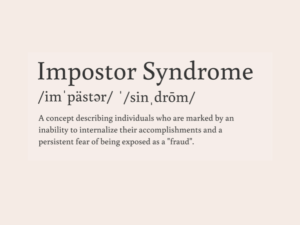
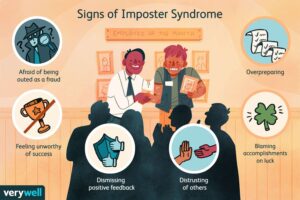 I’ve been a full time, professional voice over actor for quite a while now, but in the past year I started hearing for the first time a new term: imposter syndrome. I started hearing it on social media, on Clubhouse, and at conferences too. I found it surprising because in all my years in VO, I had never heard any other talents speak to this before. What I have learned is that this term refers to the feeling that one does not actually belong, or is not what they claim to be and is, instead, an imposter. Suddenly, in the past year, I am hearing about others feeling this way frequently. It is coming up often in conversation. Perhaps it is because many turned to voice over during covid. Perhaps it is because some start working or trying to work before they are actually prepared. For a multitude of reasons, suddenly I am hearing this all over the place. If you are interested in being a voice over actor, and you really want to succeed and do NOT want to feel like an imposter, perhaps consider my experience, as this has never been an issue for me.
 year, I worked with 4 coaches and took advanced acting and improv at a local theater. I spent sic to eight hours A DAY studying and working on my craft. I worked on scripts. I practiced characters. I recorded. I edited. I submitted to my coaches. I listened back to my assignments. I did research and followed prominent voice actors to see what they were booking. I took multiple private lessons each week. I was in group classes with GVAA. I had practice partners. I met with those partners. I did homework for those partners too and I took each and every assignment so seriously, as if my life depended on it. So when I say I had lots of training, that is just when I started out. Since then I have continued to have lots of coaching. Have coaching is the foundation of all we do. I think by the time my website launched, I was so ready to work that it never occurred to me that I was not prepared to serve my clients.
 Both as a student of voice over and now as a professional, I have always put in extremely long days. From morning to night, often going back into my booth after dinner, my days are long and rigorous. Sometimes new talents ask me when they will start booking. They tell me they have submitted 50 auditions. I try to keep a straight face. I typically submit more than 30 auditions in a day, even now, so 50 auditions is in no way impressive to me. I have often heard of the rule of 10. I believe that Gaby Nistico has even made a video about it. If you work 10 hours a day more than 10 months a year for 10 years that is when you start making six figures… Well, I believe there is something to this. I have always had the luxury of being in voice over “full-time.” Well, let’s flesh this out. What exactly does “full-time mean? To me, it means I maintain standard business hours and I am in my booth al day every day to serve my clients. The more you are available and the more you record and submit, the more legitimate your business is.
 When my business launched, in audition to lots of coaching and sweat equity under my belt, my first website helped establish my identity. I never had doubts about my identity as a professional. I had been told by every coach I ever worked with that even at the start of my career, I should introduce myself as a professional. I did so with confidence. As I get clients under my belt and had testimonials, I felt more proud of what I was building, but it never came from a place of doubt. I was certain that I was building a great service business that would help my clients get what they need.
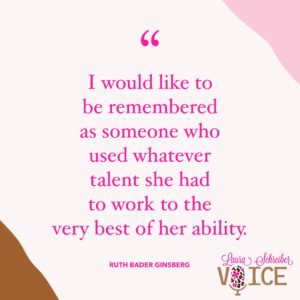
 In the past year, we lost Ruth Bader Ginsberg, feminist icon. Her story is nothing short of amazing. For any working mom, Justice Ginsberg is the quintessential role model in many ways. When institutions like Harvard tried to place road blocks before her, she simply pivoted and found another way by moving to Columbia. When Ginsburg could not get hired by the large New York City law firms because they simply did not hire women at the time she was working, she forged he own path in the public domain, a path the was paved with so much success it led her to the United States Supreme Court where for decades she was the voice of liberal change. Justice Ginsberg’s example serves as a role model for so many working women in so many fields. Her determination was limitless. She continually found a path toward success. Achievement knew no limitations. Her focus on her end goals is a model for us all. To succeed as a professional female voice over actor, the same fierce determination is vital to build something from nothing. We are constantly thrown curve balls and challenges, and it is the ability of those of us to look beyond these challenges and maintain focus that separates successful voice actors who persevere in an extremely competitive field from those who dabble for a time.
 Voiceover life is often described as feast or famine. Sometimes I say my months come in like a lamb and go out like a lion. It takes real determination to push through these ups and downs. You have to be dedicated to the long road, and understand that a voice over career can much more accurately be compared to a marathon than a sprint. When the voice over gods shine down on you, it is the best feeling in the world. But we all go through times when the work just is not abundant, and we have to continue to submit auditions and work on our craft with the confidence that in an hour or in a day the tide can turn and the work will start pouring in.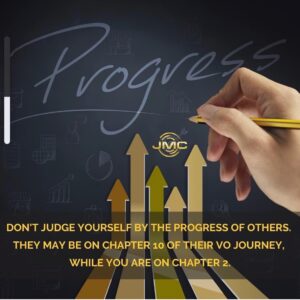
 In life, there are plenty of people with talent who abandon their goals. Why? They simply lack the determination to reach them. If you haven’t heard this yet, I will say it again here, in voice over it is not about the voice. A good voice will only get you so far. A voice over career, which is really what you want, is about fierce determination to succeed. It’s about knowing how to build industry connections and running your small business. It’s about maintaining your skills. And it’s about solid marking with a focus on your goals. If you want to succeed in voice over, you need to be committed to working hard!
 For me, my journey started in the mid-1990s. I was a student at Columbia University in New York City. I was studying political science. My younger sister Julie also went to school at Columbia, and we went out to eat off campus often. If you know anything about New York, you know that lots of waiters and waitresses are also actors who have to pay the bills. Well my sister and I have always sounded young, but when we were young we really sounded young. We also had a habit of speaking in unison and saying the same thing at the same time. It became a pattern that we would got to places like Ocean Grill or Isabella’s and every single time our server would comment on our voices. It wouldn’t just happen there, it would happen at Bergdorf’s or wherever we shopped. It even happened in taxi cabs. Often the follow up to asking if we are twins, and we are not, is that we should be in voice over.
 I remember the day clearly. It was winter during my sophomore year and I went to the famous Drama Book Shop in Times Square to research how to become a voice over actor. One of the perks of being a student in NYC is that all of this was right at my fingertips. I was able to learn so much just be talking to the people who worked at the book shop, and I left with some books and a copy of Variety in hand. What I quickly discovered was that while I was in the right city to pursue voice over, at that time everything happened in person. I would have to take my tape cassettes around, show up in person for auditions, and actually go to studios for gigs. Being a student at Columbia and doing VO seemed mutually exclusive at that moment. My studies were intense and they were my primary concern, so voice over was put on the back burner.
 My chat with Marie gave me the impetus to get started in voice over. I began researching coaches, writing a business plan, and researching how to build a studio. In the coming months, I started to lay the foundations for my VO business. I began working with Anne Ganguzza, my first coach. I started planning for my VO website, and I started having my studio built. I also had tech training to learn how to record and edit. I also began taking advanced acting and improv classes at Papermill Playhouse, our local theater. Over the years I have worked with many coaches, many of the best in the industry. I continue to push and hone my skills, update my demos, attend conferences, and build. A voice over career does not happen over night. I am so thankful for the work that I have had, and I have big dreams for what is to come!
 A professional talent has an abundance of testimonials. Period. They should have them proudly displayed on their website, on LinkedIn, on whatever Pay to Plays they are on, and likely they share them on social media. Testimonials are not difficult to get. Happy clients who have just received pristine audio are typically delighted to provide them. My very first voice coach, Anne Ganguzza, told me how important it was to get testimonials! She asked for one from me about our work and gave me my very fist one. A voice actor without testimonials is likely not a professional voiceover actor.


