Why Voice Actors Need a Policy for Pickups and Revisions
As a full-time, professional voice actor, I love working with repeat clients. I love delivering finished audio I can be proud of, and over the years I’ve come up with a few strategies to reduce the number of pickups I have to do. It is important to understand the difference between pickups and revisions, and how live sessions come into play.
Just What is a Pickup
A pickup implies that you, the voice over talent, have made an error, and typically any and all performance errors are covered by the actor regardless of the size of the job’s budget. This could mean that you misread the script, it could mean that there is an odd noise in the recording and it is obscuring your work, or it could be a performance error. Perhaps you were meant to sound calm and relaxed and the client feels you give off an agitated vibe. Any of this constitutes a pickup. When I book a job, I do ask clients to give me the courtesy of asking for pickups and deliveries within 48 hours of when I give them the finished audio. Most do. Some don’t. How flexible you want to be is up to you, and makes a difference in how you feel about your relationship with the client.
What is a Revision
A revision is different than a pickup. A revision implies that the client has changed the script. Typically this means that they got your VoiceOver audio back, reviewed it, and then decided to make tweaks. For me, for jobs over $250, I include one round of minor revisions which I define as less than 20% of the script within 48 hours of delivery. If it is after 48 hours or more than 20% I charge $75 per 30-minute revision session. If the revisions are more than 40 percent of the script I adjust the rate. If the script starts to look more than 3/4 different and it is a long narration, then it becomes a new job, and negotiations begin. This is not common. In all my years as a VO talent and coach, the two times this has happened, the clients were upfront about the revisions and offered me a new rate before I even had to start worrying. If you are noticing, they are noticing. In terms of the turnaround with revisions, again, you have to decide what you can live with. For example, I work with some eLearning companies that take quite a while to review their work. For me, this is not a problem and I am happy to wait.
Throwing a Live Session into the Mix
So you have a session for Source Connect, Zoom, or Skype. Wonderful. What should your pickup policy be? Audio from a live session is always final delivery. Period. The session should not end until the clients have what they need. This is the industry standard. If the client comes back after a life session and wants a re-record, you are entitled to a fee for an entirely new booking. Basically, you have made yourself available to however many people from their team are on the call, from the producer, to the creative director, to the folks from the brand. They have plenty of time to give direction, chat, and get all that they need from you. You are not in any hurry. If, after the spot is produced, they decide to take the work in a different direction, that’s fine. They can pay you for another session.
Tips to Avoid Pickups and Revisions
In the end, here are some tips I have come up with that leave me having to do very little pickups.
- On jobs under three and a half or four minutes, I deliver at least two takes. If a client has options, they are less likely to come back to you wanting more.
- I deliver wilds of the end. If there is a talk line, give them lots of options of the end as you would in a live session.
- If there is something that may have an unusual or unexpected pronunciation, either try to call the company and hear how they say it, or fine it on YouTube and avoid having to do the retake for that. If you can’t find it, give them wilds of the word or sentence with different pronunciations.
- Try to review your audio several times before you submit it. If you are new to VoiceOver, this is a reminder that you need to do your editing for correctness to script before adding EQ/Compression/Effect stack.
- If you have a long narration, I actually edit page by page. I go through each page twice before moving on to the next one. I catch my errors and it gives my voice a break.
Ultimately Why Pickups and Revision Policies Matter
In the end, we want our clients to have a great experience working with us. We want them to come back to us over and over again. If we lay out our policies clearly, and there is no room for ambiguities, communication should be seamless. Expectations should be clear. Relationships are built on trust, and when policies are consistent, because there is, in fact, an actual policy, it is much easier for a client to understand what they are being charged for and why.

 Having studio dogs is a luxury. As a working mom, I have blogged about this before, but I never knew if I would be able to have children. When I was 22 and I got my first Cavalier King Charles Spaniel of blessed memory, I was not sure if this fur baby would be my only child. While I have been blessed with human children too, they never changed the status of my dogs, who have meant the world to me. My dogs have been there for me and by my side on my best and worst days. For my greatest celebrations and for my worst sorrow. I believe that Barclay, Violet, and Daisy understand and connect with me in a unique and special way, and having them in my life is as much a dream come true as my professional voice over career is. I very much view having these precious fur babies by my side in my home studio as a luxury. Everything about my career, from my studio set up to being able to be present for my children is icing on the cake to being able to live the dream of life as a full-time voiceover actor. If you are thinking of getting a studio dog, I urge you to move forward without hesitation. If you are thinking about it, let me share the traits that have made my dogs ideal to be in the studio daily and give you some
 Violet has always been a wonderful studio dog. Violet is a Blenheim cavalier King Charles Spaniel. Her temperament is calm, quiet, and she is eager to please. She rarely barks and sleeps a lot. Despite her angelic personality, there are several challenges to having this love muffing in the booth. When Violet sleeps, she often snores. Despite her tiny size of only 15 lbs, her snore sounds like a local train coming through town. The next challenge is that Violet, who was bred to be a lap dog, very much wants to sit on my lap. While she will sometimes settle down and snuggle with her sister, she will more often beg to be on my lap. Imagine that I am doing a long form narration or eLearning project and she is on my lab. If she exhales or shakes and her collar rattles, the mic will pic this up. While Violet is pretty close to being perfect, there are some hiccups sometimes and as human as she seems she still has no idea that I am doing actual work or that she can interrupt it.
 I also recommend having practical hooks in your book. I have a hook for my cans and a hook for my wires. It helps keep things neat and organized.
 I also do love having Source Connect. So many clients and agents require it. I occasionally need to have support sessions, and they do offer great support from Source Connect. Again, like with Zancastr, there are no latency issues. There are, though, sometimes quirks connecting. Sometimes people are confused with how to use it. If you are not both connecting with the same sample rate, for example, you won’t connect smoothly and it will be an issue, so that all needs to be decided ahead of time.
 I wish I know how important a good travel rig is. It took me five years to get my travel rig to sound as good as my home set up. That is WAY too long. If you are just starting in voice over during the pandemic, I realize it is hard to imagine actually packing up and leaving home, but when we do, the rig matters.
 commercial campaign, getting signed by an agent, and seeing an old friend. Why is a new demo so exciting? A voice over demo means opportunity. It is a new moment for us to say here I am, listen to this. This is what I can do for you! As a full-time, professional voice over talent, there are plenty of other female voice over actors booking lots of commercials. How do I make myself get noticed? The demo. So who you do your demo with, the coach and producer you choose to spend your time and money with matters, a lot. I have worked with some of the top coaches in the field, and I can tell you that I have had outstanding experiences and I have had experiences hat should have been better. Now that I am work as a
  that show both your range and are appropriate for your brand. If you have dream VO clients, this is the time to include those scripts. So for example, if you are doing an automotive demos, and you love Audi, you would include an Audi script. If you are doing a commercial demo and you love shopping at target, why not include a target spot? The scripts should not simply descend from above on demo day, be handed to you, and recorded. They should be meaningful to you and they should show both your range and what matters to you. They can be an interesting glimpse into your interests too! So, it is very important that you can easily talk to your
  This is really important. Demo producers typically send you their preferred order, but at the end of the day the demo is yours to live with and their preferred order matters less than your preferred order. I personally have had demo producers make changes without any fuss, and I worked with others who refuse to make any changes at all and insist that it must stay the way it is.

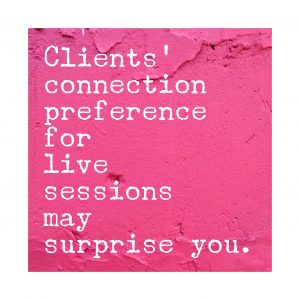 In 2020 live sessions have been more important than ever. Sure some clients still want us to self direct, but as no one or barely anyone) is recording in person, the live session is more important than ever. What surprises me is that I would have guessed that every client would want the quality offered by Source Connect. This is not the case. Surprisingly, I am asked for zoom and given phone patch dial-ins more often than I am asked to use Source Connect. As a professional voice actor, most live sessions are for commercials, but I have done a few for eLearning clients recently. Interestingly, it has been so long that I have been asked for ISDN that I gave up my direct bridge through ipDTL as no one seemed to want that anymore. So, despite the quality that some connections offer, clients seem to like what is easy for them and what they are comfortable with.
 Rates have been all over the place in 2020. I have had to turn down more jobs in 2020 than in the past 5 years combined. This may be because I am being found more, or it is because more people who never cast a voice talent are now casting and are not familiar with industry standard rates, or budgets are changing. As a working voice over professional, it is one thing to be flexible and have a range of acceptable rates, and it is another issue entirely to compromise one’s worth to pick up a new client. I have found that the biggest area that clients lack understanding in is usage for social media. They do not understand the difference between organic usage and paid placement, and they do not understand that usage across multiple platforms matters. My hope is that if voice talents continue to work together to educate clients this will shift in coming years.
 The specs are changing and the buzz words that we are asked for have changed. When I started the millennial conversational read was the go to read. Now it seems that, for commercial voice overs, the authentic, natural read is what is wanted. A real person who sounds believable is the go to read. Interestingly, I think there has been a backlash from millennials who do not like or enjoy a lot of the characteristics that have been assigned to their generation, and the shift that we see is a direct response to that.
 For those of us professional talents who are putting in the hours of work every single day, I am pleased and grateful for the abundance of work in 2020. Initially when the pandemic hit my business slowed in March and I panicked that everything would change. By April it seemed to bounce back and castings had picked up again. According to industry friends who are as established as I am or have been in the industry longer, this is the best year they have had yet. I realize it is Thanksgiving weekend, but I typically have an attitude of gratitude all year, whenever the bookings gods shine down on me. I realize that my clients have a choice and I am thankful when the choice goes my way, and this year it has happened more than last year. When so many businesses are struggling, in our industry and around the country, this is truly something to celebrate.
 My direct bookings, bookings where clients come straight to me, are triple my pay to play bookings in 2020 and up 14% from 2019. I am really pleased with this. These direct bookings are a combination of clients that find my website, rosters that I am on because I found them, or repeat clients who were initially from a pay to play but not they continue to come back to me. I also have direct bookings from social media, including instagram and LinkedIn. The number of direct bookings being so high means that I am not dependent on pay to plays to survive. Instead, I use the pat to plays to add to my client pool. I am extremely thankful for all of the direct bookings.

