Starting Out
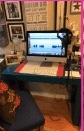
Often when we start out in a new industry, as excited and enthusiastic as we are, we don’t know if our business will actually take off. When I built my voice over business, it made sense to me to invest money where it mattered, in sound proofing and in gear like microphones, in lieu of spending it on items like desks and fancy chairs. I knew, even at the start, that if I had a hope of growing, my audio quality had to be competitive and my investment had to go there. My initial dest was cute and inexpensive, it was a teal small desk from overstock.com. This is the desk that sat outside my booth. It sufficed. It was never comfortable. It was small and quickly became cluttered. I also have always used a chair I already had in the house. As my business grew, I added a file cabinets. The chair I have always used is a lovely chair that we had. Again, the office space was not my priority.
Well, here I am, years later, an established professional female voice actor and coach, and I wanted to re-create my office space into a place I actually wanted to be. I identified the problems:
- My desk was too small.
- I did not have enough space and had clutter on my desk.
- I did not like being at my desk.
- My desk was not visually appealing.
- I did not like the way the desk faced but could not change that because I have a monitor and gear in the booth the all is hooked up to the computer outside the booth on this desk.
- I actually prefer working on a super comfy chair or sofa to working at a desk.
- I like something soft under my feet.
With all of this in mind, I began researching my office space fix up.
Guiding Questions:
If you are just new to voiceover and putting your space together or if you are fixing up your space, here are some questions to consider:
- Are you paperless or do you have paper?
- Do you like a lot of Gear?
- Do you like Texture/To be Cozy?
- Are you a minimalist or do you like decorative embellishments?
Tips:
While it was smart that I was budget conscious, I should have invested a little more into my initial space. Think about what you have and where you are going to put it, instead of buying a desk and trying to make it work.
For example, when I built my booth, I placed hooks in spaces where I needed them: on the wall for my cans and under the desk for spare wires. I built an extra ledge so that my preamp is not sitting on the desk. All of this not only customizes the space, but makes it so much more pleasant to spend long hours in.
Another tip is to actually measure. When I bought new furniture this time around, I measured the items I needed to put in a bookshelf to ensure ample space. I measured the wall where the desk is to make sure I have the biggest possible space.
Comfortable Work Space

As professional voice over actors, it is typical that we work long days across multiple time zones, so our work space, both in and out of the booth, needs to be comfortable. I have friends who swear by their standing pads. I myself have layered carpets because I love both the look and the feel. Another tip is that the desk in my booth is at my exact standing height, built for me specifically. I love this. I will say that having had both a small and cramped desk and a large and luxurious desk, it is much better to have the large desk!! I am exceedingly more comfortable.
Booth/Workspace Must Haves
There are certain items I consider non-negotiable. Keep in mind that I do actually use paper:
- great lighting/an awesome dest lamp
- bulletin boards
- an essential oil diffuser
- file cabinets. I happen to love to save scripts. Especially now that I coach, you just never know when you will need them.
- A charging station
- an array of vocal sprays
- cable ties
- A blotter/pencil cup that is in line with your branding
- an “in session” or “do not disturb” sign for when you’re recording
- A music stand and light for scripts
- family pictures so that you remember your why
- lots of outlets
- an exhaust fan
- dog beds for my studio dogs
- a scale for mail/postage
So, What Did I Choose?
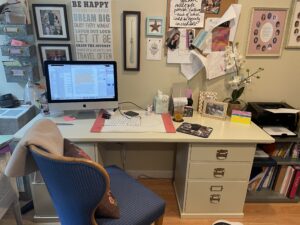
In the end, I wanted a place I would be comfortable and organized. I wanted an office space that would both look nice and function well. I ultimately made tweaks to both my booth and my work space. In my booth, I got a new rug and dog bed. In my office space I got a new desk and files, a new book case, and a beautiful new velvet chair and end table. I am elated, is all wonderful. My advice to you is that regardless of your budget, make sure you LOVE everything you pick, because if you have to re-do it it costs more.
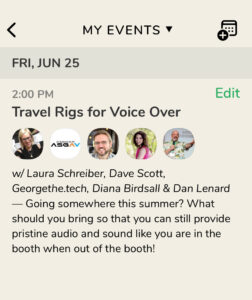 Every Friday at 2 PM Diana Birdsall and I co-host a Clubhouse in our room “Ask the VO Coaches.” I am always excited about our awesome panels, and every week I might say it’s “the best one ever,” but holy smokes was this an awesome panel! This week, just in time for your summer get-away, we talked about travel rigs and what gear you need and what you don’t need to bring with you on that much needed trip. Whether you’re going to the beach, to the mountains, or just to see family you missed during covid, we talked about it all, and we talked about it with some of the best in the field! We had George- the-tech Whittam, Dan Leonard, Dave Scott, and Rick Wasserman. So, here’s a review of some of what we chatted about in case you missed our beyond awesome chat!
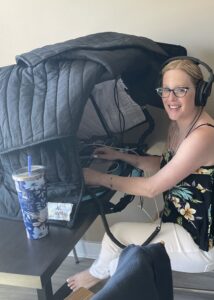 My Rig
 I also recommend having practical hooks in your book. I have a hook for my cans and a hook for my wires. It helps keep things neat and organized.
 I also do love having Source Connect. So many clients and agents require it. I occasionally need to have support sessions, and they do offer great support from Source Connect. Again, like with Zancastr, there are no latency issues. There are, though, sometimes quirks connecting. Sometimes people are confused with how to use it. If you are not both connecting with the same sample rate, for example, you won’t connect smoothly and it will be an issue, so that all needs to be decided ahead of time.
 I wish I know how important a good travel rig is. It took me five years to get my travel rig to sound as good as my home set up. That is WAY too long. If you are just starting in voice over during the pandemic, I realize it is hard to imagine actually packing up and leaving home, but when we do, the rig matters.
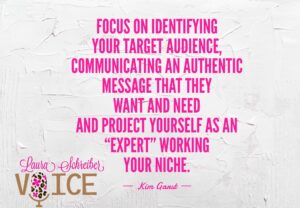 from the US and Canada. Our focus was on marketing, and even as a panel member, it really got my wheels turning. I could not help but think of the specificity of my recent outreach, especially in eLearning. I have worked so hard to build my business as an eLearning narrator, and I think in order to really reach prospects, you need to think about who you are working with. From the very beginning of the process through the completion of the booked work, understanding your audience is essential to success as a working female narrator in eLearning.
 Social media content, across platforms, needs to have the target audience in mind as well. This can be a bit trickier, as it is harder to control who sees your posts. You can, however, try to catch the eye of a specific group of clients or prospects by being clever about your target audience. If, for example, you are posing on Instagram and you want to reach out to instructional designers, both the content you use and the tags that you include in your post matters. Another way to grab your audience is to tag influencers and professionals in that field. Quote them. Have a conversation about them. If you want to work in eLearning, you need to be part of the dialogue.
 When you book an eLearning job, understanding the audience or the enduser is so important. For example, I was recently cast in a training for a local hospital: RWJ St. Barnabas, right here in NJ. It was a caller training. When I first read through the script, in my practice read, I sounded warm, gracious, and welcoming. I then re-read my roll: “Bad Caller.” I was the example of what not to do. Everything I just rehearsed had to be thrown out the window and the opposite read was needed. I was talking to the same people, but I was the example of what not to do, and I had to be the best “Bad Caller” they ever heard. Your job as an eLearning narrator is to make it obvious. They should not have had to figure out what was wrong with my phone skills, so I had to make every effort to clearly connect with the listener. Keeping the audience in mind should inform and transform every eLearning performance.

