A Lot of eLearning Trends In 2020
Whether it’s because of the Covid 19 Pandemic or the industry just continues to boom, there is more eLearning work than ever! The demand for female voice over roles is continual, and as a full-time professional voice actor, every time an eLearning job arrives in my inbox I am delighted. I have always loved working with the instructional designers and project managers to bring their content to life. Before I became a voice actor, I was a teacher, so perhaps that it was I feel so at home with this genre. At the moment, there is a huge amount of eLearning content and based on the work coming in I have noticed a lot of trends in the type of work being sought, rates, tech needs, and what books the work. If you are looking to expand your eLearning bookings or to work more in this genre, these are questions you should be asking:
What gets your foot in the door with eLearning content creators?
 You need a solid demo that represents both a range of your abilities and your understanding of the industry. My vocal range is from teen to middle age, and that is demonstrated in my eLearning demo, which goes from tech industries to pharma to medical. My demo switches gears from upbeat and engaging to serious and professional. My demo is set to music, which is controversial is often eLearning is dry. I wanted my demo to standout and by pleasant to listen to, and I believe it meets that goal.
What are you typically asked for when cast in an eLearning role?
 It has been a while since I was cast as a generic third person narrator in eLearning. Instead, for the last sic months, ever booking to land on my desk is a character role, where the instructional designer wants an authentic, genuine role that is believable for their training. For example, this week I was cast as a college student who had gone down the wrong path and had a drug problem and was now in recovery. I had to be sensitive and relatable. It had to be believable. I was telling this girl’s story in this university’s training scenario. Last week I was a caller in a pay roll company’s HR training. I was the good caller this time, but in the past I’ve been the bad caller. In both instances the character had to be believable, authentic, and sincere. As a female eLearning narrator, this is a big responsibility: to continue booking work for clients you have to be able to switch gears and maintain whatever character you are playing for them that day. The character must be consistent throughout and must have nuance.
What Rates are you booking at?
 Rates are really important. My bookings typically range between $0.25/word and $0.45/word with a $150 minimum and $1 per split. I charge for splits if there are more than 10. I prefer to quote the price per word and not per finished minute as I speak quickly. Last week I had a potential client reach out and ask me if I was on Upwork. I told them I was not. They wanted to know if I would honor Upwork’s rates, and I explained that at this point in my career I could not work for those rates. I then referred the client to GVAA and Gravy for The Brain, in hopes of keeping the conversation going. They did come back to me that if they had flexibility they would let me know, but in the mean time it is important to be willing to walk away. The next day I had a job come in that was 617 words and paid of $400. It is important never to settle.
What technological requests do you get from clients?
 Most typically, my eLearning clients want MP3s that are split and fully edited. I typically add EQ, compression, and a d-esser. If you are booking eLearning work for big companies, it is expected that you should have a professional grade studio at this point. Especially because they often do not have music or effects behind their training, the quality of the audio that you provide matters more than ever.
Final Thoughts:
There is a lot of eLearning work for voice actors at the moment. If you intend to be booking it, you need to have great sound and be able to maintain a character consistently for the duration of the script. Your demo gets you in the door, but if you can’t sound as good as that on every single job, then you are not ready to work.
 For the first time in my five years as a full time voice over actor I mis-quoted a client. In truth, I was extremely tense about the election results so if I did not make a mistake here I could have made one some where else. A new client found me on LinkedIn for a toy project. I have a tight NDA, but I can say that it’s a toy and right away my voice seemed like the perfect fit for this project.
 When the client had their final script, they emailed me an NDA and a contract. Then they emailed me the finalized script which was again an excel spreadsheet. In the email they confirmed the initial rate. To my horror, I realized immediately that I had under-quoted the client significantly. The script was not 4 lines, It was 154 lines. Further, they needed the files split which was also not included in the initial bid. My heart sank. I never want to disappoint a client or to make their job harder. I genuinely thought the job was the first four lines. I am not clear whether or not the client was also questioning if the bid covered the full scope of the project by the way their email was written, but I still had to re-quote. With all the work I had, I would be spending a good deal of time on this and could not do the job for the rate I had initially quoted. I felt, though, like a buffoon.
 Immediately I messaged my accountability group with whom I speak to all the time, every day. I trust these women more than anyone to lead me in the right direction. When they did not respond within minutes, I called them. Two of them were actually together at that moment, and they helped me draft a thoughtful and sincere email to address my error and revise the quote. It began with “I do apologize but…” I felt awful about doing it but I also could not live with myself if I did not. Interestingly, it was the opinion of two of the others in the group that the error was mine and I should do the job at the lower rate. They pointed out that I risked both losing the client and that if this client knows other clients I risked tarnishing my reputation. I weighed my options and sent the email with the revised quote.
 The client was not pleased when she got the email with the revised quote she had to go back to both her team and to the clients for approval. The next day I heard that they were ready to move forward. I ended up having to call the client. When I downloaded the excel spreadsheet, I had some formatting issues as a Mac user. I called the client and they were extremely helpful. It was actually great to speak with them and have yet another opportunity to apologize and let them know that I genuinely did not intend to make things difficult for them. Our chat went very well and I am extremely thankful to have laid what I hope is the foundation of a good working relationship.
 On Thursday I got the email that a professional voice over actor never wants to get from an agent. One of my most attentive agents took the time to email me that something was wonky with my audio. She said it sounded off, and in addition she could hear clicks and plosives that she could not normally hear. This is odd because I used isotope RX7 in my effects stack, so that never happens. She also said that my “Fs” did not sound like they usually do. While I was profoundly thankful for the feedback, my heart sank. In voice over, we are only as good as we sound, and I had recently made a ton of studio upgrades. So my mind was racing. When did these issues start? What had I submitted that sounded this way? I knew I had to fix it, and fast. I had a live commercial session the next morning with a producer I work with regularly but the client was new, and this had to be fixed prior to the session. I only had a few hours and the clock was ticking.
 I immediately reached out to Tim Tippets, aka the
  Tim and I had a zoom session. I gave Tim control of my computer. Tim right away determined I was having a UAD software issue with my Apollo MK II Thunderbolt preamp. Somehow, at some point, I had checked a box that for my settings should never be checked. In this case, it is the preamp box. Once that box was checked, it changed all of the settings, the gain, the input, basically all the levels were completely different. We quickly realized that the baseline for the Manley Voxbox that I use was not saved on my iMac. Rather, it was still on my MacBook Air that I had used before my recent upgrade. So, I needed to send it to my new computer. Tim was amazing. He was patient and confident and in very little time he had my preamp settings restored. Further, he made sure that I was now able to restore them on my own in the future. He also took the time to tell me how to do audio play back in zoom to make my live sessions with clients better.
 Put simply, in voice over, we are only as good as we sound. If we want our base of clients to keep coming back, we must offer nothing less than consistently pristine audio. If my agent could hear sibilance and plosive, then it is likely it was heard in auditions and work submitted around that time as well. Part of being a professional working voice actor means having broadcast ready audio, and broadcast ready audio is perfect. Broadcast
  I have been blessed to have three precious dogs in my life, and each of them has brought me immeasurable joy. I had no idea, however, that when we got our Labrador Retriever Daisy, in addition to being super sweet and super smart, she would also be super challenging to walk without the right training. A neighbor with two Great Dane pups introduced me to the dog training books by the Monks of New Skete, who have been training dogs since the 1970s. We made the choice to send Daisy for a board and stay training program, and I learned from the brothers that there were a few keys essential to Daisy’s success. We needed to be consistent with her obedience every day and maintain her routine. She would need structured daily exercise. We needed to plan everything- even her walks, to set her up for success. As a small business owner, I realized that in voice over all the lessons that would lead to success for Daisy also hold true to maintaining a successful professional voiceover career.
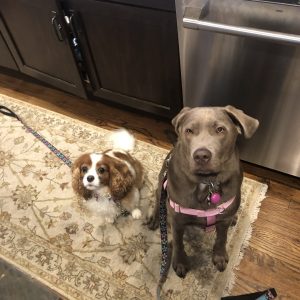 Now back from New Skete, every day Daisy has to run through her exercises, from leave it and heal to place. Similarly, working on my craft is essential every day. From warm up exercises to practicing cold reading, this is part of my daily routine. I recently reflected on this in my blog about the class that I am taking with Kim Handysides, but in order to stay strong in the reads that I submit both as auditions and as booked work, this daily work is essential to my success.
 Just as Daisy needs her purposeful walk, I need a certain amount of daily exercise to stay in shape for voice over, I walk four to five miles a day. I do pilates three times a week. All of that is in addition to my vocal warm ups. When your body is your instrument, you have to maintain your instrument every single day.
 In the same way that communicating well with Daisy strengthens our family bonds, doing all of the above plus communicating well with clients strengthens our connections with them. As they can rely on our work being consistently good and being there when they need it, they will be able to trust us for their clients, and in the end that trust is what matters most. As a professional talent, a new booking is great, but when that new booking comes back, it’s almost as good as when Daisy comes galloping towards me.
 I happened to marry a huge Bill Murray fan, and from Quick Change to Groundhog Day, I think I’ve seen all of his top hits, but Groundhog Day is my favorite. As a working mom, having a system to maintain efficiency is really important but unfortunately that same system often makes every single day feel the same. I go into my booth and warm up. I do my most pressing auditions first. Next I tend to all
  It’s important to pick the right coaches and I’ve been blessed to work with many excellent ones in the years that I’ve been in voice over. Sometimes you want private lessons and sometimes group classes can meet your training needs. Right now I wanted to shake things up. Kim Handysides and her daughter Lisa Suliteanu book a lot of work. They understand what is au courant and have created a curriculum across genres to target bookable reads. Kim has been an industry leader for 30 plus years and her talented daughter Lisa has been working steadily since she was 7 years old and has been full-time since finishing university. In case you’re wondering what the vibe of their class is like, it is upbeat, inspirational, clever, and fun. With so many coaches in the industry at the moment, this class is designed to put voice actors on the path to success and enrolling was a great step for me, even so many years into my career!
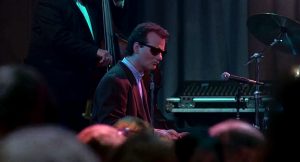 In Groundhog Day, we see Phill Conners taking piano lessons and becoming an amazing pianist. This did not happen over night. It took lots and lots of practice. Right now in The Voice Over Study, we work on different scripts and then can use those tools to go back and really work on a script. The more we learn to unravel it, the better our reads become. For me, having fresh feedback on my reads is helpful. It is also just as helpful to pay attention to the reads of the other voice actors in the class, listen to how they approach the scripts, and think about the feedback that they are given. I try to incorporate this approach into both my auditions and my booked work and bring some freshness to it all.
 In Groundhog Day, we see Phil’s relationship with others in the town blossom and develop throughout the film as he gets to relive each day. For me, having an opportunity to meet other voice over actors is really valuable. The other talents in the class are from different parts of the United States and Canada. We are at different points in our careers and we all aspire to focus on different genres of voice over. Still, I think knowing other voice actors is essential to our success, and I am so thankful to be getting to know the other actors in this class as we all learn together.
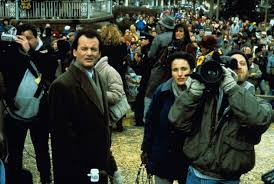 Just as we see Phil repeatedly attempting to cover the story about Punxsutawney Phil, there are countless ways each script can be approached, so wouldn’t it save a lot of time and energy to understand which reads are actually booking right now? That is the point of “The Voice Over Study,” the nuances of the bookable read are not necessarily my go to read, so I am so thankful for the first few sessions already! For example, the words to emphasize or blend may not be what I had thought of, so this valuable feedback, and the reinforcement of it, makes Kim and Lisa’s class outstanding. In class last week, Kim directed me to hit words I never word have that to enunciate, and the overall gestalt of the read was just a million times better. Her instincts are amazing. Kim and Lisa book A LOT of work on their own, and my goal is to be as busy as they are!
 In class we have homework. We have scripts to prepare and we are also supposed to work on cold reading. I also love this, as both make me more efficient and more effective in my daily work. These tasks are something that I look forward to, as I feel like I am taking control of my career and determining my own path.

