The Scenario: Two Weekends in a Row
 As a working mom, I try to only work on weekends under specific scenarios: if booked work comes in that the client specifically needs over the weekend, if I get a direct audition for the weekend, or if it is something like my blog which I generally do while my kids are asleep. Otherwise, the weekend is cherished family time. So, if a client tells me they need something over the weekend, I am generally pretty sympathetic that they have someone on the other side who needs something and has a deadline. It happens that both last weekend and this weekend I had bookings come in over the weekends. While I was delighted about both bookings, the one this weekend was much more pleasant. I think the two bookings lend themselves very well to case studies on what makes an ideal voice over client to work with and what makes a client a little more challenging.
Client A
 Earlier in the month a client I have worked with before reached out to me with a small budget for a local TV and Media campaign. After a lot of back and forth, we came to a price we could both live with. It took quite a while for the scripts to come in. Of course I finally heard from them Friday evening. I confirmed receipt of the script and asked Client A if Monday by midday was okay and they said it was needed over the weekend. Normally I would add either a “RUSH” fee or a weekend fee, but we had negotiated and the budget was low so I could not do that here. The other snag was that the client only sent one script. We had negotiated a bulk rate assuming that I was recording at once, and sending everything piecemeal was not a great start.
Client A is in a different time zone. The client is quite slow to respond to questions I have or to give any feedback when audio is sent. I sent all audio Saturday and did not hear anything back until Thursday. Typically when I deliver finished audio I invoice, but as this was just one of four deliverables, I could not invoice for the first TV spot until the entire slow moving project is complete.
Client B
My experience with Client B has been very different than my experience with Client A. I met Client B when I presented at an eLearning conference in June online. We had a follow up Zoom and the work that came in on Friday evening was also a long time coming. Like Client A, Client B also sent this booking in the evening on Friday. Also like client A, Client B was in a different time zone but in the other direction, so their workday would start before ours on Monday. In this case, Client B did not specify that they needed the work by Monday. In contrast, I was excited to get the ball rolling.
Like Client A, Client B sent clear specs and a sample. Unlike Client A, Client B, was very easy to communicate with. They answered all questions promptly and were extremely clear and direct. Client B is an international client who also needed copy writing services. Again, the ease of communication made this go extremely smoothly. I invoiced when I delivered the finished audio as I typically do and Client B paid within an hour of delivery. They also sent three follow up emails the team reviewed the files that I sent. I felt as though I were in Italy listening with them. It was great to be part of the team like that.
What Made All the Difference?
As I think about it, working on Saturday was not the problem. Subtle contrasts between Client A and Client B made the experiences quite different. I made this chart to help make the nuances more clear. Please see below:
| Client A | Client B | |
| Asked for work on weekend | X | X |
| Sent Sample | X | X |
| Sent Specific Specs | X | X |
| Easy to Correspond With | X | |
| Needed Copy Writing To | X | |
| Gave Specific and Timely Feedback | X | |
| Self Directed | X | X |
| Paid Promptly | X | |
| Overall Felt Like were on the Same Team | X |
It is much easier to work with responsive people. It is also much easier to work when you feel that your work is valued. Everyone works at their own pace, and as the voice over actor, I cannot control the pace at which the scripts are sent to me. Even though I ask that revisions come in within 48 hours in my terms at the start, I try to work with all clients, even if they pace the projects differently. While it does not feel good to have it dragged out, when I saw the first cut of the first commercial, it turned out great. The client was really nice and was working with a large team. I understand that the client cannot always control pace.
So, in the final analysis, what steps can I come up with as a business owner to have more interactions be like those with client B?
- Be clear about my terms at the start.
- Always maintain a professional demeanor.
- Maintain industry standard rates and never devalue myself.
When those are in balance I am doing my part to protect my interests, and I have to have hope that the clients will do their part as well. If all is in balance, then yes, it is worth making the effort to accommodate clients over the weekend!
 There are a lot of things that will make 2020 memorable for the rest of our lives: living through a pandemic, the national election, the state of our country in general. As a long-time professional voice over actor, one of the trends I have noticed in the past few months as bookings have picked up again is that so many of them involve live sessions also referred to as guided sessions. Prior to Covid-19, I would say that I self directed 80% of my work, and the rest were live sessions. Now I have live sessions almost daily. Interestingly most of my clients prefer zoom, although often I am asked if I have Source Connect and specifically which version I have. I do happen to have the highly sought after standard version, but interestingly that is not what is most often requested by my average client when they want or need a guided sessions. How do I feel about this rise in live sessions? I love them!
 The major trend I have noticed is how many participants are in on the call. It used to just be one or two except when I was doing video games or mobile apps, then I typically had more. Recently, on almost all of my sessions except for a tv spot last week that was just one producer, there are huge teams of 7 or 8. They seem to like to bring on everyone from the person who cast me to the person who wrote the script to the folks from the brand to the creatives putting the content together. The teams are big. And what seems to happen now is that one person will give directions. Then they will tweak the directions. Then when they are satisfied they will ask for feedback from everyone else on the team. This can go on an on and it can be very amazing, depending on how patient you are. As I have been fortunate to have a lot of well-written scripts, it is typically easy to provide alternative reads, but that is not always the case. Most of the time the teams are on the same page and most of the people keep themselves on mute. I have been on a few calls where someone forgets to mute themselves and we have some issues later.
 As I mentioned earlier, a lot of my clients ultimately ask for zoom even though I have Source Connect. I actually think this is related to the trend of included everyone in the live session. It is much easier to loop everyone in via zoom, when with Source Connect only the ones with the subscription can join.
 One quick note, as the voiceover industry is typically quite an international one, do mind your time zone conversions! It can be trickier than it seems! Years ago I had a session with a client in the South of France. I was coming back from the beach myself, and little did I realize I asked them to record at 10 PM their time. I felt terrible. More recently I had a new client in Mountain Time! I was so confused by this. I don’t know why, but it twisted my head in a pretzel. So, especially if you have multiple bookings in one day, try not to overlap them! The zoom calendar is super helpful that way!
 I’ll start out by saying that neither of my twins dream of becoming full time voice over actors like me. And though they do not share my dream, they support me in every way possible and are actually part of my small business team in integral ways this summer. In the past few weeks, one of my VO besties reached out and said that one of her regular clients needed 14-16 year old voices to do some eLearning narration, and my twins happen to be 16. So, they submitted demo reads. Again, it is not their life’s ambition, but in the summer of Covid-19 they realize that this is a great opportunity to learn and to do something that most kids never get a chance to do.
 Following multi-step directions is hard for many adults, and there are very specific directions unique to every voice over job. This booking was for sure an exercise in following multi-step directions for Jack. For Jack’s first booking:
 Maintaining a professional demeanor in the professional world is important. I remember meeting Michelle Sundholm’s sons Ashton and Everett at VO Atlanta in 2018.They were so polite and they were so composed. It is this exact behavior that I am talking about. For Jack, since his interaction was online, it meant several details. First, it meant performing his work in a timely manor. It meant taking pride in his performance and doing his best. It meant sending follow-ups and hand written thank you notes, both to the client and to the friend who referred the opportunity to him. Jack had to carry himself the way the rest of us do, and he took pride in doing so.
 Last fall, which seems like a lifetime ago given how much the world has changed during the current pandemic, I began researching upcoming eLearning conferences. I was actually hoping to find more conferences in my region. As a working mom with high school aged twins, flying across the country can sometimes be a challenge. I was overjoyed when I discovered the ICELW conference was to be held at Columbia University in the city of New York, my beloved alma mater. I submitted a proposal to speak about “Best Practices to Bring Your eLearning Module To Life” from the perspective that academics and HR people who never thought they would have to work with professional voice actors like me suddenly find themselves in the position to cast and work with voice talents as professional narrators for their eLearning modules and projects. I addressed questions that they should ask every time they have a project, VO tech and why it matters, and pricing for voiceover, including where it should be and what the price indicates. My presentation went nicely and it meant a lot to be a part of the dialogue. I am very excited, however, to share some of the larger takeaways from the more scholarly presentations during the conference as I reflect on how they will shape both my work, my voice over bookings, and client interactions as the
 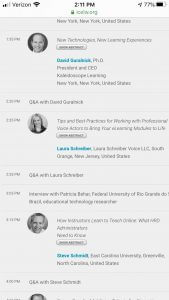 With an international audience and an enthusiastic crowd, there was a lot of discussion at the conference about how the advancing technology would enable content creators to re-imagine learning. David Guralnick from Kaleidoscope Learning and Columbia University talked about opportunities to use “technology to humanize learning” and went on to present a thrilling example combining AI and interactive technology. In this example, the student asked questions about Ancient Greece and the Acropolis and was able to create a scene where he was present in Ancient Greece having his questions answered. Particularly at a moment when students around the world are relying so heavily on on-line learning, this was thrilling and wonderful to see. The advantages of this were how realistic the scenario is and how clear the examples are. Clearly the new technology enables better communication of content. As a narrator, I have been working with more companies that create K-12 content in the last year, and I am sure such technology would be a huge asset to them.
 There were multiple sessions during the ICELW conference that addressed new technologies like AI, VR, and enhanced/mixed reality. I was riveted by these sessions as well. Someone brought up that when Steve Jobs designed the first iPod, he did not do a focus group, he just knew it would be a better device and he was creating the technology to drive a potential future experience. That is what a lot of the new experiential learning technology does. There is vast potential, the sky is the limit so to speak. Michelle Cortese, a VR Product Designer at Facebook and Professor at NYU gave a thrilling demonstration of work her students are doing. I was fascinated as a former educator, as a parent, and as a working creative. I could not help but see the intersection between technology and improv, something that so many of us in voice over spend so much of our time training in. The social behaviors that occur were fascinating, and unpredictable, and again as a working creative this made me think of improv which is not something that I typically connect to my eLearning work. Although, under further analysis, the point of studying improv, is that we are supposed to bring it with us into the booth so that our reads and takes on characters are fresh and exciting. What I found so fascinating about the sample that Michelle shared is that all of the content in the VR chat was user generated and is in the moment art. It is a vision and content that comes from the user. When so much of the learning content that we work with is contrived, this opens up a world of creative possibilities for end users. Fernando Salvetti also demonstrated work with enhanced/mixed reality and I was riveted. The possibilities that are simple and user friendly are true game changers. Having worked in eLearning for years, being exposed to such projects is eye opening.
 As in so many projects I am a part of, the bottom line matters. Dr. Tim Brock of the ROI Institute talked about creating a framework that balances needs and feasibility. The needs need to be defined at the beginning. This resonated with me a lot. Often voiceover is left off of the budget entirely, it’s an after thought. This was another area that I was addressing in my talk, the price of the voice over. When a company is looking at the ROI, the return on investment in the overall project, the voice over, and typically in eLearning we are talking about a narrator, needs to be a part of that calculation, from the start. As the technology continues to progress and is better and better, the voice over needs to be a part of the initial plan, not a lost minute add on. In Dr. Brock’s talk, he spoke of feasibility, and as the technology becomes more and more advanced, having an overall understanding for the get go of the feasibility certainly makes sense!
 What I explained to Liz, and what is interesting, is that during the Pandemic I continue to book what I have always booked, there is just less of it. So what am I still booking? Commercials, eLearning, and telephony/IVR. For me, the amount of jobs I typically have in a day or even half a day on some weeks I am having total in a week. I am thankful for every single booking, but the volume of booked work for me during the pandemic has gone down. Typically, I do a lot of radio commercials. The commercials I have booked this month have been radio commercials. They have been from steady clients who continue to send work. Some are for clients here and some have been for clients abroad, as far as New Zealand.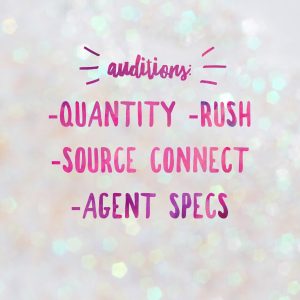
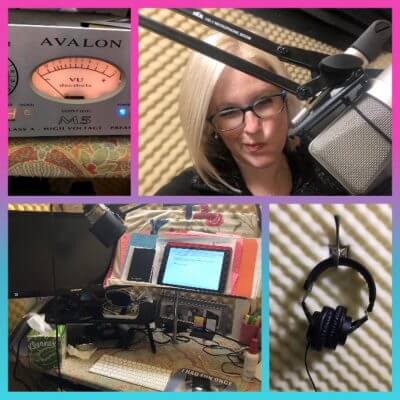 As always, I record everything in my broadcast ready home study on my Neumann TLM 103, Avalon M5 preamp, Steinberg UR12 Interface, and Macbook Air with Twisted Wav. I offer live sessions with flexible hours as I am always in the studio full time via Source Connect, Zoom, and Skype. I am always happy to self direct too, but for jobs over $250, I always offer the option of a live session, so that you have what you want when you want it. Audio recorded in live sessions is final delivery, as is industry standard. I never end a live session into my clients are thrilled with the audio.

