Why Voice Actors Need a Policy for Pickups and Revisions
As a full-time, professional voice actor, I love working with repeat clients. I love delivering finished audio I can be proud of, and over the years I’ve come up with a few strategies to reduce the number of pickups I have to do. It is important to understand the difference between pickups and revisions, and how live sessions come into play.
Just What is a Pickup
A pickup implies that you, the voice over talent, have made an error, and typically any and all performance errors are covered by the actor regardless of the size of the job’s budget. This could mean that you misread the script, it could mean that there is an odd noise in the recording and it is obscuring your work, or it could be a performance error. Perhaps you were meant to sound calm and relaxed and the client feels you give off an agitated vibe. Any of this constitutes a pickup. When I book a job, I do ask clients to give me the courtesy of asking for pickups and deliveries within 48 hours of when I give them the finished audio. Most do. Some don’t. How flexible you want to be is up to you, and makes a difference in how you feel about your relationship with the client.
What is a Revision
A revision is different than a pickup. A revision implies that the client has changed the script. Typically this means that they got your VoiceOver audio back, reviewed it, and then decided to make tweaks. For me, for jobs over $250, I include one round of minor revisions which I define as less than 20% of the script within 48 hours of delivery. If it is after 48 hours or more than 20% I charge $75 per 30-minute revision session. If the revisions are more than 40 percent of the script I adjust the rate. If the script starts to look more than 3/4 different and it is a long narration, then it becomes a new job, and negotiations begin. This is not common. In all my years as a VO talent and coach, the two times this has happened, the clients were upfront about the revisions and offered me a new rate before I even had to start worrying. If you are noticing, they are noticing. In terms of the turnaround with revisions, again, you have to decide what you can live with. For example, I work with some eLearning companies that take quite a while to review their work. For me, this is not a problem and I am happy to wait.
Throwing a Live Session into the Mix
So you have a session for Source Connect, Zoom, or Skype. Wonderful. What should your pickup policy be? Audio from a live session is always final delivery. Period. The session should not end until the clients have what they need. This is the industry standard. If the client comes back after a life session and wants a re-record, you are entitled to a fee for an entirely new booking. Basically, you have made yourself available to however many people from their team are on the call, from the producer, to the creative director, to the folks from the brand. They have plenty of time to give direction, chat, and get all that they need from you. You are not in any hurry. If, after the spot is produced, they decide to take the work in a different direction, that’s fine. They can pay you for another session.
Tips to Avoid Pickups and Revisions
In the end, here are some tips I have come up with that leave me having to do very little pickups.
- On jobs under three and a half or four minutes, I deliver at least two takes. If a client has options, they are less likely to come back to you wanting more.
- I deliver wilds of the end. If there is a talk line, give them lots of options of the end as you would in a live session.
- If there is something that may have an unusual or unexpected pronunciation, either try to call the company and hear how they say it, or fine it on YouTube and avoid having to do the retake for that. If you can’t find it, give them wilds of the word or sentence with different pronunciations.
- Try to review your audio several times before you submit it. If you are new to VoiceOver, this is a reminder that you need to do your editing for correctness to script before adding EQ/Compression/Effect stack.
- If you have a long narration, I actually edit page by page. I go through each page twice before moving on to the next one. I catch my errors and it gives my voice a break.
Ultimately Why Pickups and Revision Policies Matter
In the end, we want our clients to have a great experience working with us. We want them to come back to us over and over again. If we lay out our policies clearly, and there is no room for ambiguities, communication should be seamless. Expectations should be clear. Relationships are built on trust, and when policies are consistent, because there is, in fact, an actual policy, it is much easier for a client to understand what they are being charged for and why.
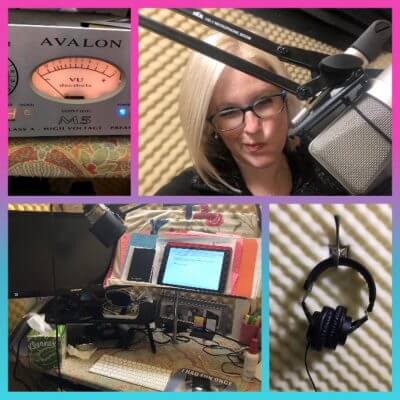 As always, I record everything in my broadcast ready home study on my Neumann TLM 103, Avalon M5 preamp, Steinberg UR12 Interface, and Macbook Air with Twisted Wav. I offer live sessions with flexible hours as I am always in the studio full time via Source Connect, Zoom, and Skype. I am always happy to self direct too, but for jobs over $250, I always offer the option of a live session, so that you have what you want when you want it. Audio recorded in live sessions is final delivery, as is industry standard. I never end a live session into my clients are thrilled with the audio.
 IpDTL was the first method I ever used to connect. My very first coach, Anne Ganguzza, used ipDTL for all of her sessions. So, I was very comfortable with this when I launched my business and proud to offer this to my clients. Around the time that I opened shop, I had two agents who said they would sign me if I had an ISDN line. I learned that it was no longer possible to get regular ISDN lines in my part of New Jersey. So, I use an ipDTL bridge to ISDN. I have my own direct number. Initially I was thrilled. I always test connect before a session. I have had more than one snafu. To his credit, the creator of ipDTL is very available via facebook and tries to address all issues. There is, however, a considerable time lag as he is across the pond and he never figured our why my hiccups happened. I have been fine with my regular ipDTL service but I am less than confident in my ISDN service. I will say that when I send my clients an ipDTL link and they have never used it before, they are always very impressed with how clear the connection is.
 I have been very pleased with my Source Connect service. The funny-not-so-funny story is that I had to sign up for it when I had a session scheduled and my ISDN line would not connect! The producer was very kind and said it happens often and that we should try this. I work with a lot of producers now who love Source Connect and it is easy. Last week, I had a commercial session for a TV spot. There were four talents on the line at the same time. The producer had the clients in the studio with him. He actually sent as a Source Connect Now line. It was great. If you have never used this before, just don’t be shocked that if the others are not muted you will hear a slight echo. Once they mute the echo goes away and it does not effect the recording. There are also not typically latency issues with Source Connect which I really like.
 I have some clients who love to use Skype and Zoom. I link them together, I suppose, because anyone could use them for anything, even outside of VO. If you are using them for voice over, be mindful to check your settings and be sure that you are coming through your pre-amp. Both of these are easy to use and for zoom if your session is under 45 minutes they are free. Skype is free as well. I find that my clients in Europe and Asia LOVE Skype and love to message on Skype! So, if you work with folks on Skype, remember to check your messages from time to time.
 Funny as it sounds, I have some older Baby Boomer aged clients who just want to be on speaker phone! They do not like anything “high tech” and they want to keep it easy. If you are like me, your mobile phone may not work in your booth. That’s ok. I have a Magic Jack line for my office and that gives me a landline phone that I can bring in my booth. It is inexpensive and reliable.
 As a full time professional voice over actor, I am well-aware that my clients have options, so I want to make it really easy for my VO clients to work with me! I consider my business model to be client centered, I put their needs first, and try to put myself in their shoes always. Whether they are video production companies, eLearning content providers, or agents, I want them to trust when they book me that the experience will be seamless because I want to make this as easy for them as possible. Why? I want them to come back over and over again, so I want to be their go to voice in my vocal range. Outstanding service is what sets the bar higher. Pristine audio is a given. It is assumed that the sound matches either our demos or the audition we have sent in, so the way to stand out and have clients keep coming back is to give them what they need and make the experience a delight! Here’s what I offer every time:
 I assume when you hire me that you need your audio back as quickly as possible. Typically when you cast me in a project, you will immediately (my average response time is 9 to 11 minutes) get my “Seal the Deal” email that confirms all the details. This will confirm the rate, the turn around time, and any questions that I may have about the booking. Unless you tell me when you send me the booking that you don’t need it for several days, I assume you want it as soon as I can get it to you. I often have people contact me about RUSH jobs and tell me that they need it “right away.” To me, that implies they need me to stop what I am working on and record their project. For that I add a $50 RUSH fee. Otherwise, I typically will have your job back to you in four to six hours. If it will be longer, the exceptions are if I am on location somewhere and I let you know. Always. Right away.
 In an industry where clients have choices, customer service matters! I want my clients to know how much I appreciate every opportunity, and I want to make it as easy as possible for them to work with me. I think back to times I have had to buy a gift for someone and hesitated because of the wait at the store or how long it took the clerk to wrap the gift. At the end of the day, I want my service to match the quality of my audio: outstanding is the only option.
 Another advantage of live sessions is that it is much easier to get to know your clients and build relationships with them when you actually work directly with their team. I learned that early on too. While you can certainly get to know clients from back and forth emails, there is nothing like actually speaking to them and working with them to make them happy. Guided sessions are fantastic and that is why I offer so many options to accommodate my clients!

