A Lot of eLearning Trends In 2020
Whether it’s because of the Covid 19 Pandemic or the industry just continues to boom, there is more eLearning work than ever! The demand for female voice over roles is continual, and as a full-time professional voice actor, every time an eLearning job arrives in my inbox I am delighted. I have always loved working with the instructional designers and project managers to bring their content to life. Before I became a voice actor, I was a teacher, so perhaps that it was I feel so at home with this genre. At the moment, there is a huge amount of eLearning content and based on the work coming in I have noticed a lot of trends in the type of work being sought, rates, tech needs, and what books the work. If you are looking to expand your eLearning bookings or to work more in this genre, these are questions you should be asking:
What gets your foot in the door with eLearning content creators?
 You need a solid demo that represents both a range of your abilities and your understanding of the industry. My vocal range is from teen to middle age, and that is demonstrated in my eLearning demo, which goes from tech industries to pharma to medical. My demo switches gears from upbeat and engaging to serious and professional. My demo is set to music, which is controversial is often eLearning is dry. I wanted my demo to standout and by pleasant to listen to, and I believe it meets that goal.
What are you typically asked for when cast in an eLearning role?
 It has been a while since I was cast as a generic third person narrator in eLearning. Instead, for the last sic months, ever booking to land on my desk is a character role, where the instructional designer wants an authentic, genuine role that is believable for their training. For example, this week I was cast as a college student who had gone down the wrong path and had a drug problem and was now in recovery. I had to be sensitive and relatable. It had to be believable. I was telling this girl’s story in this university’s training scenario. Last week I was a caller in a pay roll company’s HR training. I was the good caller this time, but in the past I’ve been the bad caller. In both instances the character had to be believable, authentic, and sincere. As a female eLearning narrator, this is a big responsibility: to continue booking work for clients you have to be able to switch gears and maintain whatever character you are playing for them that day. The character must be consistent throughout and must have nuance.
What Rates are you booking at?
 Rates are really important. My bookings typically range between $0.25/word and $0.45/word with a $150 minimum and $1 per split. I charge for splits if there are more than 10. I prefer to quote the price per word and not per finished minute as I speak quickly. Last week I had a potential client reach out and ask me if I was on Upwork. I told them I was not. They wanted to know if I would honor Upwork’s rates, and I explained that at this point in my career I could not work for those rates. I then referred the client to GVAA and Gravy for The Brain, in hopes of keeping the conversation going. They did come back to me that if they had flexibility they would let me know, but in the mean time it is important to be willing to walk away. The next day I had a job come in that was 617 words and paid of $400. It is important never to settle.
What technological requests do you get from clients?
 Most typically, my eLearning clients want MP3s that are split and fully edited. I typically add EQ, compression, and a d-esser. If you are booking eLearning work for big companies, it is expected that you should have a professional grade studio at this point. Especially because they often do not have music or effects behind their training, the quality of the audio that you provide matters more than ever.
Final Thoughts:
There is a lot of eLearning work for voice actors at the moment. If you intend to be booking it, you need to have great sound and be able to maintain a character consistently for the duration of the script. Your demo gets you in the door, but if you can’t sound as good as that on every single job, then you are not ready to work.
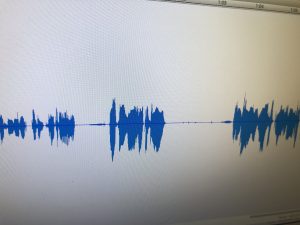 Late Friday afternoon I was in my booth recoding a bunch of agent auditions that had come in. Initially I felt fine. I had completed all of my booked work and I wanted to submit a few more reads before I called it a day. I typically don’t have a lot of mouth clicks when I record. I do run Izotope RX7 as part of my effects stack, which takes care of whatever clicks there are, but I tend to stay hydrated and am not so clicky, especially since I gave up caffeine. I noticed that even though my noise floor was the same as it always is, I had a crazy amount of spikes and clicks present that I do not typically see. This was 3 to 5 minutes before I became violently ill and had to run from the booth, I could see what I had no idea was about the be a horrible case of food poisoning, in my audio!
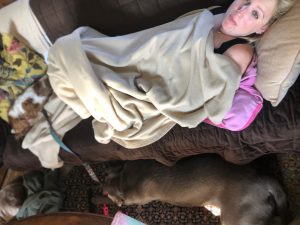 As a small business owner, I work all the time. Typically on the weekends I work less, but I still work at points every day. This food poisoning forced me to pause. I was not even sure on Saturday if I would be ok for my like sessions on Monday, but I know realize I will be. Talking is hard, sitting up is hard. Sometimes the forced rest is essential to get back to where we were. I guess it is an opportunity to reset- to restart. In truth I have no other option, when one is so dizzy that going up and down the stairs feels unsafe, the rest is the only option. In lieu of any work, I laid on the sofa in my den surrounded by my dogs and tried not o move at all.
 For the first time in my five years as a full time voice over actor I mis-quoted a client. In truth, I was extremely tense about the election results so if I did not make a mistake here I could have made one some where else. A new client found me on LinkedIn for a toy project. I have a tight NDA, but I can say that it’s a toy and right away my voice seemed like the perfect fit for this project.
 When the client had their final script, they emailed me an NDA and a contract. Then they emailed me the finalized script which was again an excel spreadsheet. In the email they confirmed the initial rate. To my horror, I realized immediately that I had under-quoted the client significantly. The script was not 4 lines, It was 154 lines. Further, they needed the files split which was also not included in the initial bid. My heart sank. I never want to disappoint a client or to make their job harder. I genuinely thought the job was the first four lines. I am not clear whether or not the client was also questioning if the bid covered the full scope of the project by the way their email was written, but I still had to re-quote. With all the work I had, I would be spending a good deal of time on this and could not do the job for the rate I had initially quoted. I felt, though, like a buffoon.
 Immediately I messaged my accountability group with whom I speak to all the time, every day. I trust these women more than anyone to lead me in the right direction. When they did not respond within minutes, I called them. Two of them were actually together at that moment, and they helped me draft a thoughtful and sincere email to address my error and revise the quote. It began with “I do apologize but…” I felt awful about doing it but I also could not live with myself if I did not. Interestingly, it was the opinion of two of the others in the group that the error was mine and I should do the job at the lower rate. They pointed out that I risked both losing the client and that if this client knows other clients I risked tarnishing my reputation. I weighed my options and sent the email with the revised quote.
 The client was not pleased when she got the email with the revised quote she had to go back to both her team and to the clients for approval. The next day I heard that they were ready to move forward. I ended up having to call the client. When I downloaded the excel spreadsheet, I had some formatting issues as a Mac user. I called the client and they were extremely helpful. It was actually great to speak with them and have yet another opportunity to apologize and let them know that I genuinely did not intend to make things difficult for them. Our chat went very well and I am extremely thankful to have laid what I hope is the foundation of a good working relationship.
 My recent commercial booking for JP Morgan makes for a great case study in voice over bookings. As a professional voice actor, every booking makes us happy, but when the producer emailed me about these radio spots, his explanation was interesting. I was cast directly without auditioning. He did not mention my voice. Nor did he mention my demos. In this instance, it was a matter of scheduling and availability. As I work full-time, they needed someone who could accommodate a live session at a specific time, which turned out to be 11 a.m. on a Friday morning, and he needed to confirm that I was available. The timing, in this scenario, was the most important question I was asked. The producer got back to me and confirmed that I had indeed booked two spots and it was a go. I was delighted.
 I prepare for every single session, whether I am self-directing or in a live session. Part of my prep is administrative. I take some time to log the job in my CRM and create the invoice. I then print a large print version of the script using my preferred font. Then, prior to marking up the script, I spend a bit of time researching the brand and their other ads. Interestingly, JP Morgan and Chase are linked. As a client, when I log in for my JP morgan account I also log into my chase account. Well, at the moment, the below Chase spot is the most sought after read in a long time. Clients often request this as the benchmark for tone, style, and pacing, so I had this in mind going into my session for sure.
 I think the start of a live session is really important. There happened to be a lot of people on this call. In addition to the producer, there were several people from the Spotify team and several people from the JP Morgan Team, including the scrip writer. In my mind looking back here were at least eight people on the session. It is my job to make them happy and to make them comfortable. I try to use the time at the start of the session to let them know that my feelings are not a factor, and that the only thing that would upset me would be for them to know have exactly what they need at the end of the call. I try to have friendly banter, but I want them to know and to be comfortable that I will give them whatever they need, and that it is not about me, it is about them. I think there are a few precious moments to establish this rapport and set the tone.
 With so many on the call, there can be a lot of side chats during a directed session to make sure everybody has the takes that they want. This team was fantastic. They gave very clear direction and it was easy to take their feedback and run with it. They also all remembered to mute themselves while I was recording, which makes everything seamless. In this session, I read the first script all the way through three times. They gave me feedback. I again did three takes, and then we did some variations of the lines. Then, after the line reads, we did the whole script again. It really came together nicely. It was also super exciting to use Zoom’s audio share feature to play back the audio for the clients during the session so that they could mark the takes that they liked and we could also check the timing of the spots. Then we moved on to the next script, and worked through it the same way. The second one went a little faster as I understood what they were looking for from the first spot. All in all, the group was great to work with. For me, because JP Morgan is my bank and I use the app, it was easy to see the product and be enthusiastic about it because I actually enjoy the very features I was describing.
 I am often asked whether I prefer live sessions or self directing. The answer is really that it depends. I love self directing because it gives me a chance to be creative and a freedom to interpret the texts in front of me. I can explore my imagination and see where it goes. The downside, of course, is that there is always a chance of missing the mark and not giving the client what they need. With live sessions, I love the creative collaboration. I love working with other people. When I have the opportunity to work with the people who created the product or the people who wrote the script, I get a higher level of understanding and can often bring more nuance to the read. So, the answer is still: I depends.
 When I was in college, I used to joke that I would love to give tours but I couldn’t as I cannot walk backwards. Well, in the world of voice over, my ability to walk in any direction does not matter and I can guide and welcome people whether they are on site or doing a virtual visit. In the voice over industry, the path that we take typically follows a specific order, and that path often begins with a demo. For me, I have been booking work for tours for years, from city tours to museum tours, and somehow I’ve been doing it without a tour specific demo. I have now amassed quite a volume of this work, so now that I am clearly on this path, I have decided to do a tour specific demo. Perhaps its because I love the versatility of emotion and roles that one can play when giving tours, and the idea that you can be on-site, have a pre- visit, or a virtual visit, that makes professional voice over for tours so appealing.
 Now, in the click of our mouse, we can visit anywhere in the world! When planning a trip, these city tours are particularly valuable. Last year, I had an opportunity to work on one of the most valuable tour projects of my career! I booked a project with
  On Thursday I got the email that a professional voice over actor never wants to get from an agent. One of my most attentive agents took the time to email me that something was wonky with my audio. She said it sounded off, and in addition she could hear clicks and plosives that she could not normally hear. This is odd because I used isotope RX7 in my effects stack, so that never happens. She also said that my “Fs” did not sound like they usually do. While I was profoundly thankful for the feedback, my heart sank. In voice over, we are only as good as we sound, and I had recently made a ton of studio upgrades. So my mind was racing. When did these issues start? What had I submitted that sounded this way? I knew I had to fix it, and fast. I had a live commercial session the next morning with a producer I work with regularly but the client was new, and this had to be fixed prior to the session. I only had a few hours and the clock was ticking.
 I immediately reached out to Tim Tippets, aka the
  Tim and I had a zoom session. I gave Tim control of my computer. Tim right away determined I was having a UAD software issue with my Apollo MK II Thunderbolt preamp. Somehow, at some point, I had checked a box that for my settings should never be checked. In this case, it is the preamp box. Once that box was checked, it changed all of the settings, the gain, the input, basically all the levels were completely different. We quickly realized that the baseline for the Manley Voxbox that I use was not saved on my iMac. Rather, it was still on my MacBook Air that I had used before my recent upgrade. So, I needed to send it to my new computer. Tim was amazing. He was patient and confident and in very little time he had my preamp settings restored. Further, he made sure that I was now able to restore them on my own in the future. He also took the time to tell me how to do audio play back in zoom to make my live sessions with clients better.
 Put simply, in voice over, we are only as good as we sound. If we want our base of clients to keep coming back, we must offer nothing less than consistently pristine audio. If my agent could hear sibilance and plosive, then it is likely it was heard in auditions and work submitted around that time as well. Part of being a professional working voice actor means having broadcast ready audio, and broadcast ready audio is perfect. Broadcast

