So You’re Leaving the Booth
 It happens, even in the time of covid, we leave our studios. As a professional voice talent, we have work we can predict, and the joy of work we cannot predict, that comes in at a moment’s notice and can have a pretty tight turn around time. As a working mom, whether I’m home or traveling I’m always juggling my responsibilities as a small business owner and my role of a mom, this year more than ever. This year, my high school juniors are looking at colleges. And as if looking at colleges for twins is not challenging enough, their interests do not overlap at all. Emma is targeting schools with Speech programs and STEM programs. Jack is looking for International Relations and Russian. So, we are doing two completely different college searches at once. What does this mean for me as a voice actor? It means I’m leaving the booth for the first time in a year and I need to be prepared. Voice over work should never prevent travel, it just means you need the right set up for your voice over travel rig and to take the necessary steps when planning.
What’s in The Travel Rig
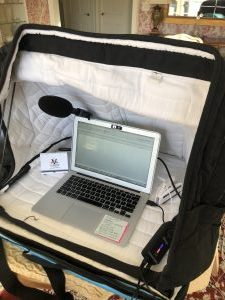 The point of the travel rig is to sound like you sound in your home studio when you are on the road so that you can provide clients with a continuity of service. I have tweaked my rig quite a few times over the years, and finally invested in a quality set up that I am pleased with. I now bring:
- A VoMo booth to go
- A Sennheiser MKE 660 microphone
- Sennheiser headphones
- An AUD Appollo MK II Preamp
- A MacBook Air with Twisted Wave
The reason this set up works, is that an effects stack works was created that gives the same sound to the finished audio of that recorded in my booth. It is quite remarkable.
If you are still in the pillow fort phase, here is a video that might be helpful from when I was using pillow forts as well:
To Bring Or Not To Bring
Now that I have this amazing set up, does this mean that I never take off or that I bring the travel rig everywhere? No. For instance, this weekend I am away Friday night through Sunday. I left the rig at home. I did have one booking come in from an international client. I asked if they could please wait until Monday and that worked out, but if not I was willing to let the gig go. Sometimes you just need a break. Typically, I evaluate what I’ll be doing, how much free time I’ll have, and how much I typically earn that time of year. For example, the last four years in a row July has been my highest earning month of the year. If I go anywhere in July, the travel rig is coming with me. June, in contrast is a slower month. It might be safer to travel without it or to plan travel for that month. Tracking your trends in a CRM can be helpful for you to make such calls. Ultimately, we are all entitled to a break, but you have to weigh how disruptive it will be to your long term success. If your client hires another talents, and then that talents gets then ongoing work instead of you, can you live with that?
Professional Procedures to Take
Ultimately the point of the travel rig is to serve your clients well. If you know travel is coming up, and you are starting a project that might have pickups or script changes you should let the client know. You might also discuss with them the option of recording on your travel rig from home so that the audio matches. If you will have limits to your availability while on the road, it is great to give your regular clients a heads up. If they are used to a speedy turn around and you will have a delay, they’ll appreciate the notice. If you send out a newsletter, the newsletter is a great place to let clients know when you’ll be out of the studio. If you are on regular rosters that send you work, they appreciate the advance notice as well. Typically two weeks notice before travel is standard, and that way clients have the chance to decide of they want to work around your dates and you can decide whether or not you need your rig!
Last Thoughts
Ultimately, there are a lot of ways to get great sound on the road, from pillow forts made out of comforters to tiny mics that plug into your phone. It makes sense to decide what your goals are: ranging from auditions to booked work to pickups, and then determine what gear best meets your needs.
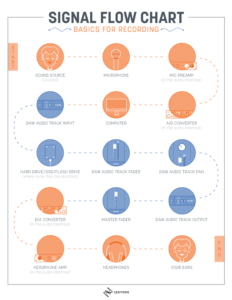 Depending on which voice actor you ask, you’ll get a different answer to the questions “What’s the best DAW for VO?” I have used Audacity, Adobe Audition, and Twisted Wave. I may be proficient in all of them, but I LOVE Twisted Wave. To be clear this does not mean that other DAWs, from Reeper to Pro Tools don’t have immense value, but for me, I am quick and good on Twisted Wave. It serves my purposes well. And when I have a client who needs total production with music, I hire a professional engineer to mix it down anyway, so I really can do all that I need to do on Twisted Wave. Some of my favorite features are the shortcuts, multiple effects stacks, and ease of file splitting.
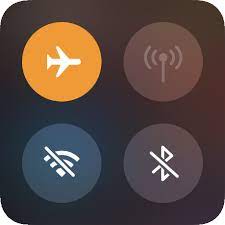 When I am in my booth, I turn my iPhone and Apple Watch to airplane mode. I do this because when I develop a good flow, I do not want the phone ringing to interrupt me. I do offer one word of caution: if you are doing a live session and you coincidentally cannot connect with your client, and have all your devices in airplane mode, it can be quite frustrating if they are unable to reach you. So, while you may not want your phone in the studio for a directed session, perhaps before you silence everything you should make certain that you connect.
 Like many in voiceover, I am constantly revising my business plan, shifting my focus from commercials to explainers to elearning to targeting specific industries. As I revise my plan, my goals change. While I have a planner or agenda that I love, I find that mapping out my strategy for the week helps me to keep my mind on the big picture. As auditions and work pours in, it’s easy to get caught up in the little things and push off the tasks that we think can wait, but in doing so, in pushing off those marketing emails and that LinkedIn outreach, we are pushing off the pursuit of our longterm goals. It is so important to always have an eye on your “why.” If you lose site of that, and you are just buys submitting audition after audition, you can easily get stuck in a rut.
 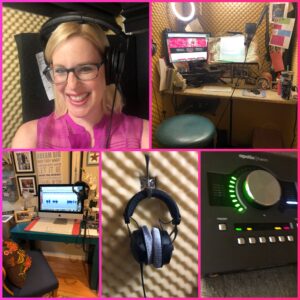 If your fan makes noise,
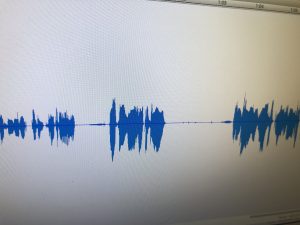 Late Friday afternoon I was in my booth recoding a bunch of agent auditions that had come in. Initially I felt fine. I had completed all of my booked work and I wanted to submit a few more reads before I called it a day. I typically don’t have a lot of mouth clicks when I record. I do run Izotope RX7 as part of my effects stack, which takes care of whatever clicks there are, but I tend to stay hydrated and am not so clicky, especially since I gave up caffeine. I noticed that even though my noise floor was the same as it always is, I had a crazy amount of spikes and clicks present that I do not typically see. This was 3 to 5 minutes before I became violently ill and had to run from the booth, I could see what I had no idea was about the be a horrible case of food poisoning, in my audio!
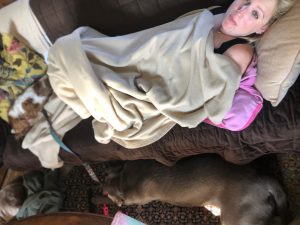 As a small business owner, I work all the time. Typically on the weekends I work less, but I still work at points every day. This food poisoning forced me to pause. I was not even sure on Saturday if I would be ok for my like sessions on Monday, but I know realize I will be. Talking is hard, sitting up is hard. Sometimes the forced rest is essential to get back to where we were. I guess it is an opportunity to reset- to restart. In truth I have no other option, when one is so dizzy that going up and down the stairs feels unsafe, the rest is the only option. In lieu of any work, I laid on the sofa in my den surrounded by my dogs and tried not o move at all.
 A professional talent has an abundance of testimonials. Period. They should have them proudly displayed on their website, on LinkedIn, on whatever Pay to Plays they are on, and likely they share them on social media. Testimonials are not difficult to get. Happy clients who have just received pristine audio are typically delighted to provide them. My very first voice coach, Anne Ganguzza, told me how important it was to get testimonials! She asked for one from me about our work and gave me my very fist one. A voice actor without testimonials is likely not a professional voiceover actor.

