Why Switch from Avalon M5?
 When everything is working perfectly in your booth, your bookings are solid, and you are happy with your sound, why shake things up with a gear upgrade? Well, life is not always so cut and dry in the voice over world. While I was really proud when I upgraded to the Avalon M5 preamp, and loved the way it sounds with my Neumann TLM 103 microphone, it is not portable. I’m at a point in my career where if I travel, which happens when there is not a pandemic, I need to sound the way I sound in my booth when in my travel rig. With an Avalon preamp and a Neumann mic, I sound pretty awesome. Even with a VOMO, it is hard to emulate that sound without bringing the Avalon, and if you have ever been in the presence of an Avalon then you know it is not portable. Thus, my journey began.
Working with Tim
 One of my VO besties, and all around favorite people on the planet, the amazing Kim Handysides, suggested that I work with the VO Tech Guru Tim Tippets. Kim said Tim does amazing stacks and would set up my travel rig. Initially I had not planned to change my in studio set up with the Avalon M5, just the rig. I reached out to Tim. Tim is amazing because he could just set you up and give you the answer, but instead he spends the time to educate you so that you understand the rationale behind his suggestions and why he is guiding you down a certain path.
The Journey- and Boy Was It One
 To Start, I was limited because I was working on a 2015 MacBook Air. Even though my MacBook Air is running really well (knock wood), it only has one Thunderbolt 2 connection and the rest are USB ports. This posed some logistical challenges in terms of suggestions Tim wanted to make. Further, at the time, I was set up to mirror in studio on a monitor. So my MacBook Air stays in an office space outside the studio and I have a great monitor in my booth.
Tim suggested I part ways with my M5, as much as I have loved it, and move on to the Apollo Twin MKII Thunderbolt. He explained the advantages of the Apollo were amazing and that I would sound the same if not better in both my home studio AND I could use it in my travel rig. So, I made the switch.
Tim set up an amazing stack for me on the Apollo and my booth in the house is up and running, almost.
Problem Solving and the Challenges
While I am delighted with the sound of the Apollo and immediately booked a pretty big job in the first round of auditions after being up and running, the big hiccup is that I cannot hookup my monitor in the studio and now my MacBook Air is in the booth, very temporarily. Before an onslaught of well-intentioned notes comes my way, I have purchased and returned multiple adaptors to try to hook up an HDMI to a USB, but to no avail, none will convert a video signal readable by Catalina. And because my MacBookAir is from Early 2015, I do not have a Thunderbolt C port and cannot use an adaptor because my computer could not process the speed. So… I am upgrading and an iMac desktop is on the way! This MacBook Air will be used for my travel rig and for marketing and correspondence, which is fine and I am thrilled with the solution.
The Travel Rig….
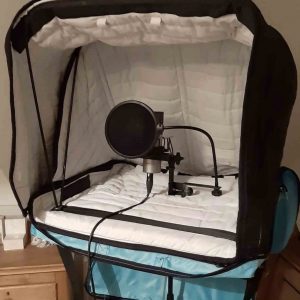 So this brings us back to the travel rig set up, which is also pretty exciting. After all, this entire journey started because of the travel rig, right? So, what is my travel rig set up now:
- VoMo Booth
- Sennheiser 660 Microphone
- Apollo Twin MK II Thunderbolt
- MacBook Air with Twisted Wav
And the great thing about working with Tim is that he set up the presets in the Apollo for this as well. Now when I go away, I can plug this in and go!
The One Note:
When I first started working with Tim to set up the Apollo, the process was not seamless, not because of Tim- sometimes life is just like that. It seemed that everything that could go wrong did go wrong. Tim was a patient as can be as he has seen it all, but I felt terrible and was quite frustrated. In the middle of attempting to set up the Apollo, I had to do a long overdue Time Machine backup and then upgrade to Catalina, so had I done those things prior to our chat that would have helped. The last thing was that my MacBook Air was not recognizing the device after all of that. I watched multiple youtube videos as I could not bare the thought of texting Tim and telling him something else was wrong. One video made me wonder if something was wrong with my thunderbolt cable. When I looked at it, I realized the lighting bolt was only on one side. If you have an old model and your are using this kind of cable, even though you can plug it in with either side up, make sure that the end with the lighting bolt is face up. Once I did that, everything worked like magic and Tim could do his thing, but it took about 8 hours in my booth to figure that out!
 As a professional voice over actor, I can say I interact with industry contacts as just that, as a professional. I get auditions, I submit auditions. It is non-emotional. It’s business. When I connect with people on Facebook or LinkedIn, it’s business. I’m delighted, but still, it’s a business contact. Yet, there is a degree of trust that we must assume when we interact with clients and new contacts alike in the voiceover industry, right? Voice actors like myself often send recorded audio to people, whether they be clients or prospects, that we actually know very little about, and when we do this we trust that the audio we send is being used under the agreed upon terms. We trust that it is not manipulated. We trust them with our contact information. There is a lot of trust going on. For those of us who are working mothers, who have a family at home, we have a lot invested in the businesses we have built, and this trust is no joking matter.
 I posted in the “Voice-Over Mamas” Facebook Group asking other
  Besides feeling shaken, I have not changed my setup yet. I have lots of questions. I think more than changing what how I am set up, this icky feeling (for lack of a better word) will stick with me. This feeling of vulnerability is not a pleasant one and I think that when future contact behave in a way that is outside the norm I will simply pass on the opportunity. I am not desperate for work, I am established in my career. I would rather forgo something that does not seem right than expose myself and my family to potential harm.
 Last fall, which seems like a lifetime ago given how much the world has changed during the current pandemic, I began researching upcoming eLearning conferences. I was actually hoping to find more conferences in my region. As a working mom with high school aged twins, flying across the country can sometimes be a challenge. I was overjoyed when I discovered the ICELW conference was to be held at Columbia University in the city of New York, my beloved alma mater. I submitted a proposal to speak about “Best Practices to Bring Your eLearning Module To Life” from the perspective that academics and HR people who never thought they would have to work with professional voice actors like me suddenly find themselves in the position to cast and work with voice talents as professional narrators for their eLearning modules and projects. I addressed questions that they should ask every time they have a project, VO tech and why it matters, and pricing for voiceover, including where it should be and what the price indicates. My presentation went nicely and it meant a lot to be a part of the dialogue. I am very excited, however, to share some of the larger takeaways from the more scholarly presentations during the conference as I reflect on how they will shape both my work, my voice over bookings, and client interactions as the
 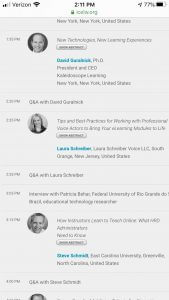 With an international audience and an enthusiastic crowd, there was a lot of discussion at the conference about how the advancing technology would enable content creators to re-imagine learning. David Guralnick from Kaleidoscope Learning and Columbia University talked about opportunities to use “technology to humanize learning” and went on to present a thrilling example combining AI and interactive technology. In this example, the student asked questions about Ancient Greece and the Acropolis and was able to create a scene where he was present in Ancient Greece having his questions answered. Particularly at a moment when students around the world are relying so heavily on on-line learning, this was thrilling and wonderful to see. The advantages of this were how realistic the scenario is and how clear the examples are. Clearly the new technology enables better communication of content. As a narrator, I have been working with more companies that create K-12 content in the last year, and I am sure such technology would be a huge asset to them.
 There were multiple sessions during the ICELW conference that addressed new technologies like AI, VR, and enhanced/mixed reality. I was riveted by these sessions as well. Someone brought up that when Steve Jobs designed the first iPod, he did not do a focus group, he just knew it would be a better device and he was creating the technology to drive a potential future experience. That is what a lot of the new experiential learning technology does. There is vast potential, the sky is the limit so to speak. Michelle Cortese, a VR Product Designer at Facebook and Professor at NYU gave a thrilling demonstration of work her students are doing. I was fascinated as a former educator, as a parent, and as a working creative. I could not help but see the intersection between technology and improv, something that so many of us in voice over spend so much of our time training in. The social behaviors that occur were fascinating, and unpredictable, and again as a working creative this made me think of improv which is not something that I typically connect to my eLearning work. Although, under further analysis, the point of studying improv, is that we are supposed to bring it with us into the booth so that our reads and takes on characters are fresh and exciting. What I found so fascinating about the sample that Michelle shared is that all of the content in the VR chat was user generated and is in the moment art. It is a vision and content that comes from the user. When so much of the learning content that we work with is contrived, this opens up a world of creative possibilities for end users. Fernando Salvetti also demonstrated work with enhanced/mixed reality and I was riveted. The possibilities that are simple and user friendly are true game changers. Having worked in eLearning for years, being exposed to such projects is eye opening.
 As in so many projects I am a part of, the bottom line matters. Dr. Tim Brock of the ROI Institute talked about creating a framework that balances needs and feasibility. The needs need to be defined at the beginning. This resonated with me a lot. Often voiceover is left off of the budget entirely, it’s an after thought. This was another area that I was addressing in my talk, the price of the voice over. When a company is looking at the ROI, the return on investment in the overall project, the voice over, and typically in eLearning we are talking about a narrator, needs to be a part of that calculation, from the start. As the technology continues to progress and is better and better, the voice over needs to be a part of the initial plan, not a lost minute add on. In Dr. Brock’s talk, he spoke of feasibility, and as the technology becomes more and more advanced, having an overall understanding for the get go of the feasibility certainly makes sense!
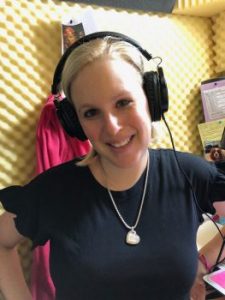 This week I had an unusual opportunity to have a zoom sessions with a few folks who do casting. I was on a zoom call with an extremely accomplished male voice actor based in Vancouver named Brent Miller. Brent and I get to spent about 45 minutes chatting with these folks about our background, experience, best clients, niche roles, and the kind of work we book. Here is a summary of what the Project Managers asked me and how I replied:
 I say this a lot: get a crockpot. It’s hard juggling a lot of balls, and if you still have household responsibilities and you have to work a full work day, it’s hard to do everything. Plan ahead as much as possible. I do weekly meal planning for all of our dinners. Another tip for working mom’s is to have patience. When I started I had all of these immediate goals for my
  Oprah. I have always loved Oprah. I actually came face to face with her once at the Jefferson Hotel in Washington, D.C. I was speechless. She looked amazing and said hello and I stood there mouth open and no words could come out. Nothing. Silence. But I have dreamt of speaking to her and collaborating with her and going to her school in Africa. I have dreamt of contributing in any way to one of her many amazing projects. I have fantasized about collaborating in numerous ways.
 Each session got my wheels turning for different reasons, but during Armin’s session that was around 11 AM EST, when he spoke of defining quality in the industry. My head was bursting with ideas. If you don’t know Armin Hierstetter, he is the founder and CEO of the online casting platform Bodalgo. Unlike some platforms where you can simply sign up, Bodalgo stands apart because Armin has a screening process to begin with, setting a bar for “quality” from the start. In his talk, Armin spent a bit of time talking about what is going on industry wide in terms of quality, what quality looks like, and how quality could be achieved.
 It is imperative that in order to be competitive in the voice over industry today a talent must have coaches and continue to work on their craft. When I started I did a combination of one on one coaching in specific genres, online classes, acting and improv. Whether or not you are working towards a demo, a good coach will help you develop your strengths and identify your weaknesses. They will also help you identify next steps and encourage you with other genres of voice over that would likely be a good fit. As MaryLynn mentioned in her blog post,
  If you want to succeed in voiceover, there are not short cuts to creating quality work. There is an industry standard and the bar is high. That is what books. If you are aware of those of us who continue to book at this time, the answer to what sets them apart is one word: quality.

