Q: What tweaks have you made to your set up that work well?
When I first built my professional home studio, I worked with my MacBook Air in the booth. For years I did this without issue. About two years in, I noticed that after very long recording sessions i had a lot of fan noise. I had gotten a great tip from Jack de Golia, a brilliant voice actor in Las Vegas, to always have ice packs handy, but after a while this became burdensome so I upgraded and put an iMac outside the booth and a monitor in the booth. This works MUCH butter. Here is a video made from a recent instagram story based on this very set-up question. If you can have this kind of set up, it’s great.
 I also recommend having practical hooks in your book. I have a hook for my cans and a hook for my wires. It helps keep things neat and organized.
Q: What is your favorite way to connect for live sessions?
I have a new favorite way to connect: Zenncastr!! I have used this quite a few times recently, especially for long, guided eLearning sessions and it is great. There are no latency issues and it is very easy to connect, even easier than Source Connect. If only one person who is connecting has it, you can send them a link so it eases the financial burden as well. There are multiple price points, all of which are affordable. I love that when we speak during the session, all participants are recorded on separate tracks. So, if you are a coach recording a demo, or a voice over actor recording for a client, you never have to edit out any back and forth as you might on zoom. Then, at the end, you simply upload the audio.
 I also do love having Source Connect. So many clients and agents require it. I occasionally need to have support sessions, and they do offer great support from Source Connect. Again, like with Zancastr, there are no latency issues. There are, though, sometimes quirks connecting. Sometimes people are confused with how to use it. If you are not both connecting with the same sample rate, for example, you won’t connect smoothly and it will be an issue, so that all needs to be decided ahead of time.
I also do still like to use zoom for the ease of use. Sometimes, even with the latency issues, it is great to just throw up a link and go! Especially this year, everyone knows how to use zoom, and it is nice to have a stress free connection for a live or guided session.
Q: If you could change anything about your studio, what would it be?
This might sound trivial, but it is not meant to. My booth is a rectangle and I have all this wasted space behind me. I could have saved a lot of money by making it a smaller square. The space behind me goes unused and is just a waste. I have to work with an acoustic board behind me, so I don’t even get to enjoy the roominess.
I have blogged about this before, but I would also choose a different color foam if I had the option. I hate that my white aurelex foam has turned yellow. I would either do panels or grew foam next time around.
Q: Can a voice over coach help with your studio set up?
A good voice over coach is still not an audio engineer. While I love to talk about gear with other voiceover actor and with students, it it is fun to talk about set up, I did not go to school for sound engineering. I do not have a degree in audio engineering. Everything I know about my studio, I know from having training with various audio engineers. As a voice over coach, I do work with students on microphone technique, but that is NOT the same thing is telling you how to set up your studio. Dave Scott, who do demo production with, can give you expert advise on how to set up your booth and guide you about what to invest in and how to actually set it up.
Q: What do you wish you knew when you first started your voice over studio?
 I wish I know how important a good travel rig is. It took me five years to get my travel rig to sound as good as my home set up. That is WAY too long. If you are just starting in voice over during the pandemic, I realize it is hard to imagine actually packing up and leaving home, but when we do, the rig matters.
I wish I know how important my website was. I spend so much time working on inbound marketing through my website now, but my business was going for several years before I figures that out.
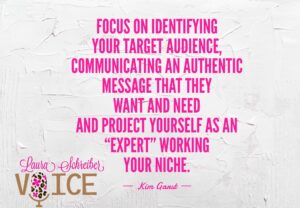 from the US and Canada. Our focus was on marketing, and even as a panel member, it really got my wheels turning. I could not help but think of the specificity of my recent outreach, especially in eLearning. I have worked so hard to build my business as an eLearning narrator, and I think in order to really reach prospects, you need to think about who you are working with. From the very beginning of the process through the completion of the booked work, understanding your audience is essential to success as a working female narrator in eLearning.
 Social media content, across platforms, needs to have the target audience in mind as well. This can be a bit trickier, as it is harder to control who sees your posts. You can, however, try to catch the eye of a specific group of clients or prospects by being clever about your target audience. If, for example, you are posing on Instagram and you want to reach out to instructional designers, both the content you use and the tags that you include in your post matters. Another way to grab your audience is to tag influencers and professionals in that field. Quote them. Have a conversation about them. If you want to work in eLearning, you need to be part of the dialogue.
 When you book an eLearning job, understanding the audience or the enduser is so important. For example, I was recently cast in a training for a local hospital: RWJ St. Barnabas, right here in NJ. It was a caller training. When I first read through the script, in my practice read, I sounded warm, gracious, and welcoming. I then re-read my roll: “Bad Caller.” I was the example of what not to do. Everything I just rehearsed had to be thrown out the window and the opposite read was needed. I was talking to the same people, but I was the example of what not to do, and I had to be the best “Bad Caller” they ever heard. Your job as an eLearning narrator is to make it obvious. They should not have had to figure out what was wrong with my phone skills, so I had to make every effort to clearly connect with the listener. Keeping the audience in mind should inform and transform every eLearning performance.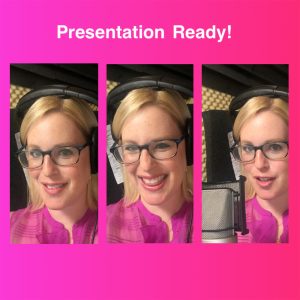
 Last fall, which seems like a lifetime ago given how much the world has changed during the current pandemic, I began researching upcoming eLearning conferences. I was actually hoping to find more conferences in my region. As a working mom with high school aged twins, flying across the country can sometimes be a challenge. I was overjoyed when I discovered the ICELW conference was to be held at Columbia University in the city of New York, my beloved alma mater. I submitted a proposal to speak about “Best Practices to Bring Your eLearning Module To Life” from the perspective that academics and HR people who never thought they would have to work with professional voice actors like me suddenly find themselves in the position to cast and work with voice talents as professional narrators for their eLearning modules and projects. I addressed questions that they should ask every time they have a project, VO tech and why it matters, and pricing for voiceover, including where it should be and what the price indicates. My presentation went nicely and it meant a lot to be a part of the dialogue. I am very excited, however, to share some of the larger takeaways from the more scholarly presentations during the conference as I reflect on how they will shape both my work, my voice over bookings, and client interactions as the
 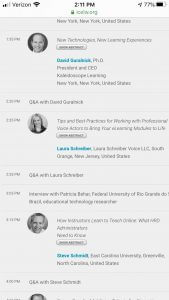 With an international audience and an enthusiastic crowd, there was a lot of discussion at the conference about how the advancing technology would enable content creators to re-imagine learning. David Guralnick from Kaleidoscope Learning and Columbia University talked about opportunities to use “technology to humanize learning” and went on to present a thrilling example combining AI and interactive technology. In this example, the student asked questions about Ancient Greece and the Acropolis and was able to create a scene where he was present in Ancient Greece having his questions answered. Particularly at a moment when students around the world are relying so heavily on on-line learning, this was thrilling and wonderful to see. The advantages of this were how realistic the scenario is and how clear the examples are. Clearly the new technology enables better communication of content. As a narrator, I have been working with more companies that create K-12 content in the last year, and I am sure such technology would be a huge asset to them.
 There were multiple sessions during the ICELW conference that addressed new technologies like AI, VR, and enhanced/mixed reality. I was riveted by these sessions as well. Someone brought up that when Steve Jobs designed the first iPod, he did not do a focus group, he just knew it would be a better device and he was creating the technology to drive a potential future experience. That is what a lot of the new experiential learning technology does. There is vast potential, the sky is the limit so to speak. Michelle Cortese, a VR Product Designer at Facebook and Professor at NYU gave a thrilling demonstration of work her students are doing. I was fascinated as a former educator, as a parent, and as a working creative. I could not help but see the intersection between technology and improv, something that so many of us in voice over spend so much of our time training in. The social behaviors that occur were fascinating, and unpredictable, and again as a working creative this made me think of improv which is not something that I typically connect to my eLearning work. Although, under further analysis, the point of studying improv, is that we are supposed to bring it with us into the booth so that our reads and takes on characters are fresh and exciting. What I found so fascinating about the sample that Michelle shared is that all of the content in the VR chat was user generated and is in the moment art. It is a vision and content that comes from the user. When so much of the learning content that we work with is contrived, this opens up a world of creative possibilities for end users. Fernando Salvetti also demonstrated work with enhanced/mixed reality and I was riveted. The possibilities that are simple and user friendly are true game changers. Having worked in eLearning for years, being exposed to such projects is eye opening.
 As in so many projects I am a part of, the bottom line matters. Dr. Tim Brock of the ROI Institute talked about creating a framework that balances needs and feasibility. The needs need to be defined at the beginning. This resonated with me a lot. Often voiceover is left off of the budget entirely, it’s an after thought. This was another area that I was addressing in my talk, the price of the voice over. When a company is looking at the ROI, the return on investment in the overall project, the voice over, and typically in eLearning we are talking about a narrator, needs to be a part of that calculation, from the start. As the technology continues to progress and is better and better, the voice over needs to be a part of the initial plan, not a lost minute add on. In Dr. Brock’s talk, he spoke of feasibility, and as the technology becomes more and more advanced, having an overall understanding for the get go of the feasibility certainly makes sense!
 Do you ever listen to the Taylor Swift song “You Need to Calm Down” and think she is singing directly to you? I can’t be the only one. So as proud as I am to be a working mom running my own small business, I would be lying if I told you I was always able to separate my feelings from my work 100% of the time. I think when you are as passionate about your industry as I am about voice over, remaining detached and having good perspective all the time can be a challenge. Why does staying calm matter? Regardless of the business scenario at hand, as voice over actors we need to remain calm in order to cultivate and maintain meaningful client relationships.
 If we have ever met in person, you would pick up right away that I do not have a calm, relaxed energy. Having spent much of my adult life in New York City, the frenetic vibe of the city always suited me just fine and if anything I thrived feeling that pulse. I will say that recent life during the pandemic has made me want to take things a little slower. Now that I am home with my family 24-7, remaining calm seems much better than getting bent out of shape over every little thing. If I let the small stuff get to me, this pandemic would be impossible to get through. I am trying to actually live by the advice I give my children. And of course, by the brilliant lyrics of Taylor Swift: “But I’ve learned a lesson that stressin’ and obsessin’ ’bout somebody else is no fun…You need to calm down, you’re being too loud.”
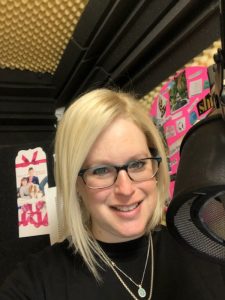 When I built my business voice over, I decided early on to build a professional home studio. It was really exciting to make choices that were specifically to my benefit. From the colors to the height of the desk, it was all about me! Everything else in my house is done for the common good. I have done my kids rooms for them. My kitchen is meant to be practical. This was the first time I built something based on my research, preferences, and taste!
 I am particularly proud of my lights and fan. Both are silent and both work well! It is always bright in the booth.
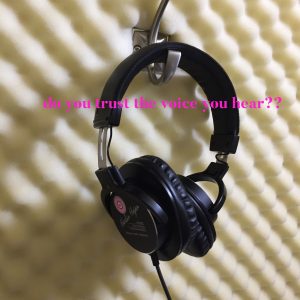 This booth was built around what is good for me! So if I have friends over they may not find everything the way they have it in their booth, but I love all my little details, from my shelf that holds the pre-amp and interface under my desk to my hooks for my head phones and wires that are at just the right locations. One of my favorite details is that we actually drilled right through the desk so that the music stand is dead center in front of me to place the scripts on. It is perfect.
 So, what I gather is that folks can’t imagine is how the work of a creative can fill an entire day, or perhaps weeks and years on end. Given the opportunity, I will happily, and enthusiastically elaborate and tell you what days are like for a working voiceover talent.
 I do try to do 20-40 auditions a day, and they come in from clients, Pay to Plays, and agents around the country. If a booking comes in mid-day, I stop what I am doing and record. For bigger jobs I typically have advance notice. For example, I did 20 videos on Thursday, but I new about them about 2 weeks in advance so that I could book out the day on my calendar. I do I lot of commercials and have a lot of RUSH work as well. I am always happy to do rush jobs. I understand when folks have deadlines, and I never mind getting audio right back to clients. Often when more booked work comes in, time on LinkedIn or for marketing takes a back seat. I tend to keep up with my client correspondence as that is very important to me!
 I can’t ever completely detach because there is no one else to man the fort. Since I am the business, if I disconnect, it ends. I find it challenging to find the right balance between savoring this precious time with my children, which goes entirely too fast, and catching the momentum of my business which I have worked so hard to build.

