How Did I Manage to Mis-Quote the Client
 For the first time in my five years as a full time voice over actor I mis-quoted a client. In truth, I was extremely tense about the election results so if I did not make a mistake here I could have made one some where else. A new client found me on LinkedIn for a toy project. I have a tight NDA, but I can say that it’s a toy and right away my voice seemed like the perfect fit for this project.
The first mistake that I made was that I opened the script on my phone. I was in my booth doing an eLearning job. I think we all feel that sense of urgency to reply promptly so that the client doesn’t go to another option, and I had so many screens open in my booth, that it seemed easier at the time to look at this on my phone. The client sent an excel spread sheet. At the top of the spread sheet were four highlighted very short sentences. I looked at the spreadsheet several times, did not see any other content, and each time I checked it was on my phone. It was my understanding that these highlighted lines were the entire script.
To be clear, I am often sent very small scripts in different genres, so this in no way seemed odd. I do a lot of commercial work, and there are a lot of short, 15 second, commercials. Even in eLearning, sometimes I am cast for one short role in a module, so this short script for the toy in no way seemed unusual. When I replied to the client, I was very clear to outline my standard toy rates, my toy revision rates, and what my quote would be for this job given how short the script was. I explained that I would provide two versions and the audio would be in what ever form they needed, fully edited, and ready for use. The client responded that they would be moving forward in the coming days.
How I Realized My Error
 When the client had their final script, they emailed me an NDA and a contract. Then they emailed me the finalized script which was again an excel spreadsheet. In the email they confirmed the initial rate. To my horror, I realized immediately that I had under-quoted the client significantly. The script was not 4 lines, It was 154 lines. Further, they needed the files split which was also not included in the initial bid. My heart sank. I never want to disappoint a client or to make their job harder. I genuinely thought the job was the first four lines. I am not clear whether or not the client was also questioning if the bid covered the full scope of the project by the way their email was written, but I still had to re-quote. With all the work I had, I would be spending a good deal of time on this and could not do the job for the rate I had initially quoted. I felt, though, like a buffoon.
How did I Decide How to Handle My Mistake
 Immediately I messaged my accountability group with whom I speak to all the time, every day. I trust these women more than anyone to lead me in the right direction. When they did not respond within minutes, I called them. Two of them were actually together at that moment, and they helped me draft a thoughtful and sincere email to address my error and revise the quote. It began with “I do apologize but…” I felt awful about doing it but I also could not live with myself if I did not. Interestingly, it was the opinion of two of the others in the group that the error was mine and I should do the job at the lower rate. They pointed out that I risked both losing the client and that if this client knows other clients I risked tarnishing my reputation. I weighed my options and sent the email with the revised quote.
What I would do Differently Next Time
- I would open the email on my iMac.
- I would not be in such a rush to reply. The few minutes could save a lot of aggravation later.
- If I was unclear about the scope of work I would call the client.
- I would ask more questions before doing the quote.
- I would give a tiered quote (which I often due) that covers different lengths of work so that I am covered either way.
How it Worked Out
 The client was not pleased when she got the email with the revised quote she had to go back to both her team and to the clients for approval. The next day I heard that they were ready to move forward. I ended up having to call the client. When I downloaded the excel spreadsheet, I had some formatting issues as a Mac user. I called the client and they were extremely helpful. It was actually great to speak with them and have yet another opportunity to apologize and let them know that I genuinely did not intend to make things difficult for them. Our chat went very well and I am extremely thankful to have laid what I hope is the foundation of a good working relationship.
 My recent commercial booking for JP Morgan makes for a great case study in voice over bookings. As a professional voice actor, every booking makes us happy, but when the producer emailed me about these radio spots, his explanation was interesting. I was cast directly without auditioning. He did not mention my voice. Nor did he mention my demos. In this instance, it was a matter of scheduling and availability. As I work full-time, they needed someone who could accommodate a live session at a specific time, which turned out to be 11 a.m. on a Friday morning, and he needed to confirm that I was available. The timing, in this scenario, was the most important question I was asked. The producer got back to me and confirmed that I had indeed booked two spots and it was a go. I was delighted.
 I prepare for every single session, whether I am self-directing or in a live session. Part of my prep is administrative. I take some time to log the job in my CRM and create the invoice. I then print a large print version of the script using my preferred font. Then, prior to marking up the script, I spend a bit of time researching the brand and their other ads. Interestingly, JP Morgan and Chase are linked. As a client, when I log in for my JP morgan account I also log into my chase account. Well, at the moment, the below Chase spot is the most sought after read in a long time. Clients often request this as the benchmark for tone, style, and pacing, so I had this in mind going into my session for sure.
 I think the start of a live session is really important. There happened to be a lot of people on this call. In addition to the producer, there were several people from the Spotify team and several people from the JP Morgan Team, including the scrip writer. In my mind looking back here were at least eight people on the session. It is my job to make them happy and to make them comfortable. I try to use the time at the start of the session to let them know that my feelings are not a factor, and that the only thing that would upset me would be for them to know have exactly what they need at the end of the call. I try to have friendly banter, but I want them to know and to be comfortable that I will give them whatever they need, and that it is not about me, it is about them. I think there are a few precious moments to establish this rapport and set the tone.
 With so many on the call, there can be a lot of side chats during a directed session to make sure everybody has the takes that they want. This team was fantastic. They gave very clear direction and it was easy to take their feedback and run with it. They also all remembered to mute themselves while I was recording, which makes everything seamless. In this session, I read the first script all the way through three times. They gave me feedback. I again did three takes, and then we did some variations of the lines. Then, after the line reads, we did the whole script again. It really came together nicely. It was also super exciting to use Zoom’s audio share feature to play back the audio for the clients during the session so that they could mark the takes that they liked and we could also check the timing of the spots. Then we moved on to the next script, and worked through it the same way. The second one went a little faster as I understood what they were looking for from the first spot. All in all, the group was great to work with. For me, because JP Morgan is my bank and I use the app, it was easy to see the product and be enthusiastic about it because I actually enjoy the very features I was describing.
 I am often asked whether I prefer live sessions or self directing. The answer is really that it depends. I love self directing because it gives me a chance to be creative and a freedom to interpret the texts in front of me. I can explore my imagination and see where it goes. The downside, of course, is that there is always a chance of missing the mark and not giving the client what they need. With live sessions, I love the creative collaboration. I love working with other people. When I have the opportunity to work with the people who created the product or the people who wrote the script, I get a higher level of understanding and can often bring more nuance to the read. So, the answer is still: I depends.
 As voice over actors, daily we play both the role of the talent and the role of the small business owner. Immediately in 2015 I decided that not only would I coach with Anne but I would hire her to help build my brand, as I needed to learn all that I could from her. She hit the nail on the head, working hard to get to know me so that the brand that we built for Laura Schreiber Voice is truly a reflection of the work that I do and what I bring to my clients. As a working creative, we are in a unique role because we ultimately get hired by other brands to represent them, but it is in solidly establishing our own unique brand that we can distinguish ourselves from others in our industry. According to Forbes article from March 2018, “your brand often acts as a function of your reputation and visibility.” As a professional voice over actor, it is essential to establish your brand so that your clients will get to know you as an individual and will trust you as a professional.
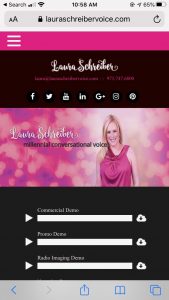 As a solopreneur, your brand begins with your website. It is your store front. Clients can listen to your demos, see samples of your booked work, and find out how to contact you. Those are the basics, but the fun begins when you use your website to do two things: show clients how you are different than other voice over actors and how you will best meet their needs. Kristin Wendys of The SelfEmployed.com advises “Think first with the eyes of a client and analyze what he is looking for, what are his biggest concerns, and what problems he needs to solve.” Some voice actors have brief summaries so that clients can quickly learn about their services, but much in the way that I am very chatty, my website is overflowing with long narrative explanations that I hope will help my clients connect with me.
 Visual images help create your brand and your logo is very much a part of this. I have both an avatar that I love and a Laura Schreiber Voice Logologo. I use them both differently. My logo is on official correspondences like
  As a working mom, I try to only work on weekends under specific scenarios: if booked work comes in that the client specifically needs over the weekend, if I get a direct audition for the weekend, or if it is something like my blog which I generally do while my kids are asleep. Otherwise, the weekend is cherished family time. So, if a client tells me they need something over the weekend, I am generally pretty sympathetic that they have someone on the other side who needs something and has a deadline. It happens that both last weekend and this weekend I had bookings come in over the weekends. While I was delighted about both bookings, the one this weekend was much more pleasant. I think the two bookings lend themselves very well to case studies on what makes an ideal voice over client to work with and what makes a client a little more challenging.
 Earlier in the month a client I have worked with before reached out to me with a small budget for a local TV and Media campaign. After a lot of back and forth, we came to a price we could both live with. It took quite a while for the scripts to come in. Of course I finally heard from them Friday evening. I confirmed receipt of the script and asked Client A if Monday by midday was okay and they said it was needed over the weekend. Normally I would add either a “RUSH” fee or a weekend fee, but we had negotiated and the budget was low so I could not do that here. The other snag was that the client only sent one script. We had negotiated a bulk rate assuming that I was recording at once, and sending everything piecemeal was not a great start.
 So on Wednesday a client emailed asking if I had availability for a live session for 4 spots, to 30 second spots and 2 60 second spots. Time was not the issue, I was happy to make time. Before even scheduling the session, which we planned to do via zoom, I had two hiccups. First, I had learned the day before that my son has to have emergency surgery tomorrow (not the day after the session, the day after I am writing the blog.) Jack has a rare problem called an intussusception which basically means his intestines are looped and it is quite dangerous, so that was weighing on me. Next, we were hit very hard by Tropical Storm Issias and still running on generator power. When I turned by iMac on in the booth it flickered constantly and I had a legitimate concern it would cut out during the session. I did not mention Jack to my client but I did tell her about our power issues. She told me she was having internet issues, but we decided to give it ago as she had a time crunch.
 At the start of the session the client could not connect via zoom. It just would not go through. We decided to connect via mobile phone. On a normal day, my mobile phone is not great in my booth because of all the insulation, so on this day it kept cutting out. I have had sessions where for no apparent reason we are cut off. On Wednesday we were cut off FOUR times. Yes, that’s right, FOUR TIMES. I kept clicking save, in fear that I would also lose my computer, which thankfully didn’t happen.
 I was terribly emotionally distracted. I should have meditated and prepared before going into the session. As a working mom, I always want to work because I have financial goals that I need to meet to help provide for my family. The thing is, I don’t have a shut off switch. I did not leave my feelings outside my booth. I have always felt that bringing all of them with me into the booth has helped with my reads, but in this case I needed to cope better. I needed to be honest about my ability to function and I needed to prepare differently. I also needed to realize sooner how frazzled I was and get it under control. I was having a real time melt down and just needed to stop and re-set.
 When the client emailed me with the booking, in truth it did not even cross my mind not to take the gig. I always think of how I can best meet a client’s needs. In retrospect, I am positive that I would have deeply regretted not trying. I would have seen it as a missed opportunity. That would have been so upsetting too. My hope is that they see me as someone willing to work hard even with this going on and that they do not write me off. I am well aware that this is a competitive industry, so it is possible I won’t hear from them again, but I sure hope not. The other take away is that I have not been spending a lot of time practicing my craft and working on my read rate. This was a great reminder that those skills always need work. My hope as I reflect on this session is that I am defined from my ability to work through this and not by the worse session I have ever had.
 Kramer is so excited to make a deal that he doesn’t hesitate to jump at 25%. I think this happens a lot in voiceover, especially with newbies, and especially when times are slow. You have to know your value and you have to know and more importantly understand industry standard rates. First the client asked me for a quote. We had a back and forth that went like this:
 Here, Mr. Seinfeld did not appreciate the value that Kramer was bringing to the table. His perspective was very one-sided. Often clients need to be educated. When Mr. Seinfeld is in the kitchen talking to Mrs. Seinfeld, they only see the value of their product, they show little understanding of the service that Kramer is providing them with his knowledge of the marketplace. In voice over, some clients do not understand why usage matters. This is why it is always important to invoice for both usage and your session fee on your invoice Every. Single. Time. I have other clients who understand perfectly why it matters and what they are paying for but think that if they are in a very small local area or if their client has a smaller budget then none of that matters. In some instances, for folks who are new to casting voice over actors, they do not understand that they are casting professionals with thousands of dollars in equipment, years of coaching, broadcast ready home studios, and all that we have invested in our businesses. So, as a voice talent, you have to decide what you can live with and what you can’t.
 Kramer got good, solid feedback from George. Kramer listened to George. He was inspired by George to go back to Mr. Seinfeld and talk about the terms again. In George, he had a friend he could count on. Who are your industry friends? This is extremely important in voice over. This is no small thing. This is why conferences, holiday parties, and Uncle Roy’s annual BBQ all matter! When I have these negotiation issues I can talk to my accountability group, the ladies of the “VO Powerhouse” as we call ourselves or I reach out to Maria Pendolino and you can actually schedule consultations with Maria to help you bid. I like talking it through with friends because sometimes I need the right words so that I don’t seem like a crazy person. After all, do you want to seem like Kramer when you go back to your clients to “educate”them? I don’t think so.
 Both Kramer and Mr. Seinfeld wanted to renegotiate. But there is a right way to say something and a wrong way, and these two, well…they do not really exemplify a way that a successful small business owner typically will build a meaningful relationship with a client. More than getting the rate that is best for you and best for the voice over industry, you also want a client and not a single gig. If you carry yourself like Kramer, or George, you are not likely to build lasting and meaningful client relationships. There is nothing wrong with taking the time to work through something. This week I was able to get my clients to double their offer. While it was lower than my initial quote, it was much higher than their initial offer, and it is a number I am comfortable stepping up to the mic for. Be positive, polite, and straightforward. Know what you are willing to do and be firm about your boundaries. And then book, book, book!

