An Opportunity for Jack
 I’ll start out by saying that neither of my twins dream of becoming full time voice over actors like me. And though they do not share my dream, they support me in every way possible and are actually part of my small business team in integral ways this summer. In the past few weeks, one of my VO besties reached out and said that one of her regular clients needed 14-16 year old voices to do some eLearning narration, and my twins happen to be 16. So, they submitted demo reads. Again, it is not their life’s ambition, but in the summer of Covid-19 they realize that this is a great opportunity to learn and to do something that most kids never get a chance to do.
A script came in for Jack first. He was delighted. He booked his first paying eLearning voiceover gig, and he just needed a little coaching. I will point out a few things. Anyone who works in voice over knows that it is not really about the voice, although I happen to think he has a really nice one. My twins are both dyslexic. Reading fluently is not an easy thing for them. Jack also lacks the extensive coaching that I had that gave and continues to give me so much confidence every time I step up to the microphone. And that’s another thing, if you have never worked with a coach, you need to learn basic mic technique and basic Twisted Wave skills. I am pleased to say all of this came very naturally for Jack. I think much more than doing the actual voiceover, there are many life skills that kids get from having an opportunity to have a voice over gig.
Following Multi-Step Directions
 Following multi-step directions is hard for many adults, and there are very specific directions unique to every voice over job. This booking was for sure an exercise in following multi-step directions for Jack. For Jack’s first booking:
- He had a pace guide that he had to match.
- He had a pronunciation guide for Mandarin names.
- He was told to keep an upbeat, happy tone.
Jack also had a lengthy, four page script to narrate while keeping all this in mind for his first time in front of the mic. It’s a lot of balls to juggle for a seasoned pro, let alone a newbie.
How to Take Feedback
Taking feedback well is something important in many aspects of life, and as a working voice talent, taking feedback in a professional manner is part of the job. After Jack submitted his audio, within 48 hours we received a spreadsheet from the client with minor feedback. Jack had done great work. For four pages of audio, he had only four minor corrections. This is pretty incredible for anyone, and especially considering he is so untrained. I explained to Jack how feedback from client works and how important it is that they have what they need. I also explained that we, as talents, cannot get emotional about it, we simply record and send. As a student who is used to the writing process, this is familiar to him. He was able to go back in the booth and re-record. There was one line that was quite long and needed to be read with more fluidity and different intonation. I gave him direction on the line and instructed him on how to break it down. It sounded great. Learning to take feedback well is a really valuable lesson for kids in voice over.
Interacting Professionally
 Maintaining a professional demeanor in the professional world is important. I remember meeting Michelle Sundholm’s sons Ashton and Everett at VO Atlanta in 2018.They were so polite and they were so composed. It is this exact behavior that I am talking about. For Jack, since his interaction was online, it meant several details. First, it meant performing his work in a timely manor. It meant taking pride in his performance and doing his best. It meant sending follow-ups and hand written thank you notes, both to the client and to the friend who referred the opportunity to him. Jack had to carry himself the way the rest of us do, and he took pride in doing so.
How to Be Part of the Team
Doing all of the above is no small thing, and in doing so Jack took pride in being a part of this client’s team and of being part of the other VO’s team. He understood that they had a choice and that there were other kids who could have booked the gig. He did his best. He was kind and he let them know he was appreciative.
My Reflections
I think it is great that my son got this glimpse of what it is like to be in front of the microphone, to live in my world. As the kids have been working for me doing marketing and social media this summer, doing the actual voice work only helps to better understand what it is they are actually marketing. I also think that the tech skills are great for anyone. Lastly, we are living in an unusual time. Kids had to regroup and reshuffle their summer plans this year. Some people who are pursuing in voiceover audition and audition and never book. It is really great that in this odd time Jack got such an exciting opportunity and he is very thankful.
 I will start by saying that the past five years have flown by and while I have had to seek help with my studio gear, my MacBook Air has been dependable in every way since its purchase. I have not had issues with my computer. I have been extremely happy since switching from a PC to a Mac, and have been extremely happy with the MacBook Air specifically. So, why switch? Well, as per my blog last week, I made a lot of gear upgrades in my studio recently. The early 2015 MacBook Air I have only has one Thunderbolt B port and NO, as an not a single one, Thunderbolt C ports, and it was not possible to have both my pre-amp and my studio monitor hooked up simultaneously, while both are essential. So, I made the choice to upgrade.
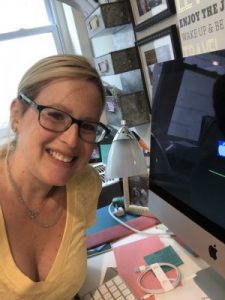 The set up went well. It took me most of the day. It arrived around 10:30 am and by dinner I was up and running, and the timing was pretty good. Coming the Friday of a holiday weekend is ideal as the bookings I have for live sessions will not be until next week anyway. I had heard some horror stories of industry friends recently setting up new computers, so I was not optimistic or overly enthusiastic and I expected it to take a while. The initial backup from iCloud went ok. Then I had to install my UAD software. Since I had just done this with Tim last week on the laptop, I still remembered how and it was not fast but I was able to do it. I was worried about getting my settings onto the iMac, but I was actually able to use airdrop to move them from one computer to the other. Twisted Wave setup was a little tricker for me. I spent a while putting in my many keyboard shortcuts. I could not figure out why my effects stack would not open in its entirety. I realized I had to find my initial izotope purchase, download that, enter the ilok, and then open the effects stack. I was getting a little nervous that I would need a session with Tim, but to my own surprise I was able to get it going! I am happy to report that the monitor in my booth connected with ease and I am so thankful to have my booth in working order. I am still making tweaks like syncing my drop box and connecting my pay to plays in my chrome short cuts, but for the most part it is set up how I want it!
 Rome was not built in a day, and I am sure that in the coming days and weeks I will realize other applications that need to be installed on the iMac. I am thankful, though, that I accomplished as mush as I did at the start. My plan is that the desktop will live in my office space and my MacBook Air will now reside upstairs and will also be dedicated to my travel rig. It has only been since Friday, 48 hours, but so far this seems like a really wonderful upgrade. Ultimately, this isn’t about just changing computers, right. I had a setup that was working until it wasn’t. I made a change. I used to really fear change, but I know know (more than understand, actually know) that change makes me better and presents opportunity.
 When everything is working perfectly in your booth, your bookings are solid, and you are happy with your sound, why shake things up with a gear upgrade? Well, life is not always so cut and dry in the voice over world. While I was really proud when I upgraded to the Avalon M5 preamp, and loved the way it sounds with my Neumann TLM 103 microphone, it is not portable. I’m at a point in my career where if I travel, which happens when there is not a pandemic, I need to sound the way I sound in my booth when in my travel rig. With an Avalon preamp and a Neumann mic, I sound pretty awesome. Even with a VOMO, it is hard to emulate that sound without bringing the Avalon, and if you have ever been in the presence of an Avalon then you know it is not portable. Thus, my journey began.
 One of my VO besties, and all around favorite people on the planet, the amazing Kim Handysides, suggested that I work with the VO Tech Guru Tim Tippets. Kim said Tim does amazing stacks and would set up my travel rig. Initially I had not planned to change my in studio set up with the Avalon M5, just the rig. I reached out to Tim. Tim is amazing because he could just set you up and give you the answer, but instead he spends the time to educate you so that you understand the rationale behind his suggestions and why he is guiding you down a certain path.
 To Start, I was limited because I was working on a 2015 MacBook Air. Even though my MacBook Air is running really well (knock wood), it only has one Thunderbolt 2 connection and the rest are USB ports. This posed some logistical challenges in terms of suggestions Tim wanted to make. Further, at the time, I was set up to mirror in studio on a monitor. So my MacBook Air stays in an office space outside the studio and I have a great monitor in my booth.
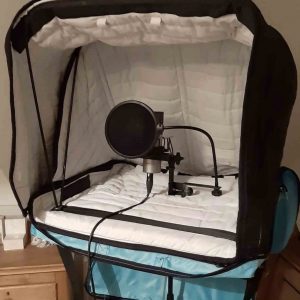 So this brings us back to the travel rig set up, which is also pretty exciting. After all, this entire journey started because of the travel rig, right? So, what is my travel rig set up now:
 As a professional voice over actor, I can say I interact with industry contacts as just that, as a professional. I get auditions, I submit auditions. It is non-emotional. It’s business. When I connect with people on Facebook or LinkedIn, it’s business. I’m delighted, but still, it’s a business contact. Yet, there is a degree of trust that we must assume when we interact with clients and new contacts alike in the voiceover industry, right? Voice actors like myself often send recorded audio to people, whether they be clients or prospects, that we actually know very little about, and when we do this we trust that the audio we send is being used under the agreed upon terms. We trust that it is not manipulated. We trust them with our contact information. There is a lot of trust going on. For those of us who are working mothers, who have a family at home, we have a lot invested in the businesses we have built, and this trust is no joking matter.
 I posted in the “Voice-Over Mamas” Facebook Group asking other
  Besides feeling shaken, I have not changed my setup yet. I have lots of questions. I think more than changing what how I am set up, this icky feeling (for lack of a better word) will stick with me. This feeling of vulnerability is not a pleasant one and I think that when future contact behave in a way that is outside the norm I will simply pass on the opportunity. I am not desperate for work, I am established in my career. I would rather forgo something that does not seem right than expose myself and my family to potential harm.
 Last fall, which seems like a lifetime ago given how much the world has changed during the current pandemic, I began researching upcoming eLearning conferences. I was actually hoping to find more conferences in my region. As a working mom with high school aged twins, flying across the country can sometimes be a challenge. I was overjoyed when I discovered the ICELW conference was to be held at Columbia University in the city of New York, my beloved alma mater. I submitted a proposal to speak about “Best Practices to Bring Your eLearning Module To Life” from the perspective that academics and HR people who never thought they would have to work with professional voice actors like me suddenly find themselves in the position to cast and work with voice talents as professional narrators for their eLearning modules and projects. I addressed questions that they should ask every time they have a project, VO tech and why it matters, and pricing for voiceover, including where it should be and what the price indicates. My presentation went nicely and it meant a lot to be a part of the dialogue. I am very excited, however, to share some of the larger takeaways from the more scholarly presentations during the conference as I reflect on how they will shape both my work, my voice over bookings, and client interactions as the
  With an international audience and an enthusiastic crowd, there was a lot of discussion at the conference about how the advancing technology would enable content creators to re-imagine learning. David Guralnick from Kaleidoscope Learning and Columbia University talked about opportunities to use “technology to humanize learning” and went on to present a thrilling example combining AI and interactive technology. In this example, the student asked questions about Ancient Greece and the Acropolis and was able to create a scene where he was present in Ancient Greece having his questions answered. Particularly at a moment when students around the world are relying so heavily on on-line learning, this was thrilling and wonderful to see. The advantages of this were how realistic the scenario is and how clear the examples are. Clearly the new technology enables better communication of content. As a narrator, I have been working with more companies that create K-12 content in the last year, and I am sure such technology would be a huge asset to them.
 There were multiple sessions during the ICELW conference that addressed new technologies like AI, VR, and enhanced/mixed reality. I was riveted by these sessions as well. Someone brought up that when Steve Jobs designed the first iPod, he did not do a focus group, he just knew it would be a better device and he was creating the technology to drive a potential future experience. That is what a lot of the new experiential learning technology does. There is vast potential, the sky is the limit so to speak. Michelle Cortese, a VR Product Designer at Facebook and Professor at NYU gave a thrilling demonstration of work her students are doing. I was fascinated as a former educator, as a parent, and as a working creative. I could not help but see the intersection between technology and improv, something that so many of us in voice over spend so much of our time training in. The social behaviors that occur were fascinating, and unpredictable, and again as a working creative this made me think of improv which is not something that I typically connect to my eLearning work. Although, under further analysis, the point of studying improv, is that we are supposed to bring it with us into the booth so that our reads and takes on characters are fresh and exciting. What I found so fascinating about the sample that Michelle shared is that all of the content in the VR chat was user generated and is in the moment art. It is a vision and content that comes from the user. When so much of the learning content that we work with is contrived, this opens up a world of creative possibilities for end users. Fernando Salvetti also demonstrated work with enhanced/mixed reality and I was riveted. The possibilities that are simple and user friendly are true game changers. Having worked in eLearning for years, being exposed to such projects is eye opening.
 As in so many projects I am a part of, the bottom line matters. Dr. Tim Brock of the ROI Institute talked about creating a framework that balances needs and feasibility. The needs need to be defined at the beginning. This resonated with me a lot. Often voiceover is left off of the budget entirely, it’s an after thought. This was another area that I was addressing in my talk, the price of the voice over. When a company is looking at the ROI, the return on investment in the overall project, the voice over, and typically in eLearning we are talking about a narrator, needs to be a part of that calculation, from the start. As the technology continues to progress and is better and better, the voice over needs to be a part of the initial plan, not a lost minute add on. In Dr. Brock’s talk, he spoke of feasibility, and as the technology becomes more and more advanced, having an overall understanding for the get go of the feasibility certainly makes sense!
 Do you ever listen to the Taylor Swift song “You Need to Calm Down” and think she is singing directly to you? I can’t be the only one. So as proud as I am to be a working mom running my own small business, I would be lying if I told you I was always able to separate my feelings from my work 100% of the time. I think when you are as passionate about your industry as I am about voice over, remaining detached and having good perspective all the time can be a challenge. Why does staying calm matter? Regardless of the business scenario at hand, as voice over actors we need to remain calm in order to cultivate and maintain meaningful client relationships.
 If we have ever met in person, you would pick up right away that I do not have a calm, relaxed energy. Having spent much of my adult life in New York City, the frenetic vibe of the city always suited me just fine and if anything I thrived feeling that pulse. I will say that recent life during the pandemic has made me want to take things a little slower. Now that I am home with my family 24-7, remaining calm seems much better than getting bent out of shape over every little thing. If I let the small stuff get to me, this pandemic would be impossible to get through. I am trying to actually live by the advice I give my children. And of course, by the brilliant lyrics of Taylor Swift: “But I’ve learned a lesson that stressin’ and obsessin’ ’bout somebody else is no fun…You need to calm down, you’re being too loud.”

