If You Jump to Conclusions You Jump to Conclusions
If you know me at all or follow me on social media, then you probably already know that my father recently had a  landmark case in the US Supreme Court: Mahanoy Area Schools Vs. B. L. In the case, as in all of his work, my dad represented the school district. My father has been a school law layer in the state of Pennsylvania since 1975, so whatever the issue, my dad is always counsel to the school, never to those suing the school. While over the years some of my dad’s cases have gotten publicity, like the Grade Gate scandal in Harrisburg sometime in the 1990s, and his more recent transgendered bathroom case where he won in the third circuit, protecting the rights of the LGBTQ community. This case, though, got international publicity. The fascinating thing was that the decisions was so complex that when it came out, I myself thought that my father lost. Instead, my father and his team of expert attorney’s were elated. Why? Put simply, the headlines were misleading, many in the media understood the issues being appealed, and the headlines that seemed clear did not paint an accurate picture of the implications of the ruling.
 So, how on earth does this relate to my professional voice over career? Well, recently, towards the end of a video demo production process, my demo client began to panic. After reading on social media about usage issues, he became concerned that using the content we were using was not permissible. Even though we spent a lot of time going over this early on, he had terrible anxiety. Why? The headlines were so misleading. The problem with jumping to conclusions is that it takes you away from the actual data and research, and down a rabbit hole of mis-information. So, as a voice talent, how do you sort out the “fake news” and build a solid foundation for your voice over business?
Building a Career Comes from Research
I spent months doing research before I ever started working with my first coach. I do research every single day. Just like in all academic realms, you have to be able to evaluate your sources. In addition to the numerous books on voice over written by long-time coaches, there are countless blogs just like this one written by voice actors who have been in the industry for years. Now, you can also go to places like VOBS, YouTube, PodCasts, and Clubhouse to hear about voiceover directly from industry experts. This was not the case when I was starting out, and that level of accessibility is fantastic.
Time in the Industry
It takes time in the voiceover industry to understand the voiceover industry. If you have industry friends, contacts, or coaches who have been in the industry longer than you have, it makes good sense to trust their guidance. Knowing who to take advice from is crucial. Someone who has been in the industry for ten plus years and does not book or have an impressive client list is not such a valuable resource. Someone who has been in the industry ten plus years and has your dream client list is exactly who you should be taking advice from.
Know What Questions to Ask
Perhaps instead of using social media to get thrown off course and begin to panic or at the very least become confused, perhaps use it to ask the right questions. Have a running list of questions for the next Clubhouse or session with your voice over coach is much more productive than going down that rabbit hole.
Don’t Be Swayed by Posts
So when I start working with a voice over student, we talk about all of the usage issues related to content in demos. My demo partners and I use content from libraries that we pay to belong to, so that our video demo clients are protected. There is a reason that when you go to the pages of DPN or Atlas Talent their talents’ demos refer to real brands and not fictitious brands. This is standard in our industry. So, when you go on social media and there is a group of newbies who have been in voice over for five minutes, use their concerns to ask questions, or to share what you have learned. Once you know better, you can help lead the voice over chatter in a better, more productive direction. And remember, if I could be so confused by my own father’s legislative triumph at the highest level, it is entirely possible that folks new to the industry talking in circles could be very confused by a bunch of well-intentioned but very mis-lead postings as well.

 I realized this year when my son had to do a rather grueling elimination diet that he hates when I say journey. Whether it is related to food, weight loss, his college search… it doesn’t matter. He hates if I say journey. I think it doesn’t resonate with him. He still thinks that where he is going, the end result, is the most important thing. As a mom of twins, I can say that I have learned I seldom end up where I thought I would. As a
  When I was in my mid-30s I decided to start my
  When I began my business, I understood that it was just that: a business. As a working creative, I wear many hats: mom, voice actor, voice over coach, demo producer, but always the business owner. Over the years I’ve had to think a lot about my practices and policies. I’ve had to think about how the business choices I make inform the
  I will say, that as a
 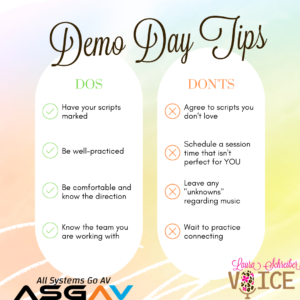 From both sides of the mic, as both a professional voice over actor and coach, I can tell you that how the demo session goes affects how the demo turns out. You’re investing a lot of time, money, and effort. The demo should be nothing short of amazing, and the key to having an amazing demo is an amazing demo session.
 I also recommend having practical hooks in your book. I have a hook for my cans and a hook for my wires. It helps keep things neat and organized.
 I also do love having Source Connect. So many clients and agents require it. I occasionally need to have support sessions, and they do offer great support from Source Connect. Again, like with Zancastr, there are no latency issues. There are, though, sometimes quirks connecting. Sometimes people are confused with how to use it. If you are not both connecting with the same sample rate, for example, you won’t connect smoothly and it will be an issue, so that all needs to be decided ahead of time.
 I wish I know how important a good travel rig is. It took me five years to get my travel rig to sound as good as my home set up. That is WAY too long. If you are just starting in voice over during the pandemic, I realize it is hard to imagine actually packing up and leaving home, but when we do, the rig matters.
 Let me share two experiences that happened in the past week. Last week, I heard from an Indie Video Game producer that I worked with in 2016. They were offering me the same role I played then. I had detailed notes in my CRM that they needed a discount as they were trying to launch the game with a kickstarter campaign. When I quoted them this time a normal, mid-range rate, they came back to me saying they were shocked that my rated had gone up. They went on to say that the five other talents had agreed to the rate they offered and they wanted to pay everyone the same. I referred them to the GVAA rate guide, which I will discuss later, and reminded them of the terms of 2016. They came up to my rate for me and for the other talents.
 Imagine a scenario where we all just stopped negotiating. Let’s say a client offers $200 for two TV commercials with no mention of the length of usage, and instead of trying to negotiate, sort out the details, and explain why buy outs don’t work for us, we all just said “sure.” The implications would be staggering. The clients, then, would assume there is nothing wrong with this sweat shop pay, and would assume that our years of coaching and on-going professional development, that our expensive studio equipment, that the service we provide, that none of it has value, and that the can continue to lower and lower the rates. Where will it end? How low will they go? I shudder at the thought, and fear that if we are not willing to walk away, these bargain basement rates will become more and more common. You must know your worth and be willing to stand up for it.

