How did I end up doing Improv?
Firstly, I never set out to study improvisational technique when I started doing voice over. Early in my VO career I worked with amazing coach Fred Frees. Fred was my character coach. We were doing private lessons working towards a character demo. Fred is not only an established talent, but he also grew up in the industry. Fred happens to be the son of VO legend Paul Frees. There is not a voice, character, or trick that Fred can’t do. The man is amazing. One day in one of our lessons Fred told me I had to find an improv class. For me, this was out of my comfort zone. He told me that he heard repetition in my characters and that I was falling into patterns. The only way to break this was with an improv class.
Why was I nervous? Well, in the safety of my studio, I was fearless in front of a microphone. Fred suggested leaving the booth and going to an actual theater with real live people. Learning a very new different skill set was scary. It was daunting. And, it was necessary.
I found a class called “Advanced Acting and Improv” at Paper Mill Playhouse. Taught by Broadway great Elisa Va Duyne, the class was hard. I was not used to learning lines. The amount of drama was also a big change. Physicality amongst others was also new to me. But I started the class none the less. Want to know how long it took for Fred to hear a difference once class started? Fred heard a difference in my reads in one week. He said I was like a different person in our sessions.
Scott Parkin and Voice Over
 Fast forward quite a few years. Now I have the luxury of having a weekly Clubhouse Room, “Ask the VO Coaches.” This week voice over legend Scott Parkin was our guest! Whether you know it or not, you likely know Scott! He is the voice and face of many recognizable brands as he does both voice over and on-camera work. He actually started out on morning radio. Scott has a national Tide TV commercial and many more. He has also made appearances on well-known shows like “Grace and Frankie.” Scott finds that the relationship between VO and on-camera work is symbiotic. Scott shared that most of his work comes in through his agents at DPN. As a single dad, his daughter Miranda grew up socializing with other talents in the DPN waiting room.
Scott Talks Improv and Voice Over
Diana Birdsall and I asked Scott why voice actors should study improv? Scott explained that improv helps you find a character. It also helps you find that sought after conversational read. For example, think about what you like to do for fun. When you respond, you make it real, including stops and starts. Scott was great fun in the Clubhouse! He fell into many characters for us. He was Angus, a Scottish soccer player. Then he was Doug from Doug’s BBQ in Texas. First Scott became the character. Then he showed how they would say their lines with ease.
Improve Across the Genres
We asked Scott which genres of voice over improv helps with. He said it is useful in all genres. We talked about assuming characters in genres like eLearning or narration. One of our attendees, Jeffrey, told Scott he is taking improv classes in Atlanta. Jeffrey asked Scott what he should look for in class. Scott said it depends on your goal, which might include:
- On-Camera work
- Sharpening your skills
- Writing Sketches
The conversation went on to consider if improv practice can happen via zoom. Scott said that he has adapted his drills to work on-line. But, in-person classes are still the gold standard.
The Culmination of Improv: “Comet Casino”

Scott has a daughter Miranda. Miranda is both a voice actor and an amazing artist. Perhaps it’s because Miranda grew up surrounded by voice actors. Maybe it’s because Miranda’s dad bursts into character at the snap of a finger. Or most likely it’s because Miranda has oodles and oodles of talent! This 21 year- old phenom has created her own cartoon: “The Comet Casino.”
The show boasts an all star cast with the likes of Tara Strong, Billy West, and Maurice LeMarsh to name a few. Dad and daughter are doing all the leg work themselves. From creating the team to raising funds for animation, it is a family project. What’s the point? If you connect the dots, it’s no accident that a kid with profound improv training did this. Miranda can act. She is also an artist. Miranda had a vision. This gal also happens to have an amazing dad behind her. Now, am I saying that if you study improv you can write a show? Maybe not. But the point is, you never know where years of exposure and on-going training and coaching will take you. That’s the point. Work on your craft. In conclusion, keep working on it. And if you have the means, also support this amazing family here.
 When you build a house, sometimes you are doing an update to make a space your own and sometimes you are doing a gut renovation. Either way, from the outset, you need to consider your goals for the project. In voiceover, knowing your goals enables you to have direction in your daily pursuits. If you know where you want to be, and if you have a clear vision for yourself, it is easier to work towards reaching those goals. And the goals you have might well be completely different from other voice talents you know. For instance, I do not do medical narration or audio books. Two of the women in my accountability group work in both of these genres, so their goals and their day to day marketing endeavors look quite different. As a professional voice over actor, I am very clear about my passions and where I want to spend my time. This is a key component of my mindset.
 Even though I am a working creative, from the start I have run my business like a business. Our mindset and the choices we make determine whether voice over is a business or a mere hobby. Do you want this to be your career or something you simply dabble in? For me, from day one, this was going to be a career. There was no other option. When I decided to pursue voiceover, I did so in lieue of returning to teaching, so I had the luxury of plunging into VO full time from the get go. Besides working full-time, other choices helped establish this is a business. Using a CRM is essential. This helps you track all of your outreach, your costs, your bookings, your contacts… all of your efforts in one place. I have blogged before about my experience using Voiceoverview, but I truly believe this specific CRM is essential to the success of my business.
 If you really want to succeed in voice over, and establish yourself as a professional voice talent, you need to have a professional studio. First, it is essential to maintain business hours. As a business owner, if you want to be available and accessible to your clients, you should have set business hours each day. For me, I typically work from 8 am- 6 pm, and schedule breaks for myself at my lunch hour for things like exercise classes or seeing friends. I also use my lunch hour to make myself available for consultations with new students or people looking for demo. But, the main point, is that I am available to clients all day, every day, during regular business hours.
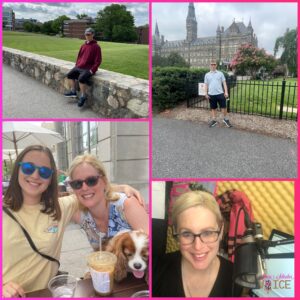 working while my family is outside enjoying a beautiful day together. I never feel like I am missing out because I have very specific goals and I am on a mission. Often having fun and reaching one’s goals are mutually exclusive. That brings me to my current conflict, I am a mom of twins, and my twins are rising seniors in high school. College visits are not only an essential part of the admissions process, but my twins have unique interests, so they are looking at entirely different schools. At the moment, all of my values as a parent and goals as a solopreneur are being put to the test: am I steady enough to juggle everything and be there for my kids while continuing to fuel my business? I have felt tremendous pressure, and been having a constant mental struggle, until our weekly Clubhouse today.
 is an on-going course that you can still take! Since then, I have followed Jonathan and continued to learn from him regularly on social media. I went to school for Political Science and History, so there was a major gap in my marketing knowledge. I studied with Jonathan to fill said gap. Anyway, the Clubhouse is meant to help others in the community, but this one hour with Jonathan left me feeling so re-inspired. It reminded me
 If you’re a professional voice over actor like me, and like me you’ve been in the business a while, then you know it is not so often that we get to speak directly with the folks who run casting platforms. Or with agents. Typically candid conversations like this only happen at conferences. It just so happens that one of my VO besties, the amazing Liz Atherton, who for many years was the founder and owner of Texas based TAG Talent, is now the brains behind Cast Voices, the newest casting platform that is sure to bring great things to our industry (know wood). Liz has an amazing team, including Nick Krause, an on-camera talent who also does some VO, and Bobby and Elizabeth Alcott. They have all worked really hard to bring us something that us new and different. They are extremely transparent in all of their practices, and they want to create something that raises the bar. In this scenario, we have unique, inside access.
  f you didn’t know, Diana Birdsall and I run a weekly Clubhouse in our Club “Ask the VO Coaches.” Last week, Liz Atherton and Nick Krause came into our club to chat with us all about the awesome features of Cast Voices. What made the hour special was that many guests got to ask their questions directly to Liz and Nick, and there was a great back and forth exchange. I noticed several things. First, Liz comes from a place of grattitude. She is so profoundly appreciative of the support they have had thus far from the voice over community. She views the process as extremely collaborative and despite her many years as an agent, speaks to every single talent with respect and patience. Next, Liz and Nick care very much about being clear and transparent about all practices. For example, if a project manager on the platform posts a job for $500, the talent sees the job as $500. They are not chipping away at it or altering anything. I also noticed that they are willing to engage in community dialogue. When a bling talent commented about accessibility issues on the site, Nick was extremely responsive and will to hear all suggestions about how to improve the tech. This is a team determined to work hard for the voice over community.
 commercial campaign, getting signed by an agent, and seeing an old friend. Why is a new demo so exciting? A voice over demo means opportunity. It is a new moment for us to say here I am, listen to this. This is what I can do for you! As a full-time, professional voice over talent, there are plenty of other female voice over actors booking lots of commercials. How do I make myself get noticed? The demo. So who you do your demo with, the coach and producer you choose to spend your time and money with matters, a lot. I have worked with some of the top coaches in the field, and I can tell you that I have had outstanding experiences and I have had experiences hat should have been better. Now that I am work as a
  that show both your range and are appropriate for your brand. If you have dream VO clients, this is the time to include those scripts. So for example, if you are doing an automotive demos, and you love Audi, you would include an Audi script. If you are doing a commercial demo and you love shopping at target, why not include a target spot? The scripts should not simply descend from above on demo day, be handed to you, and recorded. They should be meaningful to you and they should show both your range and what matters to you. They can be an interesting glimpse into your interests too! So, it is very important that you can easily talk to your
  This is really important. Demo producers typically send you their preferred order, but at the end of the day the demo is yours to live with and their preferred order matters less than your preferred order. I personally have had demo producers make changes without any fuss, and I worked with others who refuse to make any changes at all and insist that it must stay the way it is.

